Pakistan PM briefed on preparations against ‘threat’ from India on visit to ISI headquarters

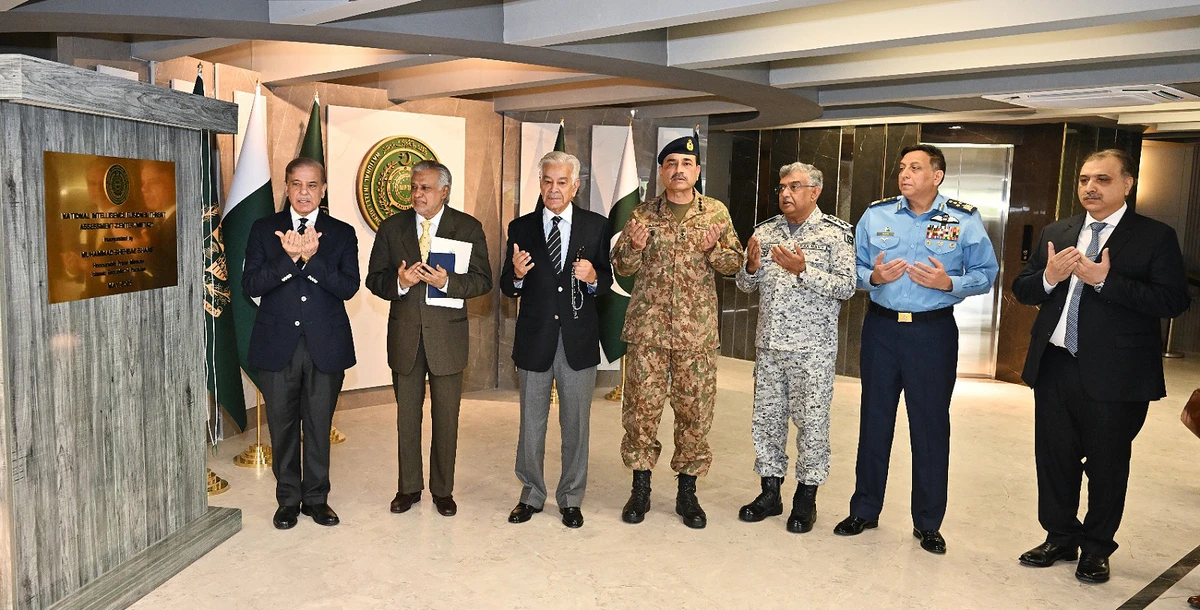
(From left to right:) Pakistan Prime Minister Shehbaz Sharif, Foreign Minister Ishaq Dar, Defense Minister Khawaja Asif, Army Chief General Syed Asim Munir, Chief on the Naval Staff Admiral Naveed Ashraf, Air Chief Marshal Zaheer Ahmed Baber Sidhu and Inter-Services Intelligence (ISI) Director General Lt. Gen. Muhammad Asim Malik gesture during the inauguration of the National Intelligence Fusion and Threat Assessment Center Headquarters at the ISI Headquarters in Islamabad on May 6, 2025. (PID)
Short Url
Updated 06 May 2025
Follow

Pakistan PM briefed on preparations against ‘threat’ from India on visit to ISI headquarters

  • Relations between the nuclear-armed neighbors have plummeted after India accused Pakistan of backing an attack in Indian-administered Kashmir
  • Islamabad denied the charged and both countries have since exchanged gunfire, taken diplomatic measures against each other and expelled citizens

ISLAMABAD: Prime Minister Shehbaz Sharif on Tuesday visited the headquarters of Pakistan’s premier Inter-Services Intelligence (ISI) agency where he was briefed on the country’s preparations against a “conventional threat” from India, Sharif’s office said, amid heightened tensions between the two nuclear-armed neighbors.
Relations between the nuclear-armed neighbors have plummeted after India accused Pakistan of backing an attack in Indian-administered Kashmir’s Pahalgam that killed 26 tourists on April 22. Islamabad has rejected the charge and both countries have since exchanged gunfire in Kashmir, taken diplomatic measures against each other, expelled citizens and ordered the border shut.
Indian Prime Minister Narendra Modi has vowed to pursue the attackers “to the ends of the earth” and there have been fears that India may carry out limited airstrikes or special forces raids near the border with Pakistan. The Pakistan military has conducted two missile tests since the standoff, with Islamabad saying it had “credible intelligence” that India was planning to attack Pakistan.
Sharif’s office said his visit to the ISI headquarters entailed a detailed briefing on the prevailing security environment, with a particular focus on preparedness for conventional threat in the light of India’s “increasingly aggressive and provocative posture along Pakistan’s eastern border,” regional developments and the evolving threat matrix, including conventional military options, hybrid warfare tactics and militant proxies.
“The prime minister and accompanying dignitaries underscored the imperative of heightened national vigilance, seamless inter-agency coordination, and reinforced operational readiness to deter and decisively respond to any violation of Pakistan’s sovereignty and territorial integrity,” Sharif’s office said.
“The leadership reaffirmed Pakistan’s unambiguous resolve to defend the homeland against all threats— conventional or otherwise.”
India’s interior ministry has asked several states to conduct mock security drills on May 7 to ensure civil preparedness, a government source told Reuters. They did not say which states or mention Pakistan.
The drills will include air raid warning sirens, evacuation plans and training people to respond in case of any attacks, added the source, who asked not to be named.
Separately, Sharif on Tuesday inaugurated his country’s National Intelligence Fusion and Threat Assessment Center (NIFTAC) Headquarters. It integrates over 50 federal and provincial departments and agencies into a unified intelligence and threat management architecture supported by a centralized national database. At the sub-national level, the platform is linked to six provincial intelligence and threat assessment hubs, including those in Azad Kashmir and Gilgit-Baltistan, to ensure seamless coordination between the federation and provinces.
“This integrated framework is designed to harmonize intelligence gathering, analysis, and operational responses across multiple domains,” Sharif’s office said. “By leveraging the full spectrum of institutional capabilities, NIFTAC will enhance national preparedness, optimize resource utilization, and enable a coherent and timely counterterrorism response.”
Pakistan has witnessed a surge in militancy in its northwest by religiously motivated militant groups like the Pakistani Taliban. The South Asian country has also been faced with a decades-long insurgency by Baloch separatists in its southwest, which has intensified in recent months.
On Tuesday, seven Pakistani army soldiers were killed when their vehicle was targeted by an improvised explosive device in the southwestern Balochistan province, Pakistan’s military said in a statement.
Sharif was accompanied by federal ministers and services chiefs at Tuesday’s inauguration of the NIFTAC headquarters, which will coordinate Pakistan’s national counterterrorism strategy. He commended all stakeholders involved in operationalizing this vital capability and described NIFTAC as a quintessential national platform for collaborative threat assessment and response.
“Dismantling the nexus between terrorism, illicit networks, and external sponsorship requires robust and efficient institutional mechanisms,” Sharif was quoted as saying by his office.
“[NIFTAC] will play a pivotal role in uprooting terrorism and its support structures from the country.”

Pakistan, Canada explore deeper mineral investment as Reko Diq mine project advances

Updated 6 sec ago
Follow

Pakistan, Canada explore deeper mineral investment as Reko Diq mine project advances

  • Canadian envoy cites Reko Diq as model for expanding Pakistan-Canada mineral cooperation
  • Islamabad pitches vast copper-gold reserves as economic lifeline after years of stalled development

ISLAMABAD: Pakistan and Canada are exploring deeper cooperation in the minerals and energy sectors as Islamabad accelerates efforts to revive long-delayed mining projects, including the Reko Diq copper-gold mine, one of the world’s largest undeveloped mineral deposits, according to a statement from Pakistan’s Information Ministry this week. 

The Reko Diq copper-gold project is one of the world’s largest undeveloped mineral deposits, with estimated reserves of around 5.9 billion tons of ore containing both copper and gold. The project, in Balochistan’s Chagai District, was stalled for over a decade amid international legal disputes but was reconstituted in 2022 with Canadian mining giant Barrick Gold holding a 50 percent stake alongside Pakistani federal and provincial partners. 

Recent steps toward implementation include multilateral financing arrangements involving international banks and institutions, and major equipment contracts, such as a $440 million deal with Japan’s Komatsu for mining machinery, signaling readiness for construction phase activities starting in 2026. Last month, Washington approved $1.25 billion in US Export-Import Bank financing for Reko Diq, with the package also expected to unlock up to $2 billion in US equipment and service exports for the project.

First production is expected by late 2028 under the revived partnership, with estimates suggesting annual output of around 200,000 tons of copper and significant gold yields once operations scale up. This project is central to Islamabad’s strategy to position mining as a pillar of economic recovery, as it hosts international mineral investment forums, seeks partnerships with Western and Gulf countries, and signs cooperation agreements on critical minerals, including with the United States. Officials see large-scale mining projects as potential drivers of exports, foreign exchange earnings and job creation in a country grappling with debt pressures and slow growth.

Against this backdrop, Federal Minister for Petroleum Ali Pervaiz Malik met Canada’s High Commissioner to Pakistan, Tarik Ali Khan, on Wednesday to discuss expanding bilateral cooperation in mining and energy, the information ministry said.

“The success of Barrick Gold at Reko Diq is a strong example to build upon Pakistan–Canada mineral cooperation,” the high commissioner said, according to the statement, adding that Canada was actively working to encourage more Canadian companies to engage with Pakistan’s mining sector.

The envoy said Canada’s ministry of natural resources was ready to support cooperation with Pakistan, noting that Canadian expertise in large-scale mining, environmental standards and community development could play a role as Pakistan opens up its mineral sector. He also said Canada was encouraging participation in the Pakistan Minerals Investment Forum to attract global investors.

The Canadian high commissioner also invited Pakistan to participate in the Prospectors & Developers Association of Canada (PDAC) convention in 2026, one of the world’s largest mining investment forums, calling it an opportunity to showcase Pakistan’s mineral potential to international investors.

Petroleum Minister Malik welcomed Canadian interest, saying technical expertise and intellectual capital would help strengthen Pakistan’s systems and boost investor confidence, particularly among international mining companies, the statement said.

Both sides also discussed cooperation in the energy sector, with Canada offering technical assistance, according to the statement. 
...