Macron to host Syrian leader’s first European visit

French President Emmanuel Macron will welcome Syrian leader Ahmed al-Sharaa to Paris on Wednesday for his first visit to Europe. (AFP)
Short Url
Updated 06 May 2025
Follow

Macron to host Syrian leader’s first European visit

  • French President Emmanuel Macron will welcome Syrian leader Ahmed Al-Sharaa to Paris on Wednesday for his first visit to Europe

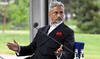
PARIS: French President Emmanuel Macron will welcome Syrian leader Ahmed Al-Sharaa to Paris on Wednesday for his first visit to Europe, despite growing doubts about Syria’s ruling Islamist coalition and protests from France’s far right.
Since the fall of longtime Syrian ruler Bashar Assad in December following fourteen years of devastating war, the international community has been pressing the new authorities, who have roots in the Al-Qaeda jihadist network, to respect personal freedoms, protect minorities and include all components of society in the country’s transition.
Many countries say they will monitor the new authorities’ conduct before fully lifting Assad-era sanctions.
“This meeting is part of France’s historic commitment to the Syrian people who aspire to peace and democracy,” the Elysee Palace said on Tuesday.
Macron will “reiterate France’s support for the construction of a new Syria, a free, stable, sovereign Syria that respects all components of Syrian society,” the presidency said.
Macron will also emphasize “his demands on the Syrian government, primarily the stabilization of the region, including Lebanon, and the fight against terrorism,” it said.
President Sharaa is still subject to a UN travel ban. France most likely had to request an exemption from the United Nations, as was the case for his recent trips to Turkiye and Saudi Arabia, according to a source familiar with the matter.
France, a former colonial ruler of Syria, is eyeing an opportunity to increase its influence in the country after years of Russian presence.
In February, France organized a conference in Paris on the reconstruction of Syria, in the hope of steering the fragile transition. Syria has been devastated by years of civil war, with over 90 percent of the population living below the poverty line.
Macron had first invited Syria’s new leader to visit France in February.
In March, he repeated the invitation but made it conditional on the formation of an inclusive Syrian government representing “all components of civil society,” describing his initial negotiations with the interim leaders as “positive.”
Syria’s new Islamist authorities have vowed inclusive rule in the multi-confessional, multi-ethnic country.
But sectarian clashes in March in which more than 1,700 people were killed, mostly from Assad’s Alawite minority, sparked widespread condemnation.
More recent clashes involving fighters from the Druze community, as well as reports of abuses from NGOs, have also raised doubts about the interim government’s ability to control extremists in its ranks.
Adding to pressure on the new Syrian government, Israel has also launched hundreds of strikes on the country since Assad’s overthrow, including one near the presidential palace in Damascus on Friday.
Israel has said its forces stand ready to protect the Druze minority and said the strike near the presidential palace was intended to send a “clear message” to Syria’s new rulers.
But the interim government described the strike as a “dangerous escalation,” while the United Nations urged Israel to halt its attacks on Syria “at once.”
The French far right criticized the upcoming talks.
Far-right leader Marine Le Pen accused Macron of hosting talks with “a jihadist” who has been involved with the Daesh group and Al-Qaeda, adding such a meeting would be “provocative and irresponsible.”
“Shock and dismay,” Le Pen said on X.
“Once again, Emmanuel Macron is damaging France’s image and discrediting its commitment, particularly among its allies, in the fight against Islamism.”
Foreign Minister Jean-Noel Barrot, who met with the Syrian leader on a visit to Damascus in January, defended the talks.
“The safety of French people is at stake in Syria,” Barrot told broadcaster RTL, adding it was important to fight terrorism and drug trafficking in the conflict-riven country as well as control migration.
Not engaging the leaders of Syria and Lebanon would amount to “rolling out the red carpet for Daesh,” he said, referring to the Daesh terrorists.
French companies are meanwhile eyeing a role in Syria’s reconstruction.
Last week, French logistics giant CMA CGM signed a 30-year contract to develop and operate the port of Latakia, at an event attended by Sharaa.


UK cyclists to ride 550km in Saudi Arabia to save children with heart defects

Updated 3 sec ago
Follow

UK cyclists to ride 550km in Saudi Arabia to save children with heart defects

  • The H&K Cycle Club was the first team to take the Hejaz route, and their endeavour has since 2022 inspired hundreds of other cyclists to follow suit
  • The cyclists expect to face scorching heat, brutal headwinds, sandstorms, and long no-U-turn stretches of roads, along with physical and mental exhaustion

LONDON: A cycling team from London set out on Sunday on a 550km journey from Makkah to Madinah in Saudi Arabia to raise funds for children in developing countries with congenital heart defects.

This is the fifth year that Shamsul Abdin, the head of the H&K Cycle Club, and 40 riders aged between 18 and 65, are taking on the challenge through the Hejaz region.

Abdin told Arab News that the “Hijrah Ride” was a replication of the journey made by Prophet Muhammad over 1,400 years ago, when he migrated from Makkah to Madinah, where he established the first city-state of Islam. This migration, known as Hijrah, also marked the beginning of the Islamic Hijri calendar.

The H&K Cycle Club has expanded from just six riders 14 years ago to more than 40 members from various cities across the UK, including London, Manchester, Oxford, and Birmingham. In November, they began their training in the freezing temperatures of the UK, aiming to cycle over 100 kilometers each day within 6 to 7 hours for a 4-day ride in Saudi Arabia. On Wednesday, they are expected to arrive in Madinah.

Riders from the H&K Cycle Club are expected to arrive in Madinah on Wednesday. (Muntada Aid)

They have cycled throughout the UK and parts of Europe, riding from London to Istanbul to raise funds for various causes through Muntada Aid, a charity that works on projects in developing countries and organizes the “Hijrah Ride”.

They were also the first cycling team to take the Hejaz route, and their endeavour has since inspired hundreds of other cyclists to follow suit. Abdin has seen Saudi Arabia become more bike-friendly over the past five years, with cycling lanes integrated into city development, while drivers, locals, and authorities are now more aware of cyclists on the roads.

The cyclists expect to face scorching heat, brutal headwinds, sandstorms, and long no-U-turn stretches of roads, along with physical and mental exhaustion. For many riders, this will be their fifth ride in Hejaz. Some of them include Uber and bus drivers, business analysts, and even entrepreneurs, according to Abdin.

“The headwind feels like climbing a mountain; it’s a constant resistance. To overcome this challenge, we ride in a peloton, taking turns at the front. One person heads into the wind while the others line up behind, shielded from the gusts. After a while, we rotate, allowing everyone a chance to lead,” Abdin explained.

Almost £923,000 has been raised by the “Hijrah Ride” since its inception, to reach a target of one million pounds this year. Some of the money went into emergency aid programs in Gaza and Sudan. Muntada Aid aims to raise about £250,000 for its flagship project, “Little Hearts,” which will fund 150 surgeries for children with congenital heart defects in Pakistan and Bangladesh this year.

“I fell in love with this project, which gives children the opportunity to live up to their potential as adults, truly,” said Abdin, who was awarded the MBE (Member of the Order of the British Empire) in December for his contribution to charitable fundraising.

Shamsul Abdin, the head of the H&K Cycle Club. (Muntada Aid)

The riders will be escorted by two vehicles, one in front and one in the rear, carrying paramedics and media staff, along with food and water. They will split into two groups based on their cycling powers. Along the route, they will pass several locations, including Jeddah on the Red Sea, King Abdullah Economic City, Rabigh, Masturah, and Badr, before reaching the elevated roads of Madinah, where their journey, which started with performing Umrah in Makkah, will end.

Muntada Aid is a part of Al-Muntada Trust, which was founded in 1986 by a group of Middle Eastern students, including individuals from Qatar and Saudi Arabia, to address the famine crisis in Ethiopia. Since then, the organization has assisted children in 17 countries, including Somalia, Sudan, Chad, Kosovo, Bosnia, Bangladesh, Pakistan, Mali, and Niger. They focus on developing infrastructure in education, health, water and sanitation sectors.

Nasrun Mir, the marketing director of Muntada Aid, told Arab News that they support “Hijrah Ride” with financial backing and logistics, and that they have obtained permits through communication with the Saudi Ministry of Transport, the Ministry of Foreign Affairs, the Saudi embassy in London, and the British Consulate in Jeddah.

Muntada Aid is a part of Al-Muntada Trust, which was founded in 1986 by a group of students, including individuals from Qatar and Saudi Arabia. (Muntada Aid)

Mir, who is joining the journey as part of the media team this week, said that the reception in Saudi Arabia could not be friendlier.

“People offer us free food and drinks. They want to have conversations with us. They want to know what we do. In the Middle East, there is still no concept of using sports as a tool for charity. The general idea is that if I want to give money to the charity, I’ll give it to them. You don’t need to run. You don’t need to cycle,” Mir said.

In one incident, a local community prevented the riders from passing through their village unless they disembarked and sat down to eat with them. In particular sections of the road near Madinah, a Saudi police vehicle has escorted the riders for a few kilometers, he added.

“There have been incidents where people have stopped us from eating our own food during the break. 
They literally took our food and said, ‘No, you come to our village; you cannot eat your food. You have to have food, which we will prepare.’ This delayed ride for a couple of hours,” Mir said.