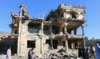
GAZA CITY, Palestinian Territories: Israel’s plan for the “conquest” of Gaza has sparked renewed fears, but for many of the Palestinian territory’s residents, the most immediate threat to their lives remains the spectre of famine amid a months-long Israeli blockade.
The plan to expand military operations, approved by Israel’s security cabinet overnight, includes holding territories in the besieged Gaza Strip and moving the population south “for their protection,” an Israeli official said.
But Gaza residents told AFP that they did not expect the new offensive would make any significant changes to the already dire humanitarian situation in the small coastal territory.
“Israel has not stopped the war, the killing, the bombing, the destruction, the siege, and the starvation — every day — so how can they talk about expanding military operations?” Awni Awad, 39, told AFP.
Awad, who lives in a tent in the southern Gaza city of Khan Yunis after being displaced by Israeli evacuation orders, said that his situation was already “catastrophic and tragic.”
“I call on the world to witness the famine that grows and spreads every day,” he said.
The UN’s World Food Programme (WFP) in late April said it had depleted all its foods stocks in Gaza due to Israel’s blockade on all supplies since March 2.
There is no food, no medicine, and no nutritional supplements. The markets are empty of food, and the government clinics and pharmacies have nothing
Umm Hashem Al-Saqqa, Gaza City resident
Aya Al-Skafy, a resident of Gaza City, told AFP her baby died because of malnutrition and medicine shortages last week.
“She was four months old and weighed 2.8 kilograms (6.2 pounds), which is very little. Medicine was not available,” she said.
“Due to severe malnutrition, she suffered from blood acidity, liver and kidney failure, and many other complications. Her hair and nails also fell out due to malnutrition.”
Umm Hashem Al-Saqqa, another Gaza City resident, fears her five-year-old son might face a similar fate, but is powerless to do anything about it.
“Hashem suffers from iron deficiency anaemia. He is constantly pale and lacks balance, and is unable to walk due to malnutrition,” she told AFP.
“There is no food, no medicine, and no nutritional supplements. The markets are empty of food, and the government clinics and pharmacies have nothing.”
New military roadmap
Gaza City resident Mohammed Al-Shawa, 65, said that Israel’s new military roadmap changes little as it already controls most of Gaza.
“The Israeli announcement about expanding military operations in Gaza is just talk for the media, because the entire Gaza Strip is occupied, and there is no safe area in Gaza,” he said.
The UN’s Office for the Coordination of Humanitarian Affairs (OCHA) estimates that 69 percent of Gaza has now been either incorporated into one of Israel’s buffer zones, or is subject to evacuation orders.
The reality is that Israel is killing Palestinians in Gaza by bombing, shooting, or through starvation and denial of medical treatment
Mohammed Al-Shawa, Gaza City resident
That number rises to 100 percent in the southern governorate of Rafah, where over 230,000 people lived before the war but which has now been entirely declared a no-go zone.
“There is no food, no medicine, and the announcement of an aid distribution plan is just to distract the world and mislead global public opinion,” Shawa said, referring to reports of a new Israeli plan for humanitarian aid delivery that has yet to be implemented.
“The reality is that Israel is killing Palestinians in Gaza by bombing, shooting, or through starvation and denial of medical treatment,” he said.
Israel says that its renewed bombardments and the blockade of Gaza are aimed at forcing Hamas to release hostages held in the territory.
Israeli Finance Minister Bezalel Smotrich praised the new plan for Gaza on Monday and evoked a proposal previously floated by US President Donald Trump to displace the territory’s residents elsewhere.
The far-right firebrand said he would push for the plan’s completion, until “Hamas is defeated, Gaza is fully occupied, and Trump’s historical plan is implemented, with Gaza refugees resettled in other countries.”