

France, EU leaders spearhead effort to lure US scientists

1 / 2
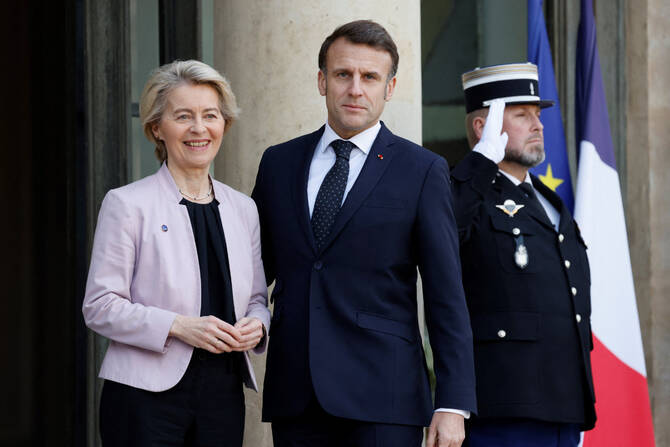
French President Emmanuel Macron welcomes European Commission President Ursula von der Leyen before an informal summit of European leaders tat The Elysee Presidential Palace in Paris on February 17, 2025. (AFP/File)
2 / 2
Short Url
Updated 05 May 2025
Follow

France, EU leaders spearhead effort to lure US scientists

PARIS: French President Emmanuel Macron and EU Commission President Ursula von der Leyen host a Paris conference Monday to attract US researchers ready to relocate because of President Donald Trump’s policies.
EU commissioners, scientists and ministers for research from member countries will discuss, among other things, financial incentives at the gathering to lure disgruntled American scientists across the Atlantic.
Paris’s Sorbonne university is hosting the conference, called “Choose Europe for Science,” which is to close with speeches by Macron and von der Leyen.


Under Trump, universities and research facilities in the United States have come under increasing political and financial pressure, including from threats of massive federal funding cuts.
Research programs face closure, tens of thousands of federal workers have been fired, while foreign students fear possible deportation for their political views.
The European Union hopes to offer an alternative for researchers and, by the same token, “defend our strategic interests and promote a universalist vision,” an official in Macron’s office told AFP.
The French president had already last month appealed to foreign, notably US, researchers to “choose France” and unveiled plans for a funding program to help universities and other research bodies cover the cost of bringing foreign scientists to France.

Shortly before, Aix Marseille University in the south of the country said its “Safe Place for Science” scheme received a flood of applicants after announcing in March it would open its doors to US scientists threatened by cuts.


Last week, France’s flagship scientific research center CNRS launched a new initiative aimed at attracting foreign researchers whose work is threatened and French researchers working abroad, some of whom “don’t want to live and raise their children in Trump’s United States,” according to CNRS President Antoine Petit.
An official in Macron’s office said Monday’s conference comes “at a time when academic freedoms are retreating and under threat in a number of cases and Europe is a continent of attractiveness.”
Experts say, however, that while EU countries can offer competitive research infrastructure and a high quality of life, research funding and researchers’ remuneration both lag far behind US levels.
But CNRS’s Petit said last week he hoped that the pay gap will seem less significant once the lower cost of education and health, and more generous social benefits are taken into account.
Macron’s office said France and the EU are targeting researchers in a number of specific sectors, including health, climate, biodiversity, artificial intelligence and space.


China’s top diplomat to visit Somalia on Africa tour

Updated 07 January 2026
Follow

China’s top diplomat to visit Somalia on Africa tour

  • Stop in Mogadishu provides diplomatic boost after Israel formally recognized breakaway Somaliland
  • Tour focusses on Beijing's strategic trade ​access across eastern and southern Africa

BEIJING: China’s top diplomat began his annual New Year tour of Africa on Wednesday, focusing on strategic trade ​access across eastern and southern Africa as Beijing seeks to secure key shipping routes and resource supply lines.
Foreign Minister Wang Yi will travel to Ethiopia, Africa’s fastest-growing large economy; Somalia, a Horn of Africa state offering access to key global shipping lanes; Tanzania, a logistics hub linking minerals-rich central Africa to the Indian Ocean; and Lesotho, a small southern African economy squeezed by US trade measures. His trip this year runs until January 12.
Beijing aims to highlight countries it views as model partners of President Xi Jinping’s flagship “Belt and Road” infrastructure program and to expand export markets, particularly in young, increasingly ‌affluent economies such ‌as Ethiopia, where the IMF forecasts growth of 7.2 percent this year.
China, ‌the ⁠world’s ​largest bilateral ‌lender, faces growing competition from the European Union to finance African infrastructure, as countries hit by pandemic-era debt strains now seek investment over loans.
“The real litmus test for 2026 isn’t just the arrival of Chinese investment, but the ‘Africanization’ of that investment. As Wang Yi visits hubs like Ethiopia and Tanzania, the conversation must move beyond just building roads to building factories,” said Judith Mwai, policy analyst at Development Reimagined, an Africa-focussed consultancy.
“For African leaders, this tour is an opportunity to demand that China’s ‘small yet beautiful’ projects specifically target our industrial gaps, ⁠turning African raw materials into finished products on African soil, rather than just facilitating their exit,” she added.
On his start-of-year trip in 2025, ‌Wang visited Namibia, the Republic of Congo, Chad and Nigeria.
His visit ‍to Somalia will be the first by a Chinese foreign minister since the 1980s and is ‍expected to provide Mogadishu with a diplomatic boost after Israel became the first country to formally recognize the breakaway Republic of Somaliland, a northern region that declared itself independent in 1991.
Beijing, which reiterated its support for Somalia after the Israeli announcement in December, is keen to reinforce its influence around the Gulf of Aden, the entrance ​to the Red Sea and a vital corridor for Chinese trade transiting the Suez Canal to Europe.
Further south, Tanzania is central to Beijing’s plan to secure access to Africa’s ⁠vast copper deposits. Chinese firms are refurbishing the Tazara Railway that runs through the country into Zambia. Li Qiang made a landmark trip to Zambia in November, the first visit by a Chinese premier in 28 years.
The railway is widely seen as a counterweight to the US and European Union-backed Lobito Corridor, which connects Zambia to Atlantic ports via Angola and the Democratic Republic of the Congo.
By visiting the southern African kingdom of Lesotho, Wang aims to highlight Beijing’s push to position itself as a champion of free trade. Last year, China offered tariff-free market access to its $19 trillion economy for the world’s poorest nations, fulfilling a pledge by Chinese President Xi Jinping at the 2024 China-Africa Cooperation summit in Beijing.
Lesotho, one of the world’s poorest nations with a gross domestic product of just over $2 billion, ‌was among the countries hardest hit by US President Donald Trump’s sweeping tariffs last year, facing duties of up to 50 percent on its exports to the United States.