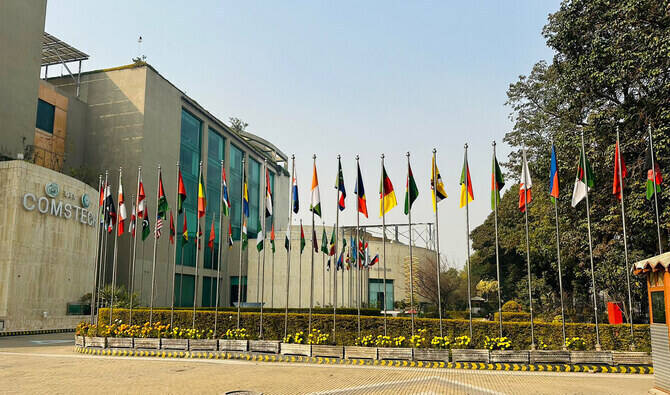
ISLAMABAD: The Organization of Islamic Cooperation’s (OIC) Standing Committee on Scientific and Technological Cooperation (COMSTECH) will hold an International Water Conference in the Pakistani capital of Islamabad on May 6–7, the committee said on Sunday, aiming to ensure sustainable management of water resources.
The conference on ‘Emerging Technologies for Water Security and Socio-Economic Development’ will take place at the OIC-COMSTECH Secretariat Islamabad. It will convene researchers, practitioners, academicians, and policymakers from around the world to address critical issues related to water management and sustainability.
Water security remains a critical issue for many OIC member states, while challenges such as climate change, water scarcity, pollution and inefficient resource management continue to threaten economic and social development.
Pakistan is among countries with highest rate of water consumption in the world. Rainfall has steadily declined over the past few decades and experts have been warning for years the South Asian country will approach “absolute scarcity” of water by 2025.
“The conference aims to foster in-depth discussions that will inform policy and practice, stimulate cross-sectoral collaboration, and promote innovative approaches for the sustainable management of water resources,” COMSTECH said on Sunday.
“Proceedings and a detailed post-conference report will be published to capture key insights, research findings, and actionable recommendations for long-term impact.”
Pakistan witnessed drought conditions in several areas amid a below-normal rainfall deficit of 40 percent from Sept. 1 to Mar. 21, according to the Pakistan Meteorological Department. There was an “acute shortage” of stored water in the Tarbela and Mangla dams, while water in different rivers flowed at an “extreme low level.”
Pakistan’s agriculture sector, which contributes nearly a quarter of Pakistan’s gross domestic product (GDP) and employs 37 percent of the national labor force, uses the most amount of fresh water than any other sector. The South Asian country generally relies on water from the Indus river which bisects it from north to south, where it empties into the Arabian Sea.
The water conference is being held at a time when Islamabad is facing a threat from India to suspend the 1960 World Bank-brokered Indus Waters Treaty, which ensures water for 80 percent of Pakistani farms, amid tensions between the two neighbors over an attack in Indian-administered Kashmir that killed 26 tourists on April 22.
Islamabad has described the move as an “act of war” and said it would take “all appropriate steps” to safeguard its due share of water.
COMSTECH said the International Water Conference in Islamabad will provide a dynamic platform for knowledge exchange and collaborative dialogue, with attendees engaging in academic presentations, interactive panel discussions, and specialized technical sessions.
“Over 80 scholarly papers will be presented under diverse sub-themes, including Environment and Climate Change, Food and Agriculture, Glaciology and Snow Hydrology, WASH (Water, Sanitation, and Hygiene), Circular Water Economy, Policy and Governance, and Artificial Intelligence for Water Security,” it said.
COMTECH is organizing the conference in collaboration with the Riphah Institute of Public Policy, Pakistan Council of Research in Water Resources (PCRWR), Water Aid and the University of Haripur.


![]()

OIC’s COMSTECH to hold International Water Conference in Islamabad this week
Short Url
https://arab.news/82q93
OIC’s COMSTECH to hold International Water Conference in Islamabad this week
- The conference is being held at a time when India has threatened to suspend the Indus Waters Treaty that ensures water for 80 percent Pakistani farmland
- The global event on emerging technologies, water security will provide a dynamic platform for knowledge exchange and collaborative dialogue, COMSTECH says
Latest updates


© 2026 SAUDI RESEARCH & PUBLISHING COMPANY, All Rights Reserved And subject to Terms of Use Agreement.