

Iraqi president invites King Salman to upcoming Arab summits in Baghdad

1 / 4
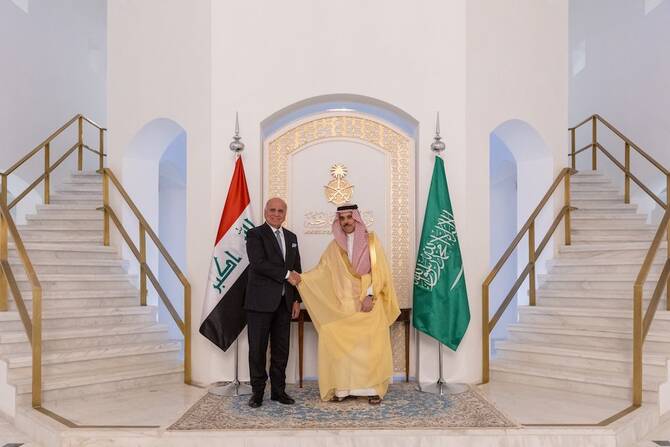
King Salman received an official invitation from Iraqi President Abdullatif Jamal Rashid on Sunday to attend the 34th regular session of the Arab League Council at the summit level, as well as the fifth Arab Economic and Social Development Summit. (SPA)
2 / 4
King Salman received an official invitation from Iraqi President Abdullatif Jamal Rashid on Sunday to attend the 34th regular session of the Arab League Council at the summit level, as well as the fifth Arab Economic and Social Development Summit. (SPA)
3 / 4
King Salman received an official invitation from Iraqi President Abdullatif Jamal Rashid on Sunday to attend the 34th regular session of the Arab League Council at the summit level, as well as the fifth Arab Economic and Social Development Summit. (SPA)
4 / 4
King Salman received an official invitation from Iraqi President Abdullatif Jamal Rashid on Sunday to attend the 34th regular session of the Arab League Council at the summit level, as well as the fifth Arab Economic and Social Development Summit. (SPA)
Short Url
Updated 04 May 2025
Follow

Iraqi president invites King Salman to upcoming Arab summits in Baghdad

  • Invitation was delivered to Foreign Minister Prince Faisal bin Farhan by Iraqi counterpart

RIYADH: King Salman received an official invitation from Iraqi President Abdullatif Jamal Rashid on Sunday to attend the 34th regular session of the Arab League Council at the summit level, as well as the fifth Arab Economic and Social Development Summit, both set to be hosted by Iraq later this month.

The invitation was delivered to Foreign Minister Prince Faisal bin Farhan during a meeting in Riyadh with Iraqi Deputy Prime Minister and Foreign Minister Fuad Mohammed Hussein, the Saudi Press Agency reported.

The two officials discussed ties between the two countries and reviewed key regional and international developments.

The meeting was also attended by Saud Al-Sati, Undersecretary of the Ministry for Political Affairs.


Saudi Arabia, regional partners reject any move to displace Palestinians from Gaza

Updated 05 December 2025
Follow

Saudi Arabia, regional partners reject any move to displace Palestinians from Gaza

  • Expressed deep concern over Israeli statements about the opening of the Rafah crossing in one direction only

RIYADH: The foreign ministers of Saudi Arabia, Egypt, Jordan, UAE, Indonesia, Pakistan, Turkiye and Qatar on Friday expressed deep concern over Israeli statements about the opening of the Rafah crossing in one direction only, the Saudi Press Agency reported. 

In a joint statement, the ministers said it was a move that could facilitate the displacement of Palestinians from the Gaza Strip into Egypt.

They firmly rejected any attempts to force Palestinians from their land, stressing the need for full adherence to the plan put forward by US President Donald Trump, which stipulated opening of the Rafah crossing in both directions and guaranteeing freedom of movement without coercion.

The ministers emphasized that conditions must be created to allow Palestinians to remain on their land and take part in rebuilding their homeland, under a comprehensive framework aimed at restoring stability and addressing the humanitarian crisis in Gaza.

They reiterated their appreciation for Trump’s commitment to regional peace and underscored the importance of implementing his plan in full and without obstruction.

The statement also highlighted the urgent need for a sustained ceasefire, an end to civilian suffering, unrestricted humanitarian access to Gaza, and the launch of early recovery and reconstruction efforts.

The ministers further called for conditions that would enable the Palestinian Authority to resume its responsibilities in the enclave.

The eight countries reaffirmed their readiness to continue coordinating with the US and international partners to ensure full implementation of UN Security Council Resolution 2803 and other relevant resolutions, in pursuit of a just and lasting peace based on international law and the two-state solution, including the establishment of an independent Palestinian state along the 1967 borders with East Jerusalem as its capital.