

In tit-for-tat move, Pakistan bans Indian ships from its ports

1 / 2
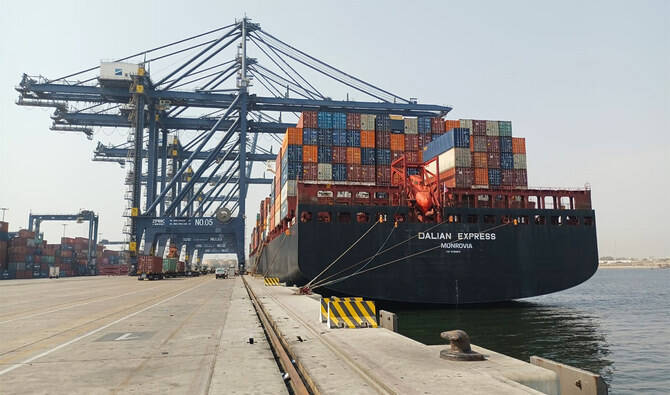
This picture taken on March 8, 2023, shows a cargo ship set to sail from a sea port in Karachi, Pakistan. (Radio Pakistan/File)
2 / 2
In this handout photo, taken and released by Karachi Port Trust, a container ship sits docked at the Karachi Port in Karachi on May 29, 2024. (Photo courtesy: KPT/File)
Short Url
Updated 04 May 2025
Follow

In tit-for-tat move, Pakistan bans Indian ships from its ports

  • Move comes in response to India’s act of banning Pakistani ships, imports on Saturday
  • Tensions surged after Apr. 22 attack in Indian-administered Kashmir killed 26 tourists

ISLAMABAD: Pakistan this week decided to close its shipping ports for Indian flag carriers, a statement from the country’s maritime affairs ministry said, as Islamabad’s tensions with New Delhi continue to surge following a deadly attack on tourists. 

The move came hours after India announced on Saturday it had banned the import of goods coming from or transiting via Pakistan and barred Pakistani ships. 

Both nations have taken a raft of measures against each other since Apr. 22, when gunmen killed 26 tourists in Indian-administered Kashmir. New Delhi pinned the blame on Islamabad, an accusation that Pakistan has vehemently denied and called for a transparent, international probe into the incident. 

Pakistan’s maritime affairs ministry said its decision to ban Indian ships from Pakistani ports has been taken to “safeguard maritime sovereignty, economic interest and national security.”

“Indian Flag Carriers shall not be allowed to visit any Pakistani port,” the statement said. “Pakistani Flag Carriers shall not visit any Indian Port. Any exemption or dispensation shall be examined and decided on case to case basis,” it added.

Trade between India and Pakistan has dwindled over the last few years. India announced on Saturday that it was banning Pakistani ships to ensure the safety of its assets, cargo and connected infrastructure, in the public interest and in the interest of the Indian shipping industry.

Both countries have been trading fire at the Line of Control frontier in Kashmir, which acts as a de facto border between India and Pakistan, for the last 10 days as per international media reports. 

Since gaining independence from British colonial India in 1947, India and Pakistan have fought two out of three wars over the disputed Himalayan region of Kashmir. Both countries claim it in full but administer only parts of it. 

The US, China, UK, Saudi Arabia, Turkiye, Iran and several other nations have called on both nuclear-armed neighbors recently to de-escalate tensions and avoid a military standoff. 

Pakistan has vowed it would issue a “strong” response if the Indian military attacks. India’s PM Narendra Modi this week gave his country’s military “operational freedom” to respond to the Apr. 22 attack.


Pakistan chief of defense forces discusses regional developments, cooperation with UAE’s national security adviser 

Updated 7 sec ago
Follow

Pakistan chief of defense forces discusses regional developments, cooperation with UAE’s national security adviser 

  • Field Marshal Syed Asim Munir meets UAE’s National Security Adviser Sheikh Tahnoon bin Zayed Al Nahyan in Abu Dhabi
  • Both sides discuss ways to strengthen cooperation in economic collaboration, trade and investment, says Pakistan military 

ISLAMABAD: Pakistan’s Chief of Defense Forces Field Marshal Syed Asim Munir met UAE’s National Security Adviser Sheikh Tahnoon bin Zayed Al Nahyan in Abu Dhabi on Monday, during which the two sides discussed regional developments and bilateral economic and investment cooperation, the Pakistani military’s media wing said. 

The meeting took place as tensions surge between Washington and Tehran. Both nations renewed negotiations earlier this month to tackle their dispute over Tehran’s nuclear program. The talks take place as Washington deploys warships, including a second aircraft carrier, to the Middle East region as mediators work to prevent a war. 

Munir met Sheikh Tahnoon, who is also the deputy ruler of Abu Dhabi, in the UAE capital. The two sides discussed ways to strengthen cooperation in economic collaboration, trade and investment, the Inter-Services Public Relations (ISPR) said in a statement. 

“They also exchanged views on regional developments and emphasized the importance of continued coordination to promote peace and stability in the region,” the ISPR said. 

Munir appreciated the UAE government for its longstanding investments and continued support to Pakistan’s economy over the decades, the military said. He noted that such support reflects the deep-rooted relations between the two countries. 

“Field Marshal Asim Munir further affirmed that the security and stability of the United Arab Emirates are an integral part of Pakistan’s own security, given the enduring historical relations and strong strategic partnership between the two countries,” the military’s media wing said. 

“He reiterated Pakistan’s firm commitment to continuing joint efforts to further strengthen this partnership in all fields, in a manner that serves the interests of both brotherly peoples and contributes to peace, stability and prosperity in the region.”

Pakistan enjoys close ties with the UAE, which along with other friendly nations, has provided Islamabad critical financial assistance over the past couple of years as it grapples with a macroeconomic crisis. 

Millions of Pakistanis live and work in the UAE, forming one of the largest expatriate communities in the Gulf state. Remittances from the UAE rank among Pakistan’s top sources of foreign currency inflows and play a significant role in supporting the country’s external accounts.

Pakistan’s President Asif Ali Zardari last month went to the UAE on an official visit during which he met senior members of the government there as well as businesspersons to discuss bilateral trade, investment and security cooperation.