



LONDON: On Sunday, July 1, 1798, a vast fleet of ships appeared off the Egyptian city of Alexandria. Aboard the flagship Orient was the French general Napoleon Bonaparte, still six years away from being proclaimed emperor of France but fresh from a series of military victories in Europe and determined to undermine Britain’s influence in Egypt and the Middle East.
With him were 50,000 men, hundreds of horses, numerous artillery pieces and, incongruously, 200 members of the Commission des Sciences et des Arts, a group including engineers, mathematicians, astronomers, geographers, writers, artists — and 22 printers.
Back in France, between 1809 and 1829 the survivors of this group of savants would produce the 37-volume Description de l’Egypte, a triumphant catalogue of all things Egyptian, ancient and modern.

The port city of Rashid, or Rosetta, is located on the Nile Delta where French soldiers discovered the famous stone stele in 1799 - key to deciphering Egyptian scripts. (Getty Images)
Their achievement would not be shared by Napoleon’s army. A month after the landing, virtually all of Napoleon’s ships were destroyed at the Battle of the Nile by a British fleet commanded by Horatio Nelson.
The following year Napoleon and a few men returned to France in secret. The general he left in charge, Jean-Baptiste Kleber, was assassinated a few months later by an Aleppo-born student living in Cairo.
The remains of the French army, decimated by disease and endless conflict, surrendered to British forces in 1801 and, under the terms of an ignominious treaty, were ferried back to France on the enemy’s ships.
IN NUMBERS:
• 50,000 Men who accompanied Napoleon to Egypt.
• £30,000 Price tag of Expedition de Syrie jusqu’a la prise de Jaffa.
• 1820 Year in which Bulaq Press was established in Cairo.
To rub salt into the French wounds, many of the Egyptian antiquities that had been looted by Napoleon’s troops and scholars fell into British hands. Some, including the Rosetta Stone, the ancient granite stele inscribed with a decree in three languages that allowed the cracking of the code of Egyptian hieroglyphs, found their way to the British Museum, where they remain to this day.
But arguably the greatest legacy of the Napoleonic invasion of Egypt lies not in what the French took, but in what they left behind — the art of printing with movable type.
Some of the products of this unintended consequence of Napoleon’s ill-fated Egyptian adventure can be seen this week at the Abu Dhabi International Book Fair — an extraordinary collection of rare books and pamphlets that together tell a fascinating story.

The Abu Dhabi International Book Fair. (Supplied)
“Aware of the printing press’s potential as a tool for governance and propaganda, Napoleon brought with him advanced French printing technology — something entirely new to Egypt,” said Pom Harrington, the owner of London-based Peter Harrington Rare Books.

Pom Harrington, the owner of London-based Peter Harrington Rare Books. (Supplied)
Just days after landing near Alexandria, Napoleon’s team of printers established the Imprimerie orientale et francaise, under the direction of the linguist and orientalist Jean-Joseph Marcel and the Marc Aurel, the 18-year-old son of a printer and bookseller.
It was, incidentally, Jean-Joseph Marcel who first recognized the third script on the Rosetta stone as Egyptian Demotic, which proved to be the ancient linguistic key to unravelling the mystery of hieroglyphics.
A first-edition copy of one of their first publications, a pamphlet containing seven reports of expeditions against Ottoman forces in Syria, is at the show.

This picture taken on July 26, 2022 shows a close-up view of the cartouche of the Ptolemaic dynasty Pharaoh Ptolemy V "Epiphanes" (210-180 BC) inscribed with the rest of the ancient Egyptian hieroglyphic text in the upper portion of the Rosetta Stone, on display at the British Museum in London. (AFP)

This picture taken on July 23, 2022 shows a view of the Rosetta Stone at the British Museum in London. (AFP)
The £30,000 price tag of Expedition de Syrie jusqu’a la prise de Jaffa (Expedition from Syria to the capture of Jaffa) reflects its extreme rarity. No copies of the pamphlet are known to exist in institutional libraries, none has ever appeared at auction and the manuscript is not even listed in Albert Geiss’ exhaustive Histoire de l’Imprimerie en Egypte, published by the Institut Francais d’Archeologie Orientale in Cairo in 1907.
Following the French victory over Ottoman forces at the Battle of the Pyramids on July 21, the press was relocated to Cairo, where it was renamed the Imprimerie nationale du Caire.
Another valuable book on show in Abu Dhabi is an extremely rare first-edition copy of the first Arabic dictionary to be printed in the Arabic world. The Vocabulaire francais-arabe, contenant les mots principaux et d’un usage plus journalier (French-Arabic vocabulary, containing the main words and those of more everyday use) was printed between September 1798 and September 1799.

The first Arabic dictionary published in the Arabic world, printed by the French press in Cairo in 1798 or 1799. (AFP)
The final eight pages of common phrases reflect the imperial expectations of those who would use the dictionary to communicate with their temporary Egyptian subjects. Alongside more typical phrases, some of which would be of use to modern travellers today, such as “I am hungry” and “I am going to Cairo,” is the altogether less common instruction “Etrillez mon cheval” — “Brush my horse.”
One of the most fascinating documents produced in Cairo by the French press was an account of the interrogation and trial of Suleiman Al-Halabi, the young man who stabbed to death Jean-Baptiste Kleber, Napoleon’s successor in Egypt as commander of the French army.
Printed in 1800, a year before the end of the French occupation, of the 500 copies that were printed of the Recueil des pieces relatives a la procedure et au jugement de Soleyman El-Hhaleby, assassin du general en chef Kleber (“Collection of documents relating to the procedure and judgement of Soleyman El-Hhaleby, assassin of general Kleber”), only 14 survive.

An account of the investigation and trial of Suleiman al-Halabi, executed in 1800 for the assassination of the commander of the French army in Egypt. (Supplied)
Suleiman Al-Halabi’s execution on June 17, 1800, the day of his victim’s funeral, was a gruesome affair; after his right forearm was burnt to the bone, he took four hours to die after being impaled on a metal spike.
The Cairo press was shut down after the French withdrew, and the printing presses were sent back to France, “but its impact was lasting,” said Harrington.
“The French conquerors could not have foreseen that the introduction of printing with movable types would lead to a revolution in printing in the Arab world, demonstrating to Egyptian scholars the transformative potential of print.”
The influence of the short-lived French printing house lingered on through individuals including Nicolas Musabiki, whose father Yusuf had been trained during the French occupation.
Nicolas later played a crucial role in the Bulaq Press, established in Cairo in 1820 by Muhammad Ali Pasha, the Ottoman viceroy and the ruler of Egypt from 1805 to 1848.

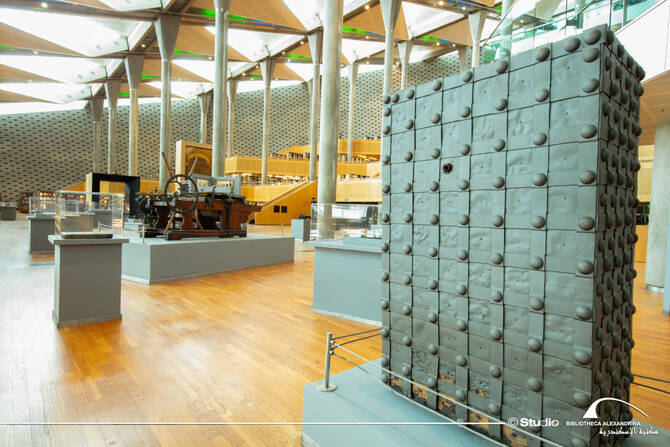
The Bulaq Press, established in Cairo in 1820 by Ottoman viceroy Muhammad Ali Pasha, was inspired by the French press that was brought along by Napoleon in his conquest of Egypt. (Photos courtesy of Bibliotheca Alexandrina)
“Ali Pasha is seen as the founder of modern Egypt and was clearly inspired by Napoleon’s printing presses,” said Harrington.
“In 1815 he sent the Syrian Nicolas Musabiki to Italy to study type-founding and printing, and ordered three presses from Milan, along with paper and ink, also from Italy.
“The establishment of the Bulaq Press meant that he could print manuals for the military, official guidebooks for the administration, and textbooks for new schools.”
Bulaq’s presses “primarily used the Naskh script, valued for its legibility and formality, making the new texts easily readable.”
Among the rare finds featured in the Abu Dhabi International Book Fair is the Alfiyat Ibn Malik, a 13th-century Arabic textbook. (Supplied)In Europe, printing with movable type had begun in the 15th century — the Gutenberg Bible was printed in Germany in 1455.

An 1835 Bulaq edition of the classic Arabic grammar written in the 13th century by Muhammad ibn Malik, an eminent grammarian and specialist in Islamic law. (Supplied)
“The delay in printing in the Arab world was certainly linked to the notion of calligraphy not only as an art form, but also as an expression of spirituality,” said Harrington.
“It wasn’t until the introduction of lithographic techniques that the beauty of Arabic script could be adapted to printing more easily.”
The Bulaq Press printed its first book, an Italian-Arabic dictionary, in 1822. But one of its greatest triumphs is on show at Abu Dhabi: the first complete edition in Arabic of the Thousand and One Nights, printed in 1835.

Two pages from the Galland manuscript, the oldest text of The Thousand and One Nights. Arabic manuscript, back to the 14th century from Syria in the Bibliotheque Nationale in Paris. (Photo courtesy of Wikimedia Commons)
The first edition of the collection of Arabic folk tales printed anywhere in the Arab world, fewer than a dozen copies are known to exist in libraries. Privately held copies are even rarer; this copy, from the collection of the French historian and orientalist Charles Barbier de Maynard, who died in 1908, is priced at £250,000.
The impact of the Bulaq Press is celebrated by Egypt’s state library, the Bibliotheca Alexandrina, which in an online history credits it with having played “an essential role in disseminating science and knowledge throughout the country.
“As books and legible material became available, a new class of intellectuals emerged, to later form the basis for a comprehensive modernization of the whole society.
“Other outcomes included an increase in the number of private schools and the emergence of female education. As the class of intellectuals broadened, self-expression and free opinions appeared in the press and daily newspapers.”
The Bulaq Press “was the main force behind this historical transformation that transferred Egypt from the Dark Ages of ignorance and backwardness and into the age of knowledge, freedom and awareness.”
The advantages of modern printing with movable type, demonstrated by the Bulaq Press, were quickly appreciated elsewhere in the Arab world. The first printing press in Makkah was set up in 1882, and the first newspaper — called Hijaz — followed there in 1908.

King Fahd Glorious Qur'an Printing Complex in Madinah, Saudi Arabia. (SPA/File photo)
In 1949, a specialist publishing house was set up in Makkah to produce the first copies of the holy Qur’an to be printed in Saudi Arabia — a task that previously had been left to printers in Egypt.
In 1984, the King Fahd Complex for the Printing of the Holy Qur’an opened in Madinah and has since produced hundreds of millions of copies of the holy book in Arabic and in multiple translations.
The Bulaq Press, also known as the Amiria Press, survives to this day. Its operations were paused during the British occupation of Egypt, but in 1956 it was revived by Gamal Abdel Nasser, the then Egyptian president, and has continued publishing books and other materials as part of the country’s ministry of trade and industry.


