

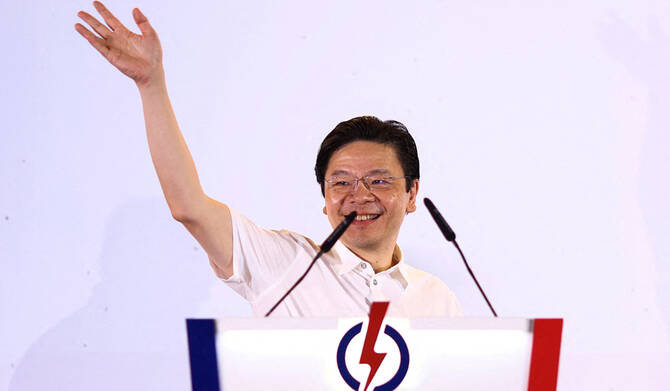
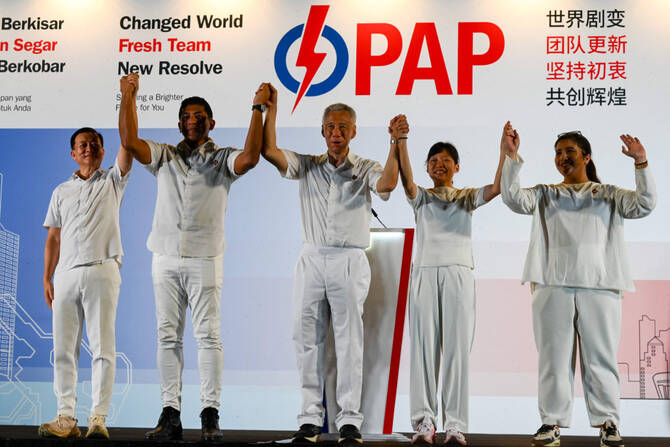

SINGAPORE: Singapore’s long-ruling People’s Action Party won another landslide in Saturday’s general elections, extending its 66-year unbroken rule in a huge boost for Prime Minister Lawrence Wong who took power a year ago.
The Election Department announced the PAP won 82 Parliamentary seats after vote counting ended. The party had earlier won five seats uncontested, giving it 87 out of a total 97 seats. The opposition Workers Party maintained its 10 seats.
The PAP’s popular vote rose to 65.6 percent, up from a near-record low of 61 percent in 2020 polls. Jubilant supporters of the PAP, which had ruled Singapore since 1959, gathered in stadiums waved flags and cheered in celebration.
A US-trained economist who is also finance minister, Wong’s appeal for a resounding mandate to steer trade-reliant Singapore through economic troubles following US President Donald Trump’s tariff hikes has hit home. The government has lowered its growth forecast and warned of a possible recession.
Wong, 52, said he was humbled and grateful for the solid mandate for the PAP. He acknowledged voters’ desire to have more alternative voices in government, but said a strong PAP team was needed to tackle challenges ahead.
“The results will put Singapore in a better position to face this turbulent world,” he said.
Eugene Tan, a law professor at the Singapore Management University, said the opposition’s failure to make further inroads after 2020 was a surprise. “Singapore voters played their cards close to their chest. Today, they indicated that their trust is with a party that has delivered over the years,” he said.
Wong succeeded Lee Hsien Loong to become the city-state’s fourth leader. Lee stepped down in May 2024 after two decades at the helm but remained in the Cabinet as a senior minister. His retirement as premier ended a family dynasty started by his father, Lee Kuan Yew, Singapore’s first leader, who built the former colonial backwater into one of the world’s richest nations during 31 years in office.
The PAP is seen as a beacon of stability and prosperity, but tight government control and the rising cost of living in one of the world’s most expensive cities also has led to growing unhappiness, especially among younger voters. Widening income disparity, increasingly unaffordable housing, overcrowding and restrictions on free speech have loosened the PAP’s grip on power.
The opposition says giving it a stronger presence in Parliament will allow a more balanced political system and greater accountability. But they face an uphill task, often hamstrung by a lack of resources, fragmented support and a lack of unity. Critics said gerrymandering also gives the PAP an advantage.
Pritam Singh, leader of the Workers Party, acknowledged it was a tough contest and vowed to continue the fight for a more balanced Parliament. “The slate is wiped clean, we start work again tomorrow, and we go again,” he said.
‘Bilateral defense and security ties’
The United States government offered its congratulations to Singapore and Wong.
In a statement, Secretary of State Marco Rubio said the US and Singapore had shared a “strong and enduring strategic partnership and a commitment to a secure, free, and prosperous Indo-Pacific region” for almost 60 years.
“We look forward to continuing to work closely with the newly elected government and Prime Minister Wong to strengthen economic growth and our bilateral defense and security ties, which benefit Americans, Singaporeans, and others across the region,” Rubio said.
While the Workers Party failed to expand its presence, it had consolidated its support with increased share vote in some areas, said Southeast Asia political analyst Bridget Welsh. Other smaller opposition parties however, failed to make a breakthrough.
Welsh said voters opted for stability amid concerns over global volatility due to sweeping US tariffs. Wong’s more approachable leadership in engaging younger voters and efforts to renew PAP by bringing in about a-third of new faces also helped swung votes, she said.
“I call this the Wong and Trump effect,” she said. “The issue of economic insecurity really did reinforce his mandate.”


