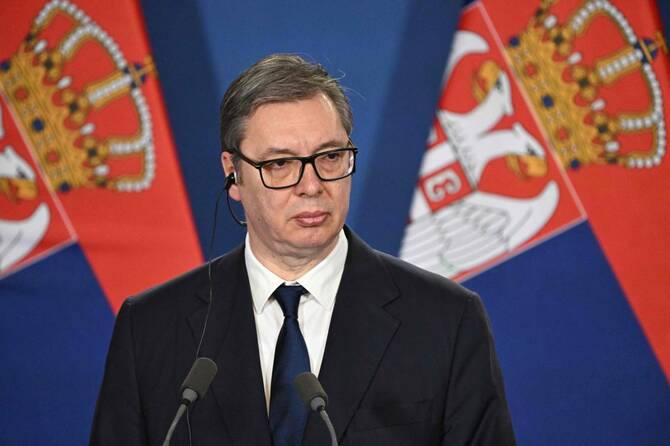
BELGRADE: Serbia’s President Aleksandar Vucic has cut short a visit to the United States and returned to Serbia over an unspecified health emergency, state RTS television reported on Saturday.
Vucic suddenly fell ill during a meeting in the US and decided to return home after consulting doctors, the report said. He was admitted to the Belgrade Military Hospital upon arrival, it added.
Vucic was previously in Miami, Florida, where he had met with former New York City mayor Rudy Giuliani. Vucic had said he also was hoping to meet with US President Donald Trump.
Richard Grenell, US presidential envoy for special missions, expressed hope that Vucic would recover. “Sorry to miss you but hope all is ok,” Grenell wrote on X.
It was not immediately clear what happened and Vucic’s office said they will inform the public later. Vucic, 55, is known to have high blood pressure.
Serbia’s populist leader also has said he would travel to Russia later this month to attend a Victory Day parade in Moscow, despite warnings from European Union officials that this could affect Serbia’s bid to join the bloc.

Serbia’s President Vucic cuts short US visit and returns home after falling ill
https://arab.news/jnpkq
Serbia’s President Vucic cuts short US visit and returns home after falling ill
- Vucic suddenly fell ill during a meeting in the US
- He was admitted to the Belgrade Military Hospital upon arrival
Top Australian writers’ festival canceled after Palestinian author barred
SYDNEY: One of Australia’s top writers’ festivals was canceled on Tuesday, after 180 authors boycotted the event and its director resigned saying she could not be party to silencing a Palestinian author and warned moves to ban protests and slogans after the Bondi Beach mass shooting threatened free speech.
Louise Adler, the Jewish daughter of Holocaust survivors, said on Tuesday she was quitting her role at the Adelaide Writers’ Week in February, following a decision by the festival’s board to disinvite a Palestinian-Australian author.
The novelist and academic Randa Abdel-Fattah said the move to bar her was “a blatant and shameless act of anti-Palestinian racism and censorship.”
Prime Minister Anthony Albanese on Tuesday announced a national day of mourning would be held on January 22 to remember the 15 people killed in last month’s shooting at a Jewish Hanukkah celebration on Bondi Beach.
Police say the alleged gunmen were inspired by the Islamic State militant group, and the incident sparked nationwide calls to tackle antisemitism, and prompted state and federal government moves to tighten hate speech laws.
The Adelaide Festival board said on Tuesday its decision last week to disinvite Abdel-Fattah, on the grounds it would not be culturally sensitive for her to appear at the literary event “so soon after Bondi,” was made “out of respect for a community experiencing the pain from a devastating event.”
“Instead, this decision has created more division and for that we express our sincere apologies,” the board said in a statement.
The event would not go ahead and remaining board members will step down, it added.
Former New Zealand Prime Minister Jacinda Ardern, British author Zadie Smith, Australian author Kathy Lette, Pulitzer Prize-winning American Percival Everett and former Greek finance minister Yanis Varoufakis are among the authors who said they would no longer appear at the festival in South Australia state, Australian media reported.
The festival board on Tuesday apologized to Abdel-Fattah for “how the decision was represented.”
“This is not about identity or dissent but rather a continuing rapid shift in the national discourse around the breadth of freedom of expression in our nation following Australia’s worst terror attack in history,” it added.
Abdel-Fattah wrote on social media that she did not accept the apology, saying she had nothing to do with the Bondi attack, “nor did any Palestinian.”
Adler earlier wrote in The Guardian that the board’s decision to disinvite Abdel-Fattah “weakens freedom of speech and is the harbinger of a less free nation, where lobbying and political pressure determine who gets to speak and who doesn’t.”
The South Australian state government has appointed a new festival board.


