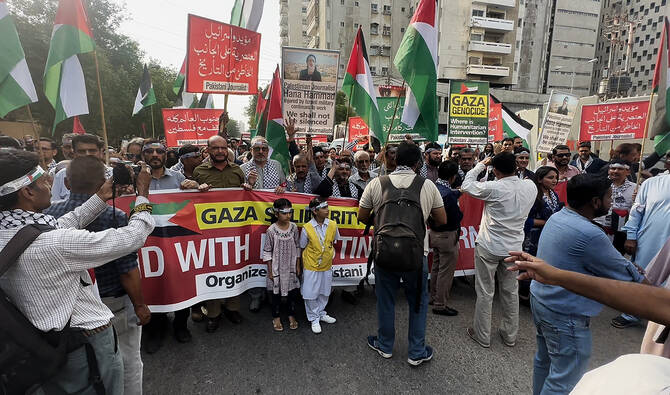
ISLAMABAD: Pakistan’s President Asif Ali Zardari and Prime Minister Shehbaz Sharif on Saturday hailed journalists who lost their lives while reporting in conflict zones like Gaza, saying their dedication continues to inspire many across the world.
The statement came on the World Press Freedom Day on May 3 that aims to raise awareness about the importance of press freedom and remind governments of their duty to respect and uphold the right to freedom of expression enshrined under Article 19 of the 1948 Universal Declaration of Human Rights.
The period from October 7, 2023, when Israel launched its war on Gaza, to May 3, 2025 has proven to be the bloodiest period of the 21st century for journalists. According to the Palestinian government, 202 journalists were killed in Israeli strikes on Gaza during this period.
The Committee to Protect Journalists says such a deadly and bloody war has never been seen before in which such a large number of journalists lost their lives, while Reporters Without Borders says the Israeli army deliberately targeted Palestinian and Lebanese journalists and media workers.
“[We] honor the sacrifices made by those who have lost their lives in pursuit of truth, especially reporting in conflict zones like Gaza and Palestine,” President Zardari said in his statement on the day.
“Their courage and dedication continue to inspire us.”
The media is indispensable in promoting dialogue, highlighting issues of social, economic and environmental significance, uncovering corruption and advocating for the marginalized communities, according to the Pakistan president.
Article 19 of the Constitution of Pakistan guarantees the right to freedom of speech and a free press, subject to “certain restrictions.”
“I commend the responsible role of the Pakistani media in national interests, which confronted the recent Indian water aggression and the use of the media for unfounded accusations with facts and truth and destroyed India’s nefarious objectives of creating an atmosphere of war in the region,” Sharif said in his message on the World Press Freedom Day.
“I hope that our responsible media will continue to support and guide our efforts to protect national and public interests in the same manner.”
Relations between the nuclear-armed neighbors have plummeted after India accused Pakistan of backing an attack in Indian-administered Kashmir that killed 26 people on April 22. Islamabad has rejected the charge and called for a credible, neutral international probe into it.
Sharif promised that his government would wholeheartedly work with journalists for their betterment.
“As a responsible democratic society, our collective responsibility is to ensure that journalism continues to serve the public good based on facts, ethics and freedom,” he said.
Pakistan ranks 152nd out of 180 countries on the RSF press freedom index, and journalists in the country have long complained of increasing state pressure on traditional media. Social media platform X is officially banned, but accessible using VPNs, while YouTube and TikTok have faced bans in the past.
“We have taken a number of steps for the protection and welfare of journalists, but more needs to be done by providing them a safe, secure, and enabling environment,” President Zardari said.
“A culture where journalists feel secure to perform their duties without fear and harassment is the need of the time. I urge the media to uphold the highest standards of journalism, accuracy, and professionalism.”


![]()

On World Press Freedom Day, Pakistan honors journalists killed in Israeli strikes on Gaza
Short Url
https://arab.news/rbwak
On World Press Freedom Day, Pakistan honors journalists killed in Israeli strikes on Gaza
- Israel’s war on Gaza has killed over 200 journalists, making it the deadliest conflict ever for media workers across the world
- PM Sharif commends responsible role of Pakistani media in confronting India’s recent unfounded accusations with ‘facts, truth’
Latest updates


Recommended


© 2026 SAUDI RESEARCH & PUBLISHING COMPANY, All Rights Reserved And subject to Terms of Use Agreement.