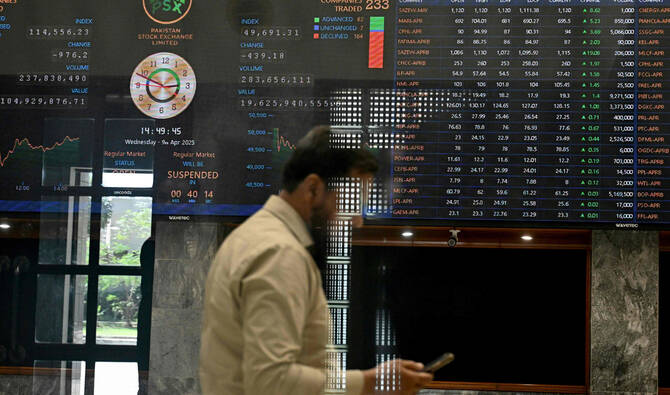
KARACHI: Pakistan’s renewed tensions with archrival India have weighed heavily on the country’s stock market, with key sectors like refineries posting losses of up to 15 percent since a gun attack killed 26 tourists in the disputed Kashmir region on April 22, according to analysts and market data on Friday.
India blamed Pakistan for the attack despite Islamabad’s denial and call for a neutral probe. The escalation, which has seen border closures, tit-for-tat diplomatic expulsions and fears of military confrontation between the nuclear-armed neighbors, has drawn international concern.
The KSE-100 Index, Pakistan’s benchmark stock gauge, fell 6 percent over six trading sessions following the attack, according to Pakistan Stock Exchange (PSX) data.
The market recovered some losses on Friday but remained volatile heading into next week.
“Pakistan’s stock market experienced heightened volatility after the Pahalgam attack,” Sana Tawfik, an economist and head of research at Arif Habib Ltd., told Arab News while referring to the attack in Indian-administered Kashmir.
Between April 22 and April 30, the index dropped 7,104 points or 6 percent, she said.
Key sectors bore the brunt of the sell-off, including refineries (-15.4 percent), transport (-15 percent), pharmaceuticals (-12.9 percent), jute (-11.6 percent) and engineering (-9.2 percent).
“This decline reflects broad investor risk aversion amid geopolitical uncertainty,” she added.
The latest flare-up with India added to pressure on Pakistani equities, which had already been hit by US President Donald Trump’s tariff increases last month. That triggered panic selling and a one-hour trading halt at the PSX.
“Foreigners remained net sellers [in April] as well, taking 10MFY25 net outflow to around $252 million,” JS Global Capital Ltd., the largest broking and investment banking firm in Pakistan, said in a note to clients.
Muhammad Waqas Ghani, its head of research, said investor caution over Pakistan’s escalating tensions with India had driven the recent market volatility.
“The impact of geopolitical concerns is beginning to wear off,” he said.
On Friday, the KSE-100 rebounded 2.5 percent to 114,113 points, trimming overall losses to 3.6 percent. Ghani attributed the recovery to US diplomatic efforts to defuse tensions between the two neighbors.
“The market opened positive today [Friday], gaining 2,900 points or 2.6 percent in the first half,” he said.
Analysts said calls for restraint from the US, United Nations and other members of the International community contributed to Friday’s rally.
US Vice President JD Vance told Fox News in a podcast interview that Washington was working to prevent further escalation and preserve regional peace.
Mohammed Sohail, CEO at Topline Securities Ltd., said stocks bounced back as investors regained confidence amid “signals of easing tensions.”
JS Global said market sentiment could improve further after the International Monetary Fund’s (IMF) expected release of funds for Pakistan following its upcoming executive board meeting this month.
“Materialization of planned foreign inflows, likely after IMF disbursement, along with geopolitical stability, remains crucial for the country and equity markets,” it added.


![]()

Pakistan stocks slide on India tensions, key sectors lose up to 15% after Kashmir attack
Short Url
https://arab.news/mzyna
Pakistan stocks slide on India tensions, key sectors lose up to 15% after Kashmir attack
- Foreign investors remained net sellers in April, taking their outflows since July to $252 million
- The market recovered some of its losses on Friday but remains volatile heading into next week
Latest updates


© 2026 SAUDI RESEARCH & PUBLISHING COMPANY, All Rights Reserved And subject to Terms of Use Agreement.