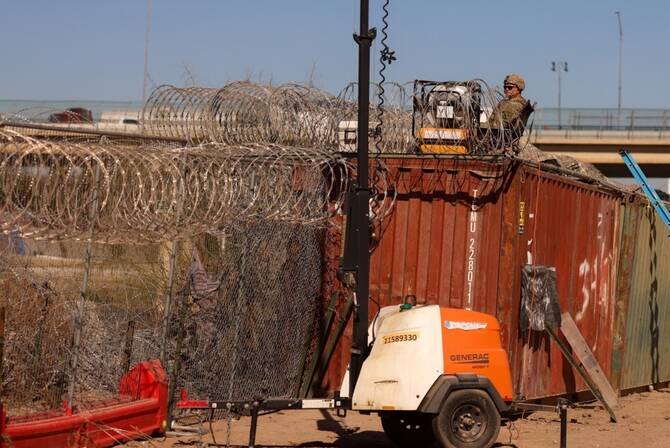
WASHINGTON: The US military has created a second military zone along the border with Mexico, adding an area in Texas where troops can temporarily detain migrants or trespassers to one designated in New Mexico last month.
President Donald Trump has launched an aggressive immigration enforcement campaign since taking office, increasing troops at the southern border and pledging to deport millions of immigrants in the United States illegally.
The Trump administration in April said it designated a 60-foot-wide, 170-mile-long (18 meter by 270 km) strip along the base of New Mexico as a “National Defense Area.”
Late on Thursday, the US military said it had established the “Texas National Defense Area” in a 63-mile-long strip running east from the Texas-New Mexico border in El Paso.
US Customs and Border Protection maintains jurisdiction over illegal border crossings in the area and troops would hand over migrants they detained to US Border Patrol or other civilian law enforcement, according to the Defense Department.
So far, 82 migrants have been charged for crossing into the New Mexico military zone, according to the state’s US Attorney’s Office. US troops have not detained any of them and they were dealt with by CBP officials.
The zone is intended to allow the Trump administration to use troops to detain migrants without invoking the 1807 Insurrection Act that empowers a president to deploy the US military to suppress events like civil disorder.
Around 11,900 troops are currently on the border. The number of migrants caught crossing illegally in March fell to the lowest level ever recorded, according to government data.
Texas Governor Gregg Abbott, a Republican, on Thursday posted pictures of razor wire barrier construction on the border, saying “Texas continues to work with the Trump Administration to stop illegal immigration.”
Since 2021 Abbott has deployed the state’s National Guard and police to border security.
New Mexico Governor Michelle Lujan Grisham has opposed what she called a “deportation buffer zone” in her state.
In a March social media post the Democrat called it “a waste of resources and military personnel, especially when migrant crossings are at the lowest in decades.”

US military creates new military zone along border with Mexico
https://arab.news/j4ky2
US military creates new military zone along border with Mexico
- The US military said it had established the “Texas National Defense Area” in a 63-mile-long strip running east from the Texas-New Mexico border in El Paso
94 million need cataract surgery, but access lacking: WHO
- Of the 94 million affected, fewer than 20 percent are blind, while the rest suffer from impaired vision
GENEVA: More than 94 million people suffer from cataracts, but half of them do not have access to the surgery needed to fix it, the World Health Organization said Wednesday.
Cataracts — the clouding of the eye’s lens that causes blurred vision and can lead to blindness — are on the rise as populations get older, with age being the main risk factor.
“Cataract surgery — a simple, 15-minute procedure — is one of the most cost-effective medical procedures, providing immediate and lasting restoration of sight,” the WHO said.
It is one of the most frequently performed surgeries undertaken in high-income countries.
However, “half of the world’s population in need of cataract surgery don’t have access to it,” said Stuart Keel, the UN health agency’s technical lead for eye care.
The situation is worst in the WHO’s Africa region, where three in four people needing cataract surgery remain untreated.
In Kenya, at the current rate, 77 percent of people needing cataract surgery are likely to die with their cataract blindness or vision impairment, said Keel.
Across all regions, women consistently experience lower access to care than men.
Of the 94 million affected, fewer than 20 percent are blind, while the rest suffer from impaired vision.
- 2030 vision -
The WHO said that over the past two decades, global cataract surgery coverage had increased by 15 percent.
In 2021, WHO member states set a target of a 30-percent increase by 2030.
However, current modelling predicts that cataract surgery coverage will rise by only about 8.4 percent this decade.
To close the gap, the WHO urged countries to integrate eye examinations into primary health care and invest in the required surgical equipment.
States should also expand the eye-care workforce, training surgeons in a standardised manner and then distributing them throughout the country, notably outside major cities.
The WHO was on Wednesday launching new guidance for countries on how to provide quality cataract surgery services.
It will also issue guidance to help support workforce development.
Keel said the main issue was capacity and financing.
“We do need money invested to get rid of this backlog, which is nearly 100 million people,” he told a press conference.
While age is the primary risk factor for cataracts, others include prolonged UV-B light exposure, tobacco use, prolonged corticosteroid use and diabetes.
Keel urged people to keep up regular eye checks as they get older, with most problems able to be either prevented or diagnosed and treated.
The cost of the new lens that goes inside the eye can be under $100.
However, out-of-pocket costs can be higher when not covered by health insurance.
“Cataract surgery is one of the most powerful tools we have to restore vision and transform lives,” said Devora Kestel, head of the WHO’s noncommunicable diseases and mental health department.
“When people regain their sight, they regain independence, dignity, and opportunity.”