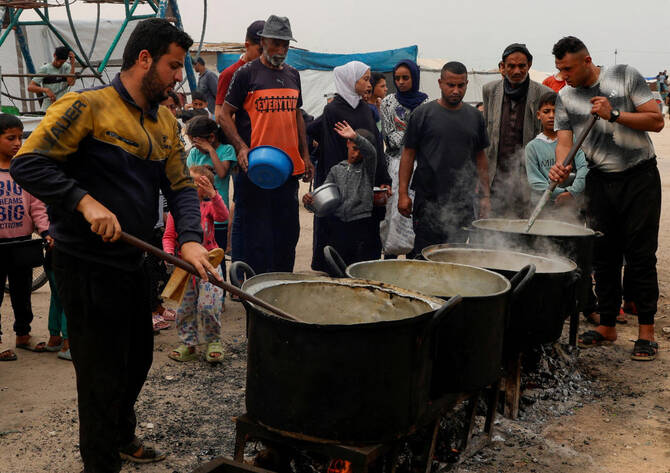
KHAN YOUNIS, Gaza Strip: Screaming in anguish as the desperate crowd crushes them against a barrier, young children and adults frantically wave pots and pans at charity workers, begging for a portion of some of the last food aid left in Gaza: Rice.
The chaos at the community kitchen in Khan Younis in southern Gaza on Friday was too overwhelming for Niveen Abu Arar. She tried and tried, but the 33-year-old mother of eight didn’t get to the front of the crowd in time. She left with her pot empty, and her eyes full of tears.
“Until when will life be like that? We’re slowly dying. We haven’t eaten bread for a month and a half. There is no flour. There is nothing,” said Abu Arar, whose ninth child, a 1-year-old boy, was killed in an Israeli strike near their home at the start of the war in 2023. “We don’t know what to do … We don’t have money. What do we get for them?”
She cradled a toddler in her lap as she spoke. With no milk to provide, she poured water into a baby bottle and pressed it into her youngest daughter’s mouth, hoping to stave off the baby’s hunger pangs.
With Israel blocking any form of aid — including food and medicine – into Gaza for the past two months, aid groups have warned that Gaza’s civilian population is facing starvation.
Israel has said that the blockade and its renewed military campaign aim to pressure Hamas to release the remaining hostages it still holds and to disarm. Aid groups stress that blocking humanitarian aid is a form of collective punishment and a violation of international law.
Israeli authorities didn’t immediately respond when asked about accusations that starvation was being used as a weapon of war, but in the past they have accused the Hamas militant group governing Gaza of stealing aid.
In an emergency call with reporters on Friday to discuss Gaza’s humanitarian crisis, aid groups described a territory nearly out of food, water and fuel, with prices for the meager supplies remaining skyrocketing beyond the reach of many.
With nearly the entire population reliant on humanitarian aid, according to the United Nations, warehouses are empty, community kitchens are closing down, and families are skipping meals.
A 25-kilogram (55-pound) bag of flour now goes for 1,300 shekels ($360), said Ghada al Haddad, Oxfam’s media coordinator in Gaza.
“Mothers in Gaza now feed their children one meal per day, dinner, so they don’t wake up and complain they are starving,” she said.
Amjad Shawwa, the director of the Palestinian NGO network, said that more than 70 of their community kitchens inside Gaza would close within the week if the Israeli blockade continues.
Israeli airstrikes have also taken out large swaths of Gaza’s agricultural land and livestock, making it nearly impossible for the territory to produce its own food, said Gavin Kelleher, a humanitarian manager with the Norwegian Refugee Council who recently left Gaza. Even fisherman have been targeted, he said, killed in small fishing boats by Israeli naval forces.
“Israel has engineered a situation where Palestinians cannot grow their own food or fish for their own food,” he said.
Kelleher, whose organization coordinates the provision of shelter to Gaza, said that not a single aid group has any tents left to distribute — as 1 million people inside Gaza remain in need of shelter given the devastation caused by the nearly 19-month war.
In Khan Younis, Mustafa Ashour said he had walked for an hour to get to the charity community kitchen, and waiting for another two hours before he managed to get food.
“The situation is hard in Gaza. The crossings are closed. It’s a full siege,” said Ashour, who was displaced from the southern city of Rafah. “There is no food. There is no water. There are no life necessities. The food being sold is expensive and very little.”
As for Abu Arar and her family — left without a handout from the charity kitchen — another family in a neighboring tent took pity, and shared their own meager portions of rice.
Keller of the NRC said that if Israel continues its blockade, “thousands of people will die, there will be a complete breakdown of order, telecommunication networks will come down and we will struggle to understand the situation because it will be unfolding in the dark.”


![]()
![]()
![]()

Desperate children and adults in Gaza struggle to get food as Israel blocks aid


Short Url
https://arab.news/nmdb2
Desperate children and adults in Gaza struggle to get food as Israel blocks aid
- “Until when will life be like that? We’re slowly dying. We haven’t eaten bread for a month and a half,” said Abu Arar
- Aid groups have warned that Gaza’s civilian population is facing starvation


Latest updates




© 2026 SAUDI RESEARCH & PUBLISHING COMPANY, All Rights Reserved And subject to Terms of Use Agreement.