

Pakistan seeks Saudi, UAE and Kuwaiti mediation to de-escalate tensions with India

Pakistan Prime Minister Shehbaz Sharif meets Saudi Ambassador Nawaf bin Said Al-Malki at the Prime Minister Office in Islamabad on May 2, 2025. (Photo courtesy: Handout/PMO)
Short Url
Updated 03 May 2025
Follow

Pakistan seeks Saudi, UAE and Kuwaiti mediation to de-escalate tensions with India

  • PM Sharif says it’s inconceivable Pakistan will jeopardize its achievements by backing militant attacks
  • He maintains that his country will never take any action that could ‘imperil regional peace and security’

ISLAMABAD: Prime Minister Shehbaz Sharif on Friday sought the assistance of Saudi Arabia, the United Arab Emirates (UAE) and Kuwait in de-escalating tensions with India over an attack that killed 26 tourists in the disputed Kashmir region, his office said.
New Delhi has accused Pakistan of backing one of the deadliest attacks in Indian-administered Kashmir in decades, though Islamabad has denied the allegation and suggested a neutral and credible international probe. The two nuclear-armed neighbors have also exchanged gunfire, traded diplomatic barbs, expelled each other’s citizens and closed their border as part of a series of punitive and reciprocal measures.
Sharif met with Saudi Ambassador to Pakistan Nawaf bin Said Al-Malki, UAE Ambassador Hamad Obaid Ibrahim Salem Al-Zaabi and Kuwaiti Ambassador Nasser Abdulrahman Jasser during the day amid growing concerns of a wider regional conflict following potential Indian actions in response to the Pahalgam attack.
Sharif shared Pakistan’s perspective on recent developments in South Asia following the Kashmir incident, highlighting that his country has made significant sacrifices in its counter-terrorism efforts over the years, not only to safeguard itself but also to contribute to global security. He also rejected the “baseless Indian accusations” linking Islamabad to the April 22 attack.
“The prime minister said it was inconceivable for Pakistan to act in an irresponsible manner to jeopardize its achievements and derail the country from the path of economic progress,” the PM Office said in a statement. “He urged brotherly countries, including Saudi Arabia, to impress upon India to de-escalate and defuse tensions. He reaffirmed Pakistan’s desire for peace and stability in South Asia.”
During his conversation with the Middle Eastern envoys, the Pakistan premier reiterated his call for a transparent and neutral international investigation into the April 22 incident.
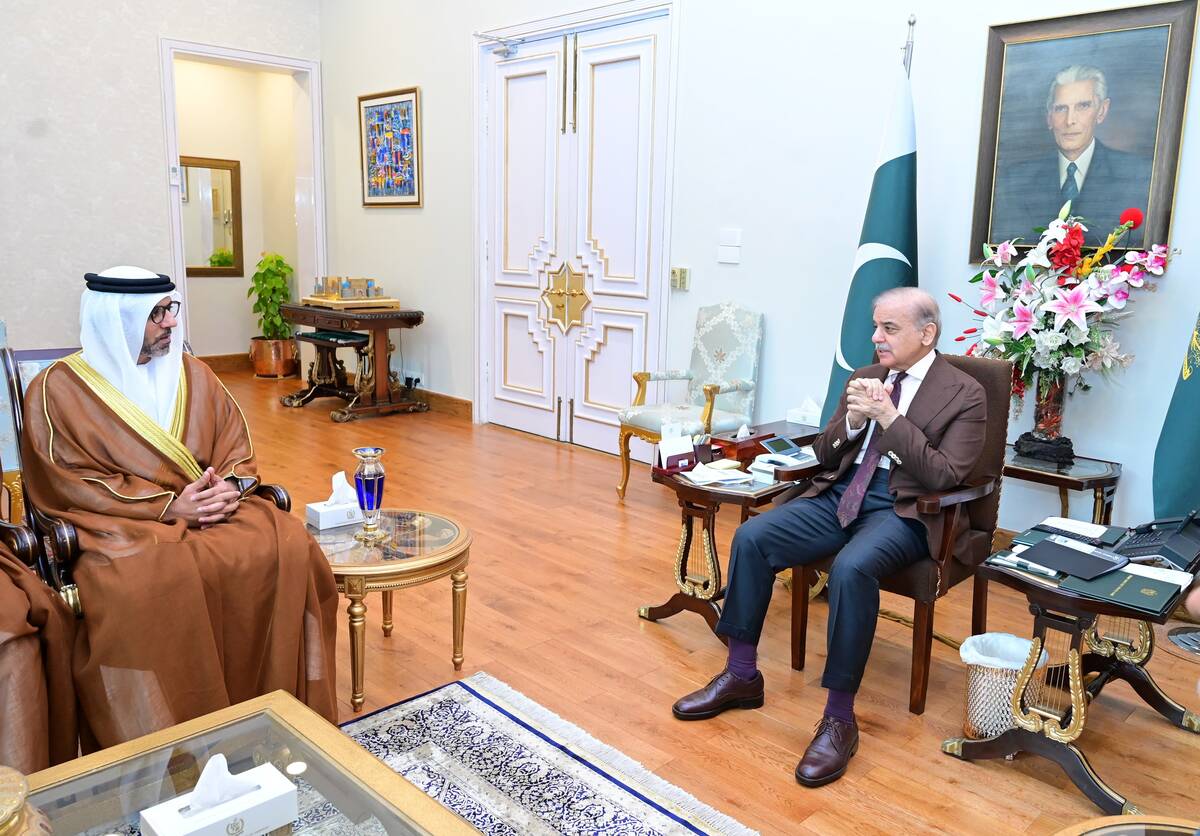


Pakistan Prime Minister Shehbaz Sharif meets UAE Ambassador Hamad Obaid Ibrahim Salem Al-Zaabi at the Prime Minister Office in Islamabad on May 2, 2025. (Photo courtesy: Handout/PMO)

He highlighted how Pakistan has been the biggest victim of militant violence and suffered 90,000 casualties with over $152 billion in economic losses.
Sharif said Pakistan would never take any action that could “imperil regional peace and security,” highlighting that his government was focused on consolidating the hard-earned economic gains of the past fifteen months that were achieved with the support of friendly countries like Saudi Arabia and the UAE.


PM Sharif meets Kuwaiti ambassador, Nasser Abdulrahman Jasser, at the Prime Minister Office in Islamabad on May 2, 2025. (Photo courtesy: Handout/PMO)

The Saudi, UAE and Kuwaiti ambassadors thanked Sharif for sharing Pakistan’s stance and reaffirmed their support for maintaining regional peace and security, the PM Office added.
Since last week, top Pakistani leaders have also reached out to senior officials in China, Iran, Egypt and other countries regarding the recent South Asian developments.
The disputed Himalayan region of Kashmir is split between India and Pakistan and claimed by both in its entirety. The two countries have fought two wars and one limited conflict over the territory.
The United Nations has urged the two arch-rivals to talk to each other, while China, which shares a border with both India and Pakistan, and other countries have called on both sides to “exercise restraint.”


Cross-border clash breaks out between Pakistan and Afghanistan amid rising tensions

Updated 55 min 2 sec ago
Follow

Cross-border clash breaks out between Pakistan and Afghanistan amid rising tensions

  • Border residents say exchange of fire in the Chaman border sector lasted nearly two hours
  • Both governments issue competing statements blaming the other for initiating the violence

ISLAMABAD: Pakistan and Afghanistan witnessed yet another border clash, according to officials in both countries who spoke in the early hours of Saturday, with each side accusing the other of launching “unprovoked” attacks.

Fighting erupted in Pakistan’s southwestern Chaman border sector, with an AFP report saying that residents on the Afghan side of the frontier reported the exchange of fire began at around 10:30 p.m. (1800 GMT) and continued for roughly two hours.

The incident underscored how tensions remain high between the neighbors, who have seen deadly clashes in recent months despite several rounds of negotiations mediated by Qatar and Türkiye that resulted in a tenuous truce in October.

“There has been unprovoked firing by Afghan Taliban elements in the Chaman Sector which is a reckless act that undermines border stability and regional peace,” said a Pakistani security official on condition of anonymity.

“Pakistani troops responded with precision, reinforcing that any violation of our territorial integrity will be met with immediate and decisive action,” he continued.

The official described Pakistan’s response as “proportionate and calibrated” that showed “professionalism even in the face of aggression.”

“The Chaman Sector exchange once again highlights the need for Kabul to rein in undisciplined border elements whose actions are destabilizing Afghanistan’s own international standing,” he added.

Relations between Pakistan and Afghanistan have grown increasingly bitter since the Taliban seized power in Kabul following the withdrawal of international forces in August 2021.

Islamabad accuses the Taliban administration of sheltering anti-Pakistan militant groups such as the Baloch Liberation Army (BLA) and Tehreek-e-Taliban Pakistan (TTP), which have carried out deadly attacks in its western provinces bordering Afghanistan, targeting civilians and security forces.

The Taliban deny the charge, saying Pakistan’s internal security challenges are its own responsibility.

The Pakistani security official said his country remained “committed to peaceful coexistence, but peace cannot be one-sided.”

“Attempts to pressure Pakistan through kinetic adventurism have repeatedly failed and will continue to fail,” he said. “The Chaman response has reaffirmed that message unmistakably.”

He added that Pakistan’s security forces were fully vigilant and that responsibility for any escalation “would solely rest with those who initiated unprovoked fire.”

Mosharraf Zaidi, spokesman for Pakistan’s prime minister, also commented on the clashes in a social media post, saying the Afghan Taliban had “resorted to unprovoked firing along the border.”

“An immediate, befitting and intense response has been given by our armed forces,” he wrote.

Afghan authorities, however, blamed Pakistan for the hostilities.

“Unfortunately, tonight, the Pakistani side started attacking Afghanistan in Kandahar, Spin Boldak district, and the forces of the Islamic Emirate were forced to respond,” Taliban spokesman Zabihullah Mujahid said on X.

Border clashes that began in October have killed dozens of people on both sides.

The latest incident comes amid reports of back-channel discussions between the two governments, although neither has publicly acknowledged such talks.