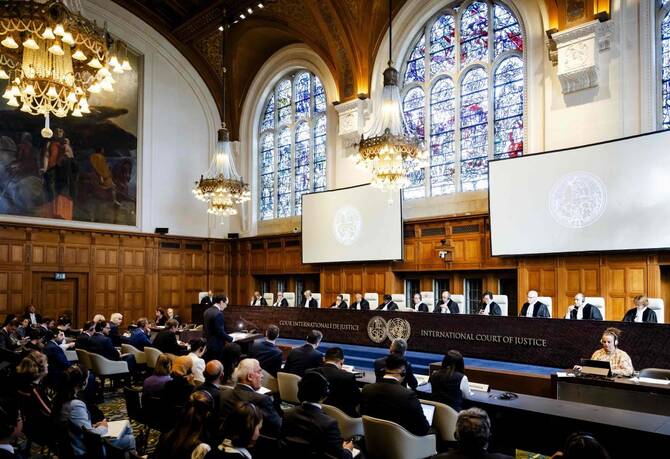
THE HAGUE: The top United Nations court on Friday wraps a week of hearings on what Israel must do to ensure desperately needed humanitarian aid reaches Palestinians in Gaza and the occupied West Bank.
Last year, the UN General Assembly asked the International Court of Justice to give an advisory opinion on Israel’s legal obligations after the country effectively banned the UN agency for Palestinian refugees, the main provider of aid to Gaza, from operating.
Experts say the case could have broader ramifications for the United Nations and its missions worldwide.
The hearings are taking place as the humanitarian aid system in Gaza is nearing collapse and ceasefire efforts remain deadlocked. Israel has blocked the entry of food, fuel, medicine and other humanitarian supplies since March 2. It renewed its bombardment on March 18, breaking a ceasefire, and seized large parts of the territory, saying it aims to push Hamas to release more hostages.
Israel denies deliberately targeting civilians and aid staff as part of its war with Hamas and did not attend the hearing. The country did provide a 38-page written submission for the court to consider.
What is at stake?
The hearings focused on provision of aid to the Palestinians, but the UN court’s 15 judges could use their advisory opinion to give legal guidance on the powers of the world body.
“The court has the opportunity to clarify and address questions about the legal immunities of the United Nations,” Mike Becker, an expert on international human rights law at Trinity College Dublin, told The Associated Press.
Advisory opinions issued by the UN court are described as “nonbinding” as there are no direct penalties attached to ignoring them. However, the treaty that covers the protections that countries must give to United Nations personnel says that disputes should be resolved through an advisory opinion at the ICJ and the opinion “shall be accepted as decisive by the parties.”
“The oddity of this particular process,” Becker said, “is a clear response to any argument that the opinion is nonbinding.”
What has the ICJ been tasked with answering?
The resolution, sponsored by Norway, seeks the ICJ’s guidance on “obligations of Israel … in relation to the presence and activities of the United Nations … to ensure and facilitate the unhindered provision of urgently needed supplies essential to the survival of the Palestinian civilian population.” The United States, Israel’s closest ally, voted against it.
Israel’s ban on the agency, known as UNRWA, which provides aid to Gaza, came into effect in January. The organization has faced increased criticism from Prime Minister Benjamin Netanyahu and his far-right allies, who claim the group is deeply infiltrated by Hamas. UNRWA rejects that claim.
“We cannot let states pick and choose where the UN is going to do its work. This advisory opinion is a very important opportunity to reinforce that,” Becker said.
Do these proceedings matter for countries other than Israel?
Whatever the judges decide will have an impact beyond the current situation in Gaza, according to Juliette McIntyre, an expert on international law at the University of South Australia. “Are these immunities absolute or is there wiggle room? This is useful for where United Nations personnel are working in other places,” McIntire told AP.
An authoritative answer from the World Court can have influence beyond judicial proceedings as well. “Every time a norm is breached, the norm gets weaker. The advisory opinion in this case could push the norm back,” said McIntyre.
In separate proceedings last year, the court issued an unprecedented and sweeping condemnation of Israel’s rule over the occupied Palestinian territories, finding Israel’s presence unlawful and calling for it to end. The ICJ said Israel had no right to sovereignty in the territories, was violating international laws against acquiring territory by force and was impeding Palestinians’ right to self-determination.
According to McIntyre, the arguments presented this week reflect the opinion handed down just nine months ago. “Now the starting premise is that Israel is illegally occupying all of Palestine,” McIntire said.
What did the Palestinians and Israelis say?
On Monday, the Palestinian delegation accused Israel of breaching international law in the occupied territories and applauded the move to bring more proceedings to the court. “Our journey with the international institutions, be it Security Council, the General Assembly or the ICJ, is we are building things block on top of another block while we are marching toward the accomplishment of the inalienable rights of the Palestinian people, including our right to self-determination, statehood, and the right of the refugees,” Palestinian UN envoy Riyad Mansour told reporters.
Israel has denied it is in violation of international law and said the proceedings are biased. Israeli Foreign Minister Gideon Saar hit back at the case during a news conference in Jerusalem on Monday. “I accuse UNRWA, I accuse the UN, I accuse the secretary-general and I accuse all those that weaponized international law and its institutions in order to deprive the most attacked country in the world, Israel, of its most basic right to defend itself,” he said.
The court is expected to take months to deliver its opinion.


![]()


Top UN court wraps a week of hearings on humanitarian aid to Gaza
Short Url
https://arab.news/njgza
Top UN court wraps a week of hearings on humanitarian aid to Gaza
- The proceedings are taking place as the humanitarian aid system in Gaza is nearing collapse and ceasefire efforts remain deadlocked
- Israel has blocked the entry of food, fuel, medicine and other humanitarian supplies since March 2


Syria’s leader set to visit Berlin with deportations in focus
BERLIN: Syrian President Ahmed Al-Sharaa is expected in Berlin on Tuesday for talks, as German officials seek to step up deportations of Syrians, despite unease about continued instability in their homeland.
Sharaa is scheduled to meet his counterpart Frank-Walter Steinmeier, the German president’s office said.
Chancellor Friedrich Merz’s office has yet to announce whether he would also hold talks with Sharaa during the visit.
Since ousting Syria’s longtime leader Bashar Assad in late 2024, Sharaa has made frequent overseas trips as the former Islamist rebel chief undergoes a rapid reinvention.
He has made official visits to the United States and France, and a series of international sanctions on Syria have been lifted.
The focus of next week’s visit for the German government will be on stepping up repatriations of Syrians, a priority for Merz’s conservative-led coalition since Assad was toppled.
Roughly one million Syrians fled to Germany in recent years, many of them arriving in 2015-16 to escape the civil war.
In November Merz, who fears being outflanked by the far-right AfD party on immigration, insisted there was “no longer any reason” for Syrians who fled the war to seek asylum in Germany.
“For those who refuse to return to their country, we can of course expel them,” he said.
- ‘Dramatic situation’ -
In December, Germany carried out its first deportation of a Syrian since the civil war erupted in 2011, flying a man convicted of crimes to Damascus.
But rights groups have criticized such efforts, citing continued instability in Syria and evidence of rights abuses.
Violence between the government and minority groups has repeatedly flared in multi-confessional Syria since Sharaa came to power, including recent clashes between the army and Kurdish forces.
Several NGOs, including those representing the Kurdish and Alawite Syrian communities in Germany, have urged Berlin to axe Sharaa’s planned visit, labelling it “totally unacceptable.”
“The situation in Syria is dramatic. Civilians are being persecuted solely on the basis of their ethnic or religious affiliation,” they said in a joint statement.
“It is incomprehensible to us and legally and morally unacceptable that the German government knowingly intends to receive a person suspected of being responsible for these acts at the chancellery.”
The Kurdish Community of Germany, among the signatories of that statement, also filed a complaint with German prosecutors in November, accusing Sharaa of war crimes, genocide and crimes against humanity.
There have also been voices urging caution within government.
On a trip to Damascus in October, Foreign Minister Johann Wadephul said that the potential for Syrians to return was “very limited” since the war had destroyed much of the country’s infrastructure.
But his comments triggered a backlash from his own conservative Christian Democratic Union party.
Sharaa is scheduled to meet his counterpart Frank-Walter Steinmeier, the German president’s office said.
Chancellor Friedrich Merz’s office has yet to announce whether he would also hold talks with Sharaa during the visit.
Since ousting Syria’s longtime leader Bashar Assad in late 2024, Sharaa has made frequent overseas trips as the former Islamist rebel chief undergoes a rapid reinvention.
He has made official visits to the United States and France, and a series of international sanctions on Syria have been lifted.
The focus of next week’s visit for the German government will be on stepping up repatriations of Syrians, a priority for Merz’s conservative-led coalition since Assad was toppled.
Roughly one million Syrians fled to Germany in recent years, many of them arriving in 2015-16 to escape the civil war.
In November Merz, who fears being outflanked by the far-right AfD party on immigration, insisted there was “no longer any reason” for Syrians who fled the war to seek asylum in Germany.
“For those who refuse to return to their country, we can of course expel them,” he said.
- ‘Dramatic situation’ -
In December, Germany carried out its first deportation of a Syrian since the civil war erupted in 2011, flying a man convicted of crimes to Damascus.
But rights groups have criticized such efforts, citing continued instability in Syria and evidence of rights abuses.
Violence between the government and minority groups has repeatedly flared in multi-confessional Syria since Sharaa came to power, including recent clashes between the army and Kurdish forces.
Several NGOs, including those representing the Kurdish and Alawite Syrian communities in Germany, have urged Berlin to axe Sharaa’s planned visit, labelling it “totally unacceptable.”
“The situation in Syria is dramatic. Civilians are being persecuted solely on the basis of their ethnic or religious affiliation,” they said in a joint statement.
“It is incomprehensible to us and legally and morally unacceptable that the German government knowingly intends to receive a person suspected of being responsible for these acts at the chancellery.”
The Kurdish Community of Germany, among the signatories of that statement, also filed a complaint with German prosecutors in November, accusing Sharaa of war crimes, genocide and crimes against humanity.
There have also been voices urging caution within government.
On a trip to Damascus in October, Foreign Minister Johann Wadephul said that the potential for Syrians to return was “very limited” since the war had destroyed much of the country’s infrastructure.
But his comments triggered a backlash from his own conservative Christian Democratic Union party.
Latest updates


© 2026 SAUDI RESEARCH & PUBLISHING COMPANY, All Rights Reserved And subject to Terms of Use Agreement.