

Prince Harry ‘devastated’ after losing legal fight with UK government over police protection

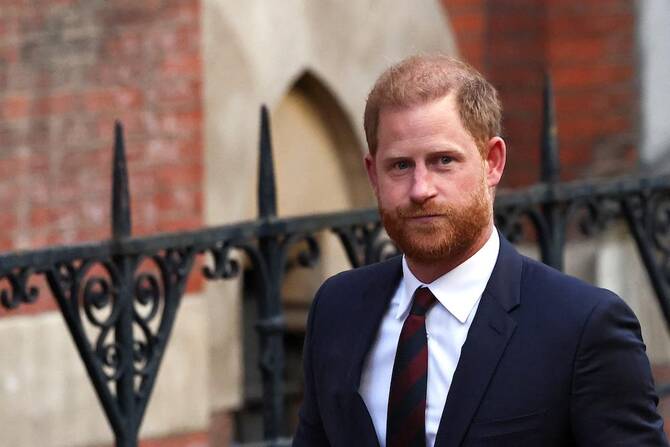
Prince Harry’s fraught ties with his family have worsened after various public allegations he and Meghan made against the royals. (AFP)
Short Url
Updated 02 May 2025
Follow

Prince Harry ‘devastated’ after losing legal fight with UK government over police protection

  • Prince Harry says security concerns have hampered his ability to visit the UK and bring his family with him
  • Harry’s fraught ties with his family have worsened after various public allegations he and Meghan made against the royals

LONDON: Prince Harry said he was “devastated” after he lost his legal challenge on Friday to Britain changing his security arrangements after he stepped down from royal duties, telling the BBC he could not safely bring his family to Britain.

Harry, King Charles’ younger son who has moved to the United States with his wife Meghan, had sought to overturn a decision by the Home Office, the ministry responsible for policing.

A specialist body decided in February 2020 that Harry would not automatically receive personal police protection while in Britain, which London’s High Court last year ruled was lawful.

On Friday, that decision was upheld by three Court of Appeal judges who said that, while Harry understandably felt aggrieved, that did not amount to an error of law.

“Obviously, pretty gutted about the decision,” Harry, who now lives in California with Meghan and their two children, told the BBC.

“We thought it was going to go our way, but it certainly has proven that there was no way to win this through the courts.”

He added: “My status hasn’t changed — it can’t change. I am who I am, I am part of what I am part of, I can’t escape that.”

Judge Geoffrey Vos said in the court’s ruling that Harry’s lawyer had made “powerful and moving arguments” about the impact of the security change.

“It was plain that the Duke of Sussex felt badly treated by the system, but ... I could not say that the Duke’s sense of grievance translated into a legal argument for the challenge to RAVEC’s decision,” he told the court.

Harry, 40, attended two days of hearings in April, when his lawyer told the court that he had been singled out for different, unjustified and inferior treatment.

LIFE AT STAKE
His lawyer Shaheed Fatima said Harry’s “life was stake,” citing that Al-Qaeda had recently called for him to be murdered, and he and Meghan had been involved in “a dangerous car pursuit with paparazzi in New York City” in 2023.

However, the government’s legal team said the bespoke arrangement for the prince had positive advantages from a security assessment point of view.

Harry, along with other senior royals, had received full publicly-funded security protection provided by the state before his high-profile exit from official royal life in March 2020.

The Executive Committee for the Protection of Royalty and Public Figures, known as RAVEC, then decided Harry would no longer receive the same level of protection, a decision Vos said was “an understandable and perhaps predictable reaction” to him stepping down from royal duties and moving abroad.

Harry, who has been involved in a number of court cases with tabloid papers, told the Daily Telegraph newspaper after the April hearings that this case “mattered the most” and evidence heard in secret had confirmed his “worst fears.”

The prince has often spoken out about his concerns, referring back to the death of his mother, Princess Diana, who was killed when her chauffeur-driven car crashed as it sped away from chasing paparazzi in Paris in 1997.

Next week, Harry’s legal team will be back at the High Court as part of the lawsuit he has brought with singer Elton John and other against Associated Newspapers, publisher of the Daily Mail and MailOnline, over alleged widespread unlawful activities.

In January, he was paid substantial damages by Rupert Murdoch’s British newspaper group after it settled a claim he had brought against its titles and admitted it had intruded into his private life. 

Israel is risking global security, warns Somali Information Minister

Updated 5 min 37 sec ago
Follow

Israel is risking global security, warns Somali Information Minister

  • Tel Aviv’s actions boost terror groups, Daud Aweis Jama tells Arab News in exclusive interview
  • He accuses Tel Aviv of wanting to relocate Palestinians from Gaza to region

RIYADH: Israel’s recognition of Somaliland and its presence in the region risks inflaming the situation there, allowing terrorist groups to undermine regional security and stability, according to Somali Information, Culture and Tourism Minister Daud Aweis Jama.

In a special interview with Arab News, Jama insisted that Israel’s unprecedented Dec. 26 move to recognize Somaliland as a sovereign state represents a major setback for Mogadishu’s fight against terrorist organizations like Al-Shabab and Daesh.

“The presence of Israel will be used by the terrorist groups to expand their operations in the region. (They will) have a pretext to spread their ideologies in the region,” he said.

Somaliland's President Abdirahman Abdullahi Mohamed speaking during a press conference with Israel's Foreign Minister Gideon Saar at the Presidential Palace in Hargeisa. (Somaliland Presidential Office/AFP)

“That is another factor that is also risking global security and regional stability, because we have been in the last stage of overcoming the challenges of the terrorist groups Al-Shabab and ISIS,” he added, using another term for Daesh.

Jama added: “We have been putting all our resources and all our time into making sure that we finalize the final stages of the fight against Al-Shabab. So, if something else interrupts us, that means that we are not going to focus fully on the operations against Al-Shabab. And that means we are giving more opportunities to Al-Shabab or other organizations.”

The consequences of this hit to Somalia’s ability to fight terror will not be restricted to the country’s borders, according to Jama, but will spread across the region and beyond.

“This might invite other, external terrorist groups to the region, because they will take advantage of this crisis and will make sure that they take over all the areas that have been defeated before,” the minister said.

Mogadishu residents wave Somali and Palestinian flags at a rally denouncing Israel’’s recognition of Somaliland. (AFP)

“We believe this has come at a time that is going to affect our security as a Somali government, the security of the Horn of Africa, the security of the Gulf of Aden, the security of the Red Sea, the security of the Middle East and global stability. This is a very important location that holds the trade of the world.”

The minister underlined that Israel’s recognition and larger presence in the region are leading to more challenges, “putting more fuel on the ongoing challenges that exist in the region, especially in Somalia.” He added: “And at this time, it is not only limited to Somalia, but it’s going to be a challenge that is going to spread like a fire all over the region and all over the world.”

Jama told Arab News that Israel has other strategic motives for its recognition of Somaliland — including the forced resettlement of Palestinians from Gaza.

A woman walks past stalls selling household items at the Waheen Market in Hargeisa. (AFP)

“According to reliable sources that our intelligence gathered, one of the conditions that Israel put forward (for recognizing Somaliland) was to have a place that they can settle the people from Gaza,” he said.

“We find that it is a violation also of the people of Palestine, because we believe that the people of Palestine have the right to self-determination. The two-state solution that has been the call of the international community has to be adhered to and implemented.”

Israel’s coalition government, the most right-wing ‌and religiously conservative in its history, includes far-right politicians who advocate the ‍annexation of both Gaza and the West ‍Bank and encouraging Palestinians to leave their homeland.

A man holds a flag of Somaliland in front of the Hargeisa War Memorial monument. (AFP)

Somalia’s UN Ambassador Abukar Dahir Osman said ‍Security Council members Algeria, Guyana, Sierra Leone and Somalia “unequivocally reject any steps aimed at advancing this objective, including any attempt by Israel to relocate the Palestinian population from Gaza to the northwestern region of Somalia.”

Israel last month became the first country to recognize Somaliland as an independent nation. In the three-plus decades since its self-declaration of independence in 1991, no state had recognized the northwestern territory as being separate from Somalia.

Mogadishu immediately rejected the Israeli move, alongside countries all over the world.

Soldiers of the Somalia National Army (SNA) secure a village that ws allegedly destroyed by retreating insurgents during a visit by senior officers at Awdheegle. (AFP/File)

Saudi Arabia affirmed its rejection of any attempts to impose parallel entities that conflict with the unity of Somalia. It also affirmed its support for the legitimate institutions of the Somali state and its keenness to preserve the stability of Somalia and its people.

A group of foreign ministers from Arab and Islamic countries, alongside the Organization of Islamic Cooperation, also firmly rejected Israel’s announcement. In a joint statement, the ministers warned that the move carries “serious repercussions for peace and security in the Horn of Africa and the Red Sea region” and undermines international peace and security.

The 22-member Arab League rejected “any measures arising from this illegitimate recognition aimed at facilitating forced displacement of the Palestinian people or exploiting northern Somali ports to establish military bases,” the organization’s UN Ambassador Maged Abdelfattah Abdelaziz told the UN Security Council.

In the most recent development in Israel-Somaliland relations, less than two weeks after Tel Aviv’s recognition, Israeli Foreign Minister Gideon Saar visited the region on Tuesday to publicly formalize diplomatic relations.

“It was a blatant violation of Somalia’s sovereignty that Israel recognized a region within the Somali Federal Republic as an independent state,” Jama underlined. “That was a total violation of international laws. It was a violation of the territorial integrity and sovereignty of Somalia.

Mogadishu residents attend a rally denouncing Israel’’s recognition of Somaliland. (AFP)

“From the beginning, our path was to follow diplomatic efforts. And we kind of started with a successful UN Security Council meeting that supported Somalia’s territorial integrity and sovereignty. (This was) followed by other international actors like the Arab League, the Organization of Islamic Cooperation, the African Union and regional bodies like the East African Community and IGAD.

“Also, the Peace and Security Council of the African Union has reiterated the importance of supporting Somali sovereignty and territorial integrity.”