Bangladesh to tour Pakistan for five-match T20 series in May

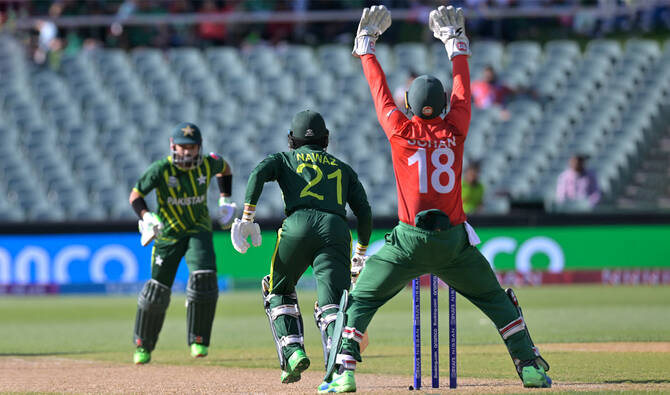
Bangladesh's wicketkeeper Nurul Hasan (R) shouts an Leg-Before-Wicket (LBW) appeal against Pakistan's Mohammad Nawaz (C) during the ICC men's Twenty20 World Cup 2022 cricket match between Pakistan and Bangladesh at Adelaide Oval in Adelaide on November 6, 2022. (AFP/File)
Short Url
Updated 30 April 2025
Follow

Bangladesh to tour Pakistan for five-match T20 series in May

  • Bangladesh last toured Pakistan in August 2024 and achieved a historic 2-0 Test series victory
  • The upcoming five-match series in May is scheduled to prepare for T20 World Cup next year

ISLAMABAD: Bangladesh will tour Pakistan in May for a five-match Twenty20 International series, the Pakistan Cricket Board (PCB) said on Wednesday, confirming the shift from the originally planned three One Day Internationals and three T20s to an all-T20 format ahead of next year’s T20 World Cup.​

The announcement of the series, scheduled from May 25 to June 3, comes as Pakistan hosts the Pakistan Super League (PSL) matches.

Bangladesh last toured Pakistan in August 2024 for a Test series, where they achieved a historic 2-0 whitewash, marking their first Test win on Pakistani soil.

“Bangladesh team will arrive on 21 May and will undergo training sessions at the Iqbal Stadium [Faisalabad] from 22 to 24 May,” the PCB said in a statement.​

The upcoming T20 series will be played in Faisalabad and Lahore.

Iqbal Stadium, which last hosted an international match in 2008, will stage the first two T20Is on May 25 and 27.

The remaining three matches will be held at Lahore’s Qaddafi Stadium on May 30, June 1 and June 3. All matches are scheduled to begin at 8:00 PM local time.​

The series is part of the ICC’s Future Tours Program (FTP). The decision to replace the ODIs with additional T20Is was made mutually by both boards to better prepare for the upcoming T20 World Cup, said the PCB.


Pakistan, Libya discuss defense and counterterrorism cooperation during army chief’s visit

Updated 4 sec ago
Follow

Pakistan, Libya discuss defense and counterterrorism cooperation during army chief’s visit

  • Military says Field Marshal Asim Munir met Libyan Commander-in-Chief Khalifa Belqasim Haftar during the visit
  • Unlike several other states in the region, bilateral defense collaboration remains limited between the two countries

ISLAMABAD: Pakistan and Libya discussed enhancing defense cooperation, with a focus on training and counterterrorism partnership, during a visit by Pakistan’s Chief of Army Staff Field Marshal Asim Munir to the North African country, the military said in a statement on Thursday.

Pakistan and Libya established diplomatic relations in 1951, with ties particularly close during the era of former Libyan leader Muammar Qaddafi, when Tripoli positioned itself as a supporter of Muslim causes and developing countries, including

Pakistan. Relations have been more restrained since Libya’s political upheaval in 2011.

According to the military’s media wing, Inter-Services Public Relations (ISPR), Munir met Field Marshal Khalifa Belqasim Haftar, commander-in-chief of the Libyan Arab Armed Forces, and Lt. Gen. Saddam Khalifa Haftar, deputy commander-in-chief, during the visit.

“Both sides underscored the importance of collaboration in training, capacity building and counterterrorism domains,” ISPR said in a statement.

“Field Marshal Syed Asim Munir reaffirmed Pakistan’s commitment to strengthening defense ties with Libya, based on shared interests,” it added.

ISPR said Munir was accorded a guard of honor by a contingent of the Libyan Armed Forces on arrival and that the talks also covered matters of mutual interest, regional security dynamics and avenues for expanding military-to-military cooperation.

The Libyan military leadership appreciated the professionalism of the Pakistan armed forces and expressed a desire to expand defense cooperation between the two countries, the statement said.

Unlike Pakistan’s relations with some Gulf and Middle Eastern states, there is currently no significant defense or military cooperation between Islamabad and Tripoli, with engagement remaining limited amid Libya’s prolonged political instability.