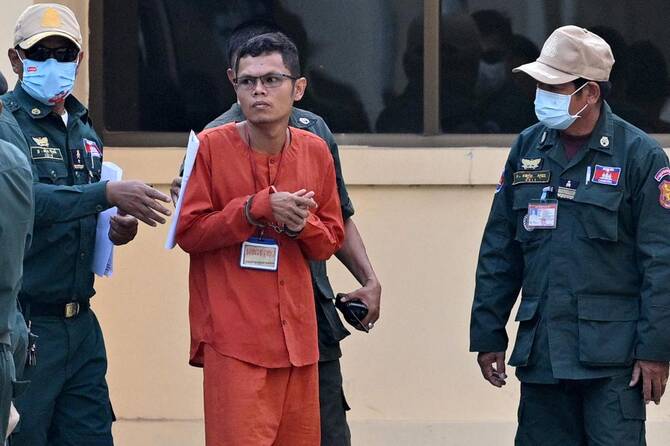
PHNOM PENH: Cambodia’s top court on Wednesday denied bail to five environmentalists jailed for their activism, a family member said, in a case widely condemned by the UN and human rights campaigners.
The activists from Mother Nature, one of Cambodia’s few environmental advocacy groups, denied charges of plotting against the state, which they said were politically motivated.
The five activists were among 10 environmentalists sentenced to between six and eight years in jail last year.
Path Raksmey, 34, wife of activist Thun Ratha, said that she was disappointed with Wednesday’s ruling by the Supreme Court.
“I am very regretful that the court does not allow bail for them. They are the ones who protect the environment but they are locked in jail while people who have destroyed natural resources live happily,” said Path Raksmey.
“It is unjust for the five,” she said, adding that her husband remains “strong.”
The five activists have been jailed in different prisons after their sentencing in July, but have launched appeals.
The United Nations Human Rights Office said last year it was “gravely concerned by the conviction and harsh sentencing.”
The tussle over protecting or exploiting Cambodia’s natural resources has long been a contentious issue in the Southeast Asian nation, with environmentalists threatened, arrested and even killed in the past decade.
Cambodian journalist Chhoeung Chheung died in December after he was shot while investigating illegal logging in the country’s northwest.
Unchecked illicit logging has contributed to a sharp drop in Cambodia’s forest cover over the years, according to activists.
From 2002 to 2023, a third of Cambodia’s humid primary forests – some of the world’s most biodiverse and a key carbon sink – were lost, according to monitoring site Global Forest Watch.
Cambodia’s government has approved plans for a cement factory deep inside a protected wildlife sanctuary, according to an order seen by AFP on Tuesday.

Cambodian court refuses bail for jailed environmental activists
Short Url
https://arab.news/n67qf
Cambodian court refuses bail for jailed environmental activists
- The activists from Mother Nature, one of Cambodia’s few environmental advocacy groups, denied charges of plotting against the state
- The five activists have been jailed in different prisons after their sentencing in July, but have launched appeals
France’s screen siren Brigitte Bardot dies at 91
- French PM Emmanuel Macron hails the actor as a legend who 'embodied a life of freedom'
- Film star also courted controversy, embracing far-right views in her later years
PARIS: French film sensation Brigitte Bardot, a symbol of sexual liberation in the 1950s and 1960s who reinvented herself as an animal rights defender and embraced far-right views, died on Sunday aged 91, her foundation said.
She died in her Saint-Tropez home, La Madrague, on the French Riviera.
“The Brigitte Bardot Foundation announces with immense sadness the death of its founder and president, Madame Brigitte Bardot, a world-renowned actor and singer, who chose to abandon her prestigious career to dedicate her life and energy to animal welfare and her foundation,” it said in a statement sent to AFP.
The cause of death was not given. But Bardot was briefly hospitalized in October for what her office called a “minor” procedure. Bardot at the time had lambasted “idiot” Internet users for speculation that she had died.
Tributes were immediately paid to the star who was known as “BB” in her home country, with President Emmanuel Macron calling her a “legend” of the 20th century.
Born on September 28, 1934 in Paris, Bardot was raised in a well-off traditional Catholic household. Married four times, she had one child, Nicolas-Jacques Charrier, with her second husband, actor Jacques Charrier.
Bardot became a global star after appearing in “And God created Woman” in 1956, and went on to appear in about 50 more movies before giving up acting in 1973.
She turned her back on celebrity to look after abandoned animals, saying she was “sick of being beautiful every day.”
Far-right leanings
“With her films, her voice, her dazzling glory, her initials (BB), her sorrows, her generous passion for animals, and her face that became Marianne, Brigitte Bardot embodied a life of freedom,” Macron wrote on X, referring to the Marianne image used as the female symbol of the French republic.
His tribute, though, made no reference of Bardot’s alignment with far-right views in her post-cinema years, which alienated many of her fans.
Bardot was convicted five times for hate speech, mostly about Muslims, but also the inhabitants of the French island of Reunion whom she described as “savages.”
A supporter of far-right politician Marine Le Pen, Bardot declared herself “against the Islamization of France” in a 2003 book, citing “our ancestors, our grandfathers, our fathers have for centuries given their lives to push out successive invaders.”
The head of Le Pen’s far-right National Rally party, Jordan Bardella, was among the first to pay homage.
“Today the French people have lost the Marianne they so loved,” he wrote on X, calling her an “ardent patriot.”
Le Pen, who has been barred from public office pending an appeal trial in January, also paid tribute to Bardot as “incredibly French: free, untamable, whole.”
In her final book, Mon BBcedaire (“My BB Alphabet“), published weeks before her death, Bardot fired barbs at what she described as a “dull, sad, submissive” France and at her home town of Saint-Tropez, now packed with the wealthy tourists she helped attract.
The book also contained derogatory remarks about gay and transgender people.
Saint-Tropez retreat
After retiring from cinema, Bardot withdrew to her home in the Riviera resort of Saint-Tropez where she devoted herself to fighting for animals.
Her calling apparently came when she encountered a goat on the set of her final film, “The Edifying and Joyous Story of Colinot.” To save it from being killed, she bought the animal and kept it in her hotel room.
Bardot went on to found the Brigitte Bardot Foundation in 1986, which now has 70,000 donors and around 300 employees, according to its website.
“I’m very proud of the first chapter of my life,” she told AFP in a 2024 interview ahead of her 90th birthday.
“It gave me fame, and that fame allows me to protect animals — the only cause that truly matters to me.”
She added that she lived in “silent solitude” in her home “La Madrague,” surrounded by nature and content to be “fleeing humanity.”
On the subject of death, she warned that she wanted to avoid the presence of “a crowd of idiots” at her funeral and wished for a simple wooden cross above her grave, in her garden — the same as for her animals.
She died in her Saint-Tropez home, La Madrague, on the French Riviera.
“The Brigitte Bardot Foundation announces with immense sadness the death of its founder and president, Madame Brigitte Bardot, a world-renowned actor and singer, who chose to abandon her prestigious career to dedicate her life and energy to animal welfare and her foundation,” it said in a statement sent to AFP.
The cause of death was not given. But Bardot was briefly hospitalized in October for what her office called a “minor” procedure. Bardot at the time had lambasted “idiot” Internet users for speculation that she had died.
Tributes were immediately paid to the star who was known as “BB” in her home country, with President Emmanuel Macron calling her a “legend” of the 20th century.
Born on September 28, 1934 in Paris, Bardot was raised in a well-off traditional Catholic household. Married four times, she had one child, Nicolas-Jacques Charrier, with her second husband, actor Jacques Charrier.
Bardot became a global star after appearing in “And God created Woman” in 1956, and went on to appear in about 50 more movies before giving up acting in 1973.
She turned her back on celebrity to look after abandoned animals, saying she was “sick of being beautiful every day.”
Far-right leanings
“With her films, her voice, her dazzling glory, her initials (BB), her sorrows, her generous passion for animals, and her face that became Marianne, Brigitte Bardot embodied a life of freedom,” Macron wrote on X, referring to the Marianne image used as the female symbol of the French republic.
His tribute, though, made no reference of Bardot’s alignment with far-right views in her post-cinema years, which alienated many of her fans.
Bardot was convicted five times for hate speech, mostly about Muslims, but also the inhabitants of the French island of Reunion whom she described as “savages.”
A supporter of far-right politician Marine Le Pen, Bardot declared herself “against the Islamization of France” in a 2003 book, citing “our ancestors, our grandfathers, our fathers have for centuries given their lives to push out successive invaders.”
The head of Le Pen’s far-right National Rally party, Jordan Bardella, was among the first to pay homage.
“Today the French people have lost the Marianne they so loved,” he wrote on X, calling her an “ardent patriot.”
Le Pen, who has been barred from public office pending an appeal trial in January, also paid tribute to Bardot as “incredibly French: free, untamable, whole.”
In her final book, Mon BBcedaire (“My BB Alphabet“), published weeks before her death, Bardot fired barbs at what she described as a “dull, sad, submissive” France and at her home town of Saint-Tropez, now packed with the wealthy tourists she helped attract.
The book also contained derogatory remarks about gay and transgender people.
Saint-Tropez retreat
After retiring from cinema, Bardot withdrew to her home in the Riviera resort of Saint-Tropez where she devoted herself to fighting for animals.
Her calling apparently came when she encountered a goat on the set of her final film, “The Edifying and Joyous Story of Colinot.” To save it from being killed, she bought the animal and kept it in her hotel room.
Bardot went on to found the Brigitte Bardot Foundation in 1986, which now has 70,000 donors and around 300 employees, according to its website.
“I’m very proud of the first chapter of my life,” she told AFP in a 2024 interview ahead of her 90th birthday.
“It gave me fame, and that fame allows me to protect animals — the only cause that truly matters to me.”
She added that she lived in “silent solitude” in her home “La Madrague,” surrounded by nature and content to be “fleeing humanity.”
On the subject of death, she warned that she wanted to avoid the presence of “a crowd of idiots” at her funeral and wished for a simple wooden cross above her grave, in her garden — the same as for her animals.
© 2025 SAUDI RESEARCH & PUBLISHING COMPANY, All Rights Reserved And subject to Terms of Use Agreement.


