

Pakistan says India planning military action within ‘24 to 36 hours’ as US calls for restraint

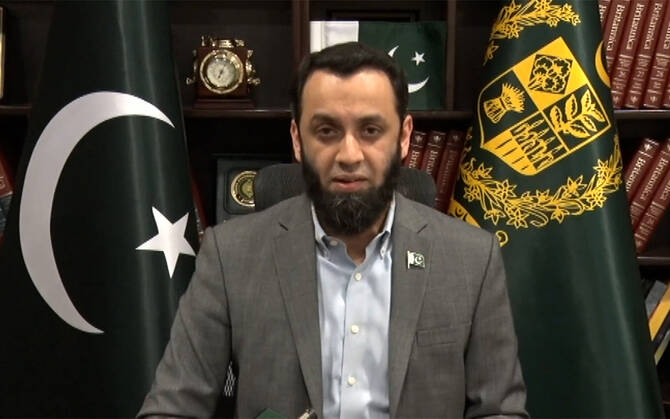
Pakistan Federal Minister for Information Ataullah Tarrar speaks to public in Islamabad, Pakistan, on April 29, 2025. (PTV News/Screengrab)
Short Url
Updated 30 April 2025
Follow

Pakistan says India planning military action within ‘24 to 36 hours’ as US calls for restraint

  • Ataullah Tarrar warns ‘onus of escalatory spiral and its ensuing consequences shall squarely lie with India’
  • US says Secretary of State Marco Rubio will contact Pakistan and India ‘as early as today or tomorrow’

ISLAMABAD: Federal Minister for Information Ataullah Tarrar said on Wednesday Islamabad had “credible intelligence” India was planning to launch a military action against Pakistan within the next “24 to 36 hours,” as the United States urged both nuclear-armed neighbors to resolve their differences peacefully.

Relations between the two South Asian nations have deteriorated sharply following an attack on April 22 in Pahalgam, a tourist hotspot in Indian-administered Kashmir, which killed 26 people.

New Delhi blamed Islamabad for backing the assault, but Pakistan denied any involvement and called for an independent investigation while warning India against any escalation.

Tarrar issued the warning in a video statement, hours after Indian Prime Minister Narendra Modi met with his top military commanders alongside the country’s defense minister and national security adviser, reportedly granting them “operational freedom” to respond to last week’s attack.

“Pakistan has credible intelligence that India intends carrying out military action against Pakistan in the next 24 to 36 hours on the pretext of baseless and concocted allegations of involvement in the Pahalgam incident,” he said.

“Indian self-assumed hubristic role of judge, jury, and executioner in the region is reckless and vehemently rejected,” he added.

Tarrar reiterated that Pakistan had itself suffered from militancy and “always condemned terrorism in all its forms and manifestations anywhere in the world.”

He said Islamabad had proposed a credible and transparent probe by a neutral commission of experts to ascertain facts around the Pahalgam attack, but “India had decided to tread the path of confrontation.”

“Evasion of credible investigation is in itself sufficient evidence exposing India’s real motives, consciously making strategic decisions hostage to public sentiments purposefully trumped up for securing political objectives is unfortunate and deplorable,” he said.

“Pakistan reiterates that any such military adventurism by India would be responded to assuredly and decisively,” he added. “The international community must remain alive to the reality that the onus of escalatory spiral and its ensuing consequences shall squarely lie with India.”

Meanwhile, the United States said it was closely monitoring the situation and had reached out to both governments.

“We’re also monitoring the developments across the board in that region, and we ... are in touch with the governments of India and Pakistan, not just at the foreign minister level, certainly, but at multiple levels,” State Department spokesperson Tammy Bruce said during a media briefing.

“The Secretary [of State Marco Rubio] expects to speak with the foreign ministers of Pakistan and India as early as today or tomorrow,” she added. “He is encouraging other national leaders, other foreign ministers, to also reach out to the countries on this issue.”

On Friday, US President Donald Trump had sought to downplay the tensions, saying tensions over Kashmir had lingered for a significantly long period and the matter would be “figured out, one way or another.”


Pakistan, UK sign £35 million Green Compact to strengthen climate resilience

Updated 21 December 2025
Follow

Pakistan, UK sign £35 million Green Compact to strengthen climate resilience

  • Pakistan ranks among nations most vulnerable to climate change and has seen erratic changes in its weather patterns
  • UK will help Pakistan mobilize climate finance, strengthen regulatory frameworks and develop bankable climate projects

ISLAMABAD: Pakistan and the United Kingdom (UK) have formalized a comprehensive climate partnership with the launch of a Green Compact that aims to enhance climate resilience, accelerate clean energy transition and scale up nature-based solutions, including mangrove conservation, Pakistani state media reported on Sunday.

The agreement, signed in Islamabad by Federal Minister for Climate Change and Environmental Coordination Dr. Musadik Malik and UK Minister for International Development Jennifer Chapman, unlocks £35 million in targeted support for green development and long-term climate action, according to Radio Pakistan broadcaster.

Pakistan ranks among nations most vulnerable to climate change and has seen erratic changes in its weather patterns that have led to frequent heatwaves, untimely rains, storms, cyclones, floods and droughts in recent years. In 2022, monsoon floods killed over 1,700 people, displaced another 33 million and caused over $30 billion losses, while another 1,037 people were killed in floods this year.

Mohammad Saleem Shaikh, a spokesperson for Pakistan’s Ministry of Climate Change, described the compact as a “decisive move toward action-oriented climate cooperation,” noting that its implementation over the next decade will be critical for Pakistan which regularly faces floods, heatwaves and water stress.

“The Compact is structured around five core pillars: climate finance and investment, clean energy transition, nature-based solutions, innovation and youth empowerment, and adaptation and resilience,” the report read.

“Under the agreement, the UK will work with Pakistan to mobilize public and private climate finance, strengthen regulatory frameworks for green investment, and develop bankable climate projects.”

Clean energy forms a central component of Pakistan’s transition, with Islamabad planning to expand solar and wind generation to reduce fossil fuel dependence, improve energy security and stabilize power costs, according to Shaikh.

“Renewable energy is now economically competitive, making the transition both environmentally and financially viable,” he was quoted as saying.

“Nature-based solutions, particularly large-scale mangrove restoration, will protect coastal communities from storm surges and erosion while enhancing biodiversity and carbon sequestration.”

Under the Compact, technical support, mentoring and access to investors will be provided to climate-smart startups and young innovators, reflecting Pakistan’s recognition of youth-led initiatives as central to future climate solutions.

On the occasion, Chapman, on her first official visit to Pakistan, underscored the urgency of climate action, highlighting the UK’s support for renewable energy, mangrove and ecosystem restoration, early-warning systems, climate budgeting and international investment flows into Pakistan.

Shaikh described the Green Compact as “a strategic turning point” in Pakistan–UK relations on climate change, saying its effective implementation is essential for Pakistan to meet its national climate targets.