

Harvard pledges reforms following internal reports on antisemitism and anti-Arab bias

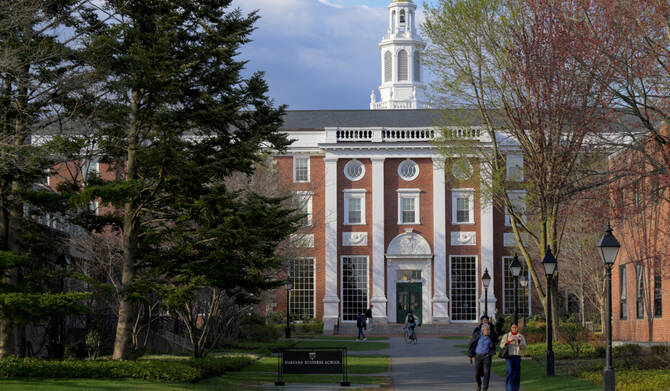
People walk on the Business School campus of Harvard University in Cambridge, Massachusetts, U.S., April 15, 2025. (REUTERS)
Short Url
Updated 30 April 2025
Follow

Harvard pledges reforms following internal reports on antisemitism and anti-Arab bias

  • In a list of “actions and commitments,” Harvard said it will review admissions processes to make sure applicants are evaluated based on their ability to “engage constructively with different perspectives, show empathy and participate in civil discourse”

WASHINGTON: Harvard University is promising to review its academic offerings and admissions policies in response to a pair of internal reports on antisemitism and anti-Arab prejudice at the Ivy League campus commissioned in the aftermath of last spring’s pro-Palestinian protests.
Harvard released the reports on Tuesday while the university simultaneously battles the Trump administration over demands to limit campus activism — reforms the government says are necessary to root out campus antisemitism. The administration has frozen $2.2 billion in federal funding and Harvard responded with a lawsuit in a clash that is being watched closely across higher education.
In a campus message, Harvard President Alan Garber said Harvard has made “necessary changes and essential progress” over the last year but promised further action.
“We will redouble our efforts to ensure that the University is a place where ideas are welcomed, entertained and contested in the spirit of seeking truth,” Garber wrote.
Garber convened two panels to study campus antisemitism and anti-Muslim bias last year, with an initial round of recommendations released last June. The final reports total more than 500 pages and include dozens of recommended changes.
Harvard said it will begin implementing at least some of the recommendations, with potential updates to admissions, hiring and discipline systems.
In a list of “actions and commitments,” Harvard said it will review admissions processes to make sure applicants are evaluated based on their ability to “engage constructively with different perspectives, show empathy and participate in civil discourse.”
It pointed to a recently added application question asking students about a time they strongly disagreed with someone. The antisemitism task force called for that kind of questioning, saying Harvard should reject anyone with a history of bias and look unfavorably on “exhibitions of hostility, derision or dismissiveness.”
Still, it appears to fall short of the Trump administration’s demands around admissions, which called on Harvard to end all preferences “based on race, color, national origin, or proxies thereof” and implement “merit-based” policies by August. The Supreme Court has rejected the use of race in college admissions, but many colleges look at factors including students’ family income and geography to bring a diverse class to campus.
Responding to complaints that Harvard’s instruction had become too politicized and anti-Israel, the university said it will work to hold professors to new standards of “excellence.” Deans will make sure faculty promote intellectual openness and refrain from endorsing political positions “that may cause students to feel pressure to demonstrate allegiance,” the university said.
Courses and curriculum will also be reviewed to reflect those standards.
Other changes include required antisemitism training for students and staff, along with expanded academic offerings on Hebrew, Judaic, Arab and Islamic studies. Harvard will put money toward a research project on antisemitism along with a historical overview on Muslims, Arabs and Palestinians at the university.
In his message, Garber said Harvard will accelerate a campus-wide effort to promote viewpoint diversity, though he didn’t elaborate. Viewpoint diversity is among the top concerns of the White House, which demanded that Harvard hire an external auditor to make sure the student body and every academic department represent diverse views.
Harvard is the first university to openly defy the Trump administration as it uses its hold on colleges’ federal funding to press its political agenda.
The administration has argued that universities did not do enough to check antisemitism at campus protests last year. Garber has said Harvard will not bend to the demands, calling it a threat to academic freedom and the autonomy of all universities.


US signs new health deals with 9 African countries that mirror Trump’s priorities

A pharmacist counts HIV medicine inside a clinic in Ha Lejone, Lesotho, July 16, 2025. (AP)
Updated 4 sec ago
Follow

US signs new health deals with 9 African countries that mirror Trump’s priorities

  • US aid cuts have crippled health systems across the developing world, including in Africa, where many countries relied on the funding for crucial programs, including those responding to outbreaks of disease
  • The agreements signed so far, with Kenya, Nigeria and Rwanda among others, are the first under the new global health framework, which makes aid dependent on negotiations between the recipient country and the US

JOHANNESBURG: The US government has signed health deals with at least nine African countries, part of its new approach to global health funding, with agreements that reflect the Trump administration’s interests and priorities and are geared toward providing less aid and more mutual benefits.
The agreements signed so far, with Kenya, Nigeria and Rwanda among others, are the first under the new global health framework, which makes aid dependent on negotiations between the recipient country and the US.
Some of the countries that have signed deals either have been hit by US aid cuts or have separate agreements with the Trump administration to accept and host third-country deportees, although officials have denied any linkage.
The Trump administration says the new “America First” global health funding agreements are meant to increase self-sufficiency and eliminate what it says are ideology and waste from international assistance. The deals replace a patchwork of previous health agreements under the now-dismantled United States Agency for International Development.
US aid cuts have crippled health systems across the developing world, including in Africa, where many countries relied on the funding for crucial programs, including those responding to outbreaks of disease.
The new approach to global health aligns with President Donald Trump’s pattern of dealing with other nations transactionally, using direct talks with foreign governments to promote his agenda abroad. It builds on his sharp turn from traditional US foreign assistance, which supporters say furthered American interests by stabilizing other countries and economies and building alliances.
A different strategy
The deals mark a sharp departure from how the US has provided health care funding over the years and mirrors the Trump administration’s interests.
South Africa, which has lost most of its US funding — including $400 million in annual support — due in part to its disputes with the US, has not signed a health deal, despite having one of the world’s highest HIV prevalence rates.
Nigeria, Africa’s most populous country, reached a deal but with an emphasis on Christian-based health facilities, although it has a slight majority Muslim population. Rwanda and Uganda, which each have deportation deals with the US, have announced the health pacts.
Cameroon, Eswatini, Lesotho, Liberia and Mozambique also are among those that have signed health deals with the US
According to the Center for Global Development, a Washington think tank, the deals “combine US funding reductions, ambitious co-financing expectations, and a shift toward direct government-to-government assistance.”
The deals represent a reduction in total US health spending for each country, the center said, with annual US financial support down 49 percent compared with 2024.
A faith-based deal in Nigeria, a lifeline for several others

Under its deal, Nigeria, a major beneficiary of USAID funds, would get support that has a “strong emphasis” on Christian faith-based health care providers.
The US provided approximately $2.3 billion in health assistance to Nigeria between 2021 and 2025, mostly through USAID, official data shows. The new five-year agreement will see US support at over $2 billion, while Nigeria is expected to raise $2.9 billion to boost its health care programs.
The agreement “was negotiated in connection with reforms the Nigerian government has made to prioritize protecting Christian populations from violence and includes significant dedicated funding to support Christian health care facilities,” the State Department said in a statement.
The department said “the president and secretary of state retain the right to pause or terminate any programs which do not align with the national interest,” urging Nigeria to ensure “that it combats extremist religious violence against vulnerable Christian populations.”
For several other countries, the new deals could be a lifeline after US aid cuts crippled their health care systems and left them racing to fill the gaps.
Under its deal, Mozambique will get US support of over $1.8 billion for HIV and malaria programs. Lesotho, one of the poorest countries in the world, clinched a deal worth over $232 million.
In the tiny kingdom of Eswatini, the US committed to provide up to $205 million to support public health data systems, disease surveillance and outbreak response, while the country agreed to increase domestic health expenditures by $37 million.
No deal for South Africa after disputes
South Africa is noticeably absent from the list of signatories following tensions with the Trump administration.
Trump has said he will cut all financial assistance to South Africa over his widely rejected claims that it is violently persecuting its Afrikaner white minority.
The dismantling of USAID resulted in the loss of over $436 million in yearly financing for HIV treatment and prevention in South Africa, putting the program and thousands of jobs in the health care industry at risk.
Health compacts with countries that signed deportation deals
At least four of the countries that have reached deals previously agreed to receive third-country deportees from the US, a controversial immigration policy that has been a trademark of the Trump administration.
The State Department has denied any linkage between the health care compacts and agreements regarding accepting third-country asylum seekers or third-country deportees from the United States. However, officials have said that political considerations unrelated to health issues may be part of the negotiations.
Rwanda, one of the countries with a deportation deal with the US, signed a $228 million health pact requiring the US to support it with $158 million.
Uganda, another such country, signed a health deal worth nearly $2.3 billion in which the US will provide up to $1.7 billion. Also Eswatini, which has started receiving flights with deported prisoners from the US