Grand Egyptian Museum CEO thanks Japan for its cooperation

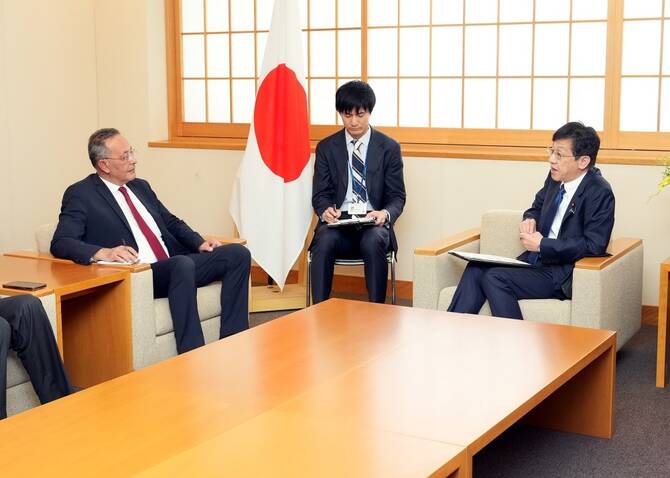
Dr. Ahmed Ghoneim, CEO of the Grand Egyptian Museum in Cairo, paid a courtesy call on Parliamentary Vice-Minister for Foreign Affairs Matsumoto Hisashi to thank the Japanese government for its cooperation in financing the museum. (ANJ Photo)
Short Url
Updated 29 April 2025
Follow

Grand Egyptian Museum CEO thanks Japan for its cooperation

  • Japan is providing financial cooperation in the form of $585m for the construction of the museum
  • Matsumoto welcomed Ghoneim and looked forward to the upcoming opening

TOKYO: Dr. Ahmed Ghoneim, CEO of the Grand Egyptian Museum in Cairo, paid a courtesy call on Parliamentary Vice-Minister for Foreign Affairs Matsumoto Hisashi on Friday to thank the Japanese government for its cooperation in financing the museum and to look forward to its opening in July, Japan’s Foreign Ministry reported.
Japan is providing financial cooperation in the form of yen loans totaling 84.247 billion yen ($585 million) for the construction of the museum, as well as technical cooperation aimed at preserving and restoring artifacts at the adjacent conservation and restoration center.
Cultural assets such as Tutankhamun’s golden mask are scheduled to be transferred to and exhibited at the museum, and it is expected that the museum will contribute to strengthening the preservation, restoration and research of Egypt’s historical and cultural heritage, as well as promoting tourism.
Matsumoto welcomed Ghoneim and looked forward to the upcoming opening of the museum, which is seen as a symbol of development cooperation between Japan and Egypt.
Director Ghoneim expressed his gratitude for the cooperation that the Japanese government has extended and also hoped that high-level Japanese officials would be able to attend the official opening ceremony in July.
The Grand Egyptian Museum is set to be the world’s largest museum and is located in the Giza region near the three Great Pyramids.


First urban cable car unveiled outside Paris

Updated 13 December 2025
Follow

First urban cable car unveiled outside Paris

  • The cable car will carry some 11,000 passengers per day in its 105 gondolas
  • The 138-million-euro project was cheaper to build than a subway, officials said

PARIS: Gondolas floated above a cityscape in the southeastern suburbs of Paris Saturday as the first urban cable car in the French capital’s region was unveiled.
Officials inaugurated the C1 line in the suburb of Limeil-Brevannes in the presence of Valerie Pecresse, the head of the Ile-de-France region, and the mayors of the towns served by the cable car.
The 4.5-kilometer route connects Creteil to Villeneuve-Saint-Georges and passes through Limeil-Brevannes and Valenton.
The cable car will carry some 11,000 passengers per day in its 105 gondolas, each able to accommodate ten seated passengers.
The total journey will take 18 minutes, including stops along the way, compared to around 40 minutes by bus or car, connecting the isolated neighborhoods to the Paris metro’s line 8.
The 138-million-euro project was cheaper to build than a subway, officials said.
“An underground metro would never have seen the light of day because the budget of more than billion euros could never have been financed,” said Gregoire de Lasteyrie, vice president of the Ile-de-France regional council in charge of transport.
It is France’s seventh urban cable car, with aerial tramways already operating in cities including Brest, Saint-Denis de La Reunion and Toulouse.
Historically used to cross rugged mountain terrain, such systems are increasingly being used to link up isolated neighborhoods.
France’s first urban cable car was built in Grenoble, nestled at the foot of the Alps, in 1934. The iconic “bubbles” have become one of the symbols of the southeastern city.