

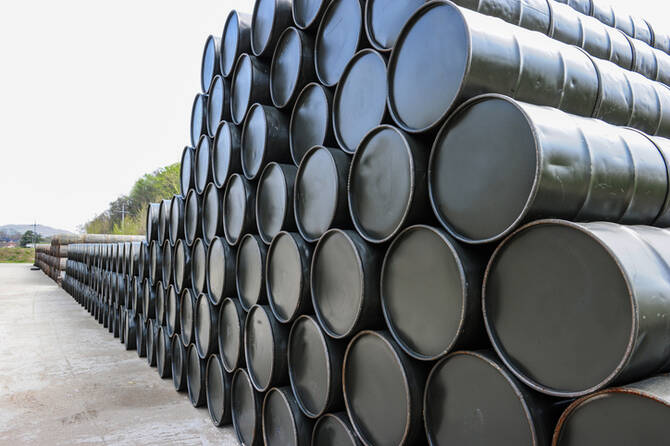
Oil Updates — crude falls as economic jitters dampen demand outlook

Brent crude futures fell by 78 cents, or 1.18 percent, to $65.08 per barrel by 10:49 a.m. Saudi time. Getty
Short Url
Updated 29 April 2025
Follow

Oil Updates — crude falls as economic jitters dampen demand outlook

SINGAPORE: Crude oil prices fell on Tuesday as investors lowered their demand growth expectations due to the ongoing trade war between the US and China, the world’s two biggest economies.

Brent crude futures fell by 78 cents, or 1.18 percent, to $65.08 per barrel by 10:49 a.m. Saudi time. US West Texas Intermediate crude futures fell 75 cents, or 1.21 percent, to $61.30 a barrel. Both benchmarks fell more than $1 on Monday.

“Markets are closely monitoring the US-China trade negotiations, understanding that deteriorating trade relations between the world’s two largest economies could lead the global economy toward a recession,” said Priyanka Sachdeva, senior market analyst at Phillip Nova.

“The lack of confidence in future demand and the absence of concrete signals for demand revival in mainland China will continue to overshadow oil prices.”

US President Donald Trump’s push to reshape world trade by imposing tariffs on all US imports has created a high risk that the global economy will slip into a recession this year, according to a majority of economists in a Reuters poll.

China, hit with the steepest of those tariffs, has responded with its own levies against US imports, stoking a trade war between the top two oil consuming nations. That has prompted analysts to sharply lower their oil demand and price forecasts.

Barclays on Monday cut its 2025 Brent crude price forecast by $4 to $70 a barrel, citing elevated trade tensions and a pivot in production strategy by the OPEC+ group as drivers of a 1 million barrel per day oil supply surplus this year.

Meanwhile, several members of OPEC+, which comprises the Organization of the Petroleum Exporting Countries and its allies, will suggest an acceleration of output hikes for a second consecutive month in June, sources told Reuters last week.

“A substantial (oil) price decrease appears probable if exporting countries boost production,” oil analyst Philip Verleger said in a note.

US crude oil stockpiles also likely rose by about 500,000 barrels in the week ended April 15, according to a preliminary Reuters poll of analysts on Monday.

Industry group American Petroleum Institute will publish its estimates on US oil inventories on Tuesday. Official figures from the Energy Information Administration will follow on Wednesday.


Saudi stock market opens its doors to foreign investors

Updated 06 January 2026
Follow

Saudi stock market opens its doors to foreign investors

RIYADH: Foreigners will be able to invest directly in Saudi Arabia’s stock market from Feb. 1, the Kingdom’s Capital Market Authority has announced.

The CMA’s board has approved a regulatory change which will mean the capital market, across all its segments, will be accessible to investors from around the world for direct participation.

According to a statement, the approved amendments aim to expand and diversify the base of those permitted to invest in the Main Market, thereby supporting investment inflows and enhancing market liquidity.

International investors' ownership in the capital market exceeded SR590 billion ($157.32 billion) by the end of the third quarter of 2025, while international investments in the main market reached approximately SR519 billion during the same period — an annual rise of 4 percent.

“The approved amendments eliminated the concept of the Qualified Foreign Investor in the Main Market, thereby allowing all categories of foreign investors to access the market without the need to meet qualification requirements,” said the CMA, adding: “It also eliminated the regulatory framework governing swap agreements, which were used as an option to enable non-resident foreign investors to obtain economic benefits only from listed securities, and the allowance of direct investment in shares listed on the Main Market.”

In July, the CMA approved measures to simplify the procedures for opening and operating investment accounts for certain categories of investors. These included natural foreign investors residing in one of the Gulf Cooperation Council countries, as well as those who had previously resided in the Kingdom or in any GCC country. 

This step represented an interim phase leading up to the decision announced today, with the aim of increasing confidence among participants in the Main Market and supporting the local economy.

Saudi Arabia, which ‌is more than halfway ‍through an economic plan ‍to reduce its dependence on oil, ‍has been trying to attract foreign investors, including by establishing exchange-traded funds with Asian partners in Japan and Hong Kong.