MADRID: The cause of Spain and Portugal’s widespread blackouts remained a mystery on Tuesday, with some isolated disruption remaining after power was largely restored to both countries.
One of Europe’s most severe blackouts grounded flights, paralyzed metro systems, disrupted mobile communications and shut down ATMs across the Iberian Peninsula on Monday.
By 7 a.m. on Tuesday more than 99 percent of energy demand in Spain had been restored, the country’s electricity operator Red Eléctrica said. Portuguese grid operator REN said all 89 power substations were back online and power had been restored to all 6.4 million customers.
As life began to return to normal — with schools and offices reopening, traffic easing and public transport restarting — the authorities in Spain have yet to provide further explanations for what caused one of the most serious blackouts to ever take place in Europe.
The Southern European nation of 49 million people lost 15 gigawatts — equivalent to 60 percent of its national demand — in just five seconds.
On Tuesday, Prime Minister Pedro Sánchez said that the government’s priorities were twofold: restoring Spain’s electrical system and finding the causes of the blackout so that a similar event “never takes place again.”
Cause remains a mystery
Such widespread electric failure has little precedent on the Iberian Peninsula or in Europe.
Eduardo Prieto, director of services for system operations at Spain’s electricity operator, noted two steep, back-to-back “disconnection events” before Monday’s blackout. Speaking at a new conference on Tuesday, he said that more investigation was needed to understand why they took place.
Spain’s meteorological agency, AEMET, said that it hadn’t detected any “unusual meteorological or atmospheric phenomena” on Monday, and no sudden temperature fluctuations were recorded at their weather stations.
Portugal’s National Cybersecurity Center on Monday dismissed speculation about foul play, saying that there was no sign that the outage resulted from a cyberattack.
European Council President António Costa also said that there were “no indications of any cyberattack,” while Teresa Ribera, an executive vice president of the European Commission, also ruled out sabotage. Nonetheless, the outage “is one of the most serious episodes recorded in Europe in recent times,” she said.
Madrid Open resumes
At Spain’s largest train stations, droves of travelers waited Tuesday morning to board trains, or to rebook tickets for journeys that were canceled or disrupted.
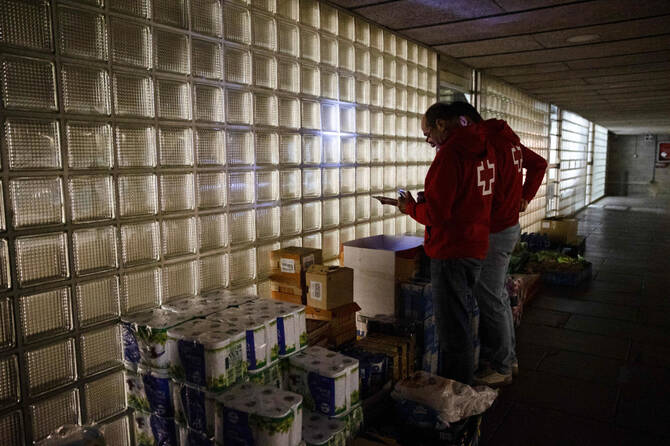
At Madrid’s Atocha station, hundreds of people stood near screens waiting for updates. Many had spent the night at the station, wrapped in blankets provided by the Red Cross. Similar scenes played out at Barcelona’s Sants station.
The Madrid Open tennis tournament resumed after the blackout caused 22 matches to be postponed on Monday. A packed schedule Tuesday included second-ranked Iga Swiatek advancing to the quarterfinals.
Mainline trains still disrupted
By 11 a.m. Tuesday, service on Madrid’s cubway system was fully restored. In Barcelona, the system was operating normally, but commuter trains were suspended because of “electrical instability,” the company that runs the service, Rodalies Catalunya, said on X.
In some parts of the country, commuter and mid-distance services were still suspended or running at reduced capacity.
Emergency workers in Spain said they had rescued around 35,000 passengers on Monday stranded along railways and underground. The blackout was especially disruptive on transit systems, turning sports centers, train stations and airports into makeshift overnight refuges.
Rubén Carión was stranded on a commuter train outside Madrid but managed to open a window and walk to the nearest transit station. He and a friend later spent the night in Atocha station after their train back to Barcelona was canceled.
The 24-year-old Carión said that he chose to wait at the station instead of a hotel, so he could stay updated on when he could buy a new ticket home. Sleeping on the floor “hungry, thirsty and tired,” Cairón described his experience in two words: “pure chaos.”


![]()

Spain and Portugal focus on the cause of the huge blackout after power is almost fully restored
Short Url
https://arab.news/r92sv
Spain and Portugal focus on the cause of the huge blackout after power is almost fully restored
- Authorities in Spain have yet to provide further explanations for what caused one of the most serious blackouts to ever take place in Europe
- Portugal’s National Cybersecurity Center on Monday dismissed speculation about foul play


Latest updates


© 2026 SAUDI RESEARCH & PUBLISHING COMPANY, All Rights Reserved And subject to Terms of Use Agreement.