Pakistan invites Turkmenistan’s energy companies to set up operations amid investment push

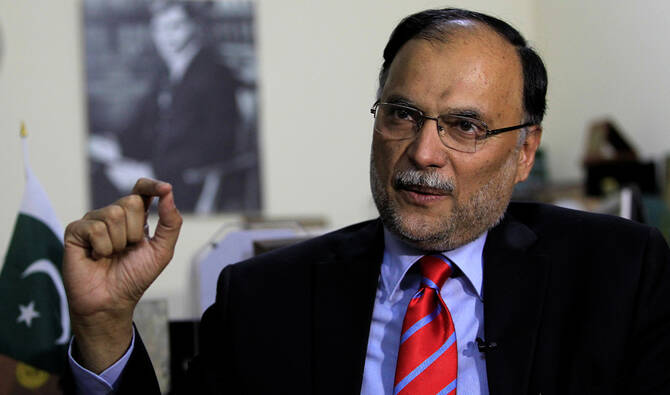
Ahsan Iqbal Pakistan's Minister of Planning and Development speaks with a Reuters correspondent during an interview in Islamabad, Pakistan on June 12, 2017 (Reuters/File)
Short Url
Updated 28 April 2025
Follow

Pakistan invites Turkmenistan’s energy companies to set up operations amid investment push

  • Islamabad is actively seeking energy cooperation with Turkmenistan through TAPI gas pipeline project
  • Pakistan faces energy problems due to rising demand, depleting resources and poor management

ISLAMABAD: Planning Minister Ahsan Iqbal has invited Turkmenistan’s energy companies to set up operations in Pakistan, state media reported on Monday, as Islamabad seeks foreign investment to boost the country’s economy and resolve its energy issues. 

Energy-starved Pakistan is actively pursuing energy cooperation with Turkmenistan, particularly through the TAPI (Turkmenistan-Afghanistan-Pakistan-India) gas pipeline project. This initiative aims to transport natural gas from Turkmenistan’s Galkynysh field to Pakistan, passing through Afghanistan and extending to India as well. 

Pakistan has attempted to strengthen cooperation in energy, tourism, mines and minerals as well as other priority sectors in recent months in its bid to attract international investment. It seeks to establish itself as a trade and transit hub that connects landlocked Central Asian states to the global economy.

“Minister for Planning and Development Ahsan Iqbal has invited energy companies of Turkmenistan to establish operations in Pakistan,” Radio Pakistan said in a report, adding that the minister was speaking at an event in Ashgabat. 

Iqbal said the TAPI gas pipeline project would contribute to regional energy security and support Pakistan’s green energy transition, deeming it essential to cope with climate change impacts.

The TAPI project was envisaged in the early 1990s and officially agreed upon in December 2010. It has primarily been delayed due to security concerns, geopolitical tensions, funding challenges and bureaucratic hurdles.

Pakistan faces significant gas and energy problems that have deepened over the years due to a combination of rising demand, depleting domestic resources and poor management.

The country’s natural gas reserves are rapidly declining, while efforts to discover new fields have lagged behind.

Pakistan has increasingly relied on imported liquefied natural gas which strains its foreign exchange reserves and exposes it to global price fluctuations.

Frequent power shortages known as load-shedding disrupt daily life and hurt economic productivity. Outdated infrastructure, inefficiencies in the energy sector, circular debt and policy inconsistencies have made it difficult to develop long-term sustainable solutions. 


Pakistan, ADB sign $730 loan agreements to boost SOE reforms, energy infrastructure

Updated 25 December 2025
Follow

Pakistan, ADB sign $730 loan agreements to boost SOE reforms, energy infrastructure

  • Both sign $330 million Power Transmission Strengthening Project and $400 million SOE Transformation Program loan agreements
  • Economic Affairs Division official says Transmission Project will secure Pakistan’s energy future by strengthening national grid’s backbone

KARACHI: Pakistan and the Asian Development Bank (ADB) on Thursday signed two loan agreements totaling $730 million to boost reforms in state-owned enterprises (SOEs) and energy infrastructure in the country, the bank said.

The first of the two agreements pertains to the SOE Transformation Program worth $400 million while the second loan, worth $330 million, is for a Power Transmission Strengthening Project, the lender said. 

The agreements were signed by ADB Country Director for Pakistan Emma Fan and Pakistan’s Secretary of Economic Affairs Division Humair Karim. 

“The agreements demonstrate ADB’s enduring commitment to supporting sustainable and inclusive economic growth in Pakistan,” the ADB said. 

Pakistan’s SOEs have incurred losses worth billions of dollars over the years due to financial mismanagement and corruption. These entities, including the country’s national airline Pakistan International Airlines, which was sold to a private group this week, have relied on subsequent government bailouts over the years to operate.

The ADB approved the $400 million loan for SOE reforms on Dec. 12. It said the program seeks to improve governance and optimize the performance of Pakistan’s commercial SOEs. 

Karim highlighted that the Power Transmission Strengthening Project will enable reliable evacuation of 2,300 MW from Pakistan’s upcoming hydropower projects, relieve overloading of existing transmission lines and enhance resilience under contingency conditions, the Press Information Department (PID) said. 

“The Secretary emphasized that both initiatives are transformative in nature as the Transmission Project will secure Pakistan’s energy future by strengthening the backbone of the national grid whereas the SOE Program will enhance transparency, efficiency and sustainability of state-owned enterprises nationwide,” the PID said. 

The ADB has supported reforms by Pakistan to strengthen its public finance and social protection systems. It has also undertaken programs in the country to help with post-flood reconstruction, improve food security and social and human capital. 

To date, ADB says it has committed 764 public sector loans, grants and technical assistance totaling $43.4 billion to Pakistan.