

US in touch with India and Pakistan, urges work toward ‘responsible solution’

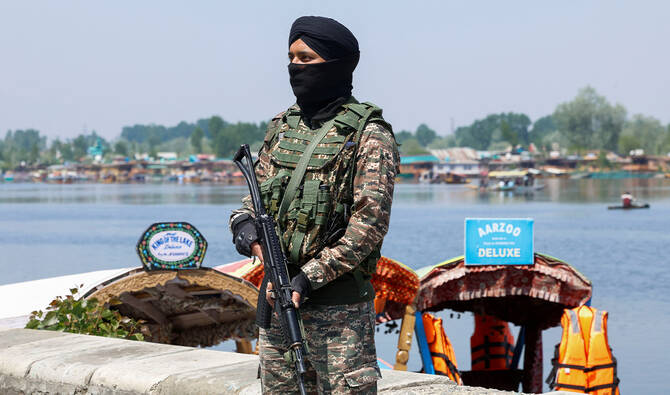
Indian security force personnel stands guard on the banks of Dal Lake, following a suspected militant attack near south Kashmir's Pahalgam, in Srinagar, Indian administrated Kashmir, April 27, 2025. (Reuters)
Short Url
Updated 28 April 2025
Follow

US in touch with India and Pakistan, urges work toward ‘responsible solution’

  • Tensions have surged after India blamed Pakistan for Apr. 22 attack in Indian-administered Kashmir
  • India and Pakistan have exchanged fire since last week at de facto border after four years of relative calm

WASHINGTON: The US State Department said on Sunday Washington was in touch with both India and Pakistan while urging them to work toward what it called a “responsible solution” as tensions have risen between the two Asian nations following a recent Islamist militant attack in Kashmir.

In public, the US government has expressed support for India after the attack but has not criticized Pakistan. India blamed Pakistan for the April 22 attack in Indian-administered Kashmir that killed over two dozen people. Pakistan denies responsibility and called for a neutral probe.

“This is an evolving situation and we are monitoring developments closely. We have been in touch with the governments of India and Pakistan at multiple levels,” a US State Department spokesperson told Reuters in an emailed statement.

“The United States encourages all parties to work together toward a responsible resolution,” the spokesperson added.

The State Department spokesperson also said Washington “stands with India and strongly condemns the terrorist attack in Pahalgam,” reiterating comments similar to recent ones made by President Donald Trump and Vice President JD Vance.

India is an increasingly important US partner as Washington aims to counter China’s rising influence in Asia while Pakistan remains a US ally even as its importance for Washington has diminished after the 2021 US withdrawal from neighboring Afghanistan.

Michael Kugelman, a Washington-based South Asia analyst and writer for the Foreign Policy magazine, said India is now a much closer US partner than Pakistan.

“This may worry Islamabad that if India retaliates militarily, the US may sympathize with its counter-terrorism imperatives and not try to stand in the way,” Kugelman told Reuters.

Kugelman also said that given Washington’s involvement and ongoing diplomatic efforts in Russia’s war in Ukraine and Israel’s war in Gaza, the Trump administration is “dealing with a lot on its global plate” and may leave India and Pakistan on their own, at least in the early days of the tensions.

Hussain Haqqani, a former Pakistan ambassador to the US and a senior fellow at the Hudson Institute think tank, also said that there seemed to be no US appetite to calm the situation at this moment.

“India has a longstanding grievance about terrorism emanating or supported from across border. Pakistan has a longstanding belief that India wants to dismember it. Both work themselves into a frenzy every few years. This time there is no US interest in calming things down,” Haqqani said.
ESCALATING TENSIONS
Muslim-majority Kashmir is claimed in full by both Hindu-majority India and Islamic Pakistan who each rule over only parts of it and have previously fought wars over the Himalayan region.

Hindu nationalist Indian Prime Minister Narendra Modi has vowed to pursue the attackers to “the ends of the earth” and said that those who planned and carried out the Kashmir attack “will be punished beyond their imagination.” Calls have also grown from Indian politicians and others for military action against Pakistan.

After the attack, India and Pakistan unleashed a raft of measures against each other, with Pakistan closing its airspace to Indian airlines and India suspending the 1960 Indus Waters Treaty that regulates water-sharing from the Indus River and its tributaries.

The two sides have also exchanged fire across their de facto border after four years of relative calm.

A little-known militant group, Kashmir Resistance, claimed responsibility for the attack in a social media message. Indian security agencies say Kashmir Resistance, also known as The Resistance Front, is a front for Pakistan-based militant organizations such as Lashkar-e-Taiba and Hizbul Mujahideen.

Ned Price, a former US State Department official under the administration of former President Joe Biden, said that while the Trump administration was giving this issue the sensitivity it deserves, a perception that it would back India at any cost may escalate tensions further.

“The Trump Administration has made clear it wishes to deepen the US-India partnership — a laudable goal — but that it is willing to do so at almost any cost. If India feels that the Trump Administration will back it to the hilt no matter what, we could be in store for more escalation and more violence between these nuclear-armed neighbors,” Price said.


Pakistan joins regional talks on Afghanistan in Iran as Kabul stays away

Updated 6 sec ago
Follow

Pakistan joins regional talks on Afghanistan in Iran as Kabul stays away

  • China, Pakistan, Pakistan, Tajikistan, Uzbekistan, Turkmenistan all joined talks organized by Iran, as did Russia
  • Afghanistan was invited but decided not to attend, Taliban-led government was tight-lipped on the reasons

TEHRAN, Iran: Afghanistan’s neighbors met in Iran and agreed to deepen regional coordination to address political, economic and security challenges, as well as calling for sanctions on Afghanistan to be lifted. 

The only absent party? Afghanistan itself.

China, Pakistan, Pakistan, Tajikistan, Uzbekistan and Turkmenistan all joined the talks organized by Iran, as did Russia, according to a statement released after the meeting on Sunday.

Afghanistan was invited but decided not to attend. Its Taliban-led government was tight-lipped on the reasons, with the foreign ministry saying only that it would not participate because Afghanistan “currently maintains active engagement with regional countries through existing regional organizations and formats, and has made good progress in this regard.”

The statement from the talks in Iran stressed the importance of maintaining economic and trade ties with Afghanistan to improve living conditions and called for the country’s integration into regional political and economic processes.

The Taliban were isolated after they retook power in Afghanistan in August 2021, but in the past year, they have developed diplomatic ties. They now raise several billion dollars every year in tax revenues to keep the lights on.

However, Afghanistan is still struggling economically. Millions rely on aid for survival, and the struggling economy has been further impacted by the international community not recognizing the Taliban government’s seizure of power in the wake of the chaotic withdrawal of US-led troops in 2021. Natural disasters and the flow of Afghans fleeing Pakistan under pressure to return home have underlined Afghanistan’s reliance on foreign aid to meet essential needs.

The countries at the talks also voiced security concerns and pledged cooperation in combating terrorism, drug trafficking and human smuggling, while opposing any foreign military presence in Afghanistan. They underscored the responsibility of the international community to lift sanctions and release Afghanistan’s frozen assets, and urged international organizations to support the dignified return of Afghan refugees from neighboring countries.

The participants backed efforts to reduce tensions between Afghanistan and Pakistan, which have been particularly strained, with border clashes between the two sides killing dozens of civilians, soldiers and suspected militants and wounding hundreds more.

The violence followed explosions in Kabul on Oct. 9 that Afghan authorities blamed on Pakistan. A Qatar-mediated ceasefire has largely held since October, although there have been limited border clashes. The two sides failed to reach an overall agreement in November despite three rounds of peace talks.

Asif Durrani, Pakistan’s former special representative for Afghanistan, said the Taliban government’s decision to skip the meeting reflected a “lack of political maturity.” 

Writing on X, Durrani said the move reinforced concerns that the Taliban were unwilling to negotiate, instead adopting an “I don’t accept” stance that he said would do little to resolve serious regional problems.

Mohammad Sadiq, the current Pakistani special representative for Afghanistan who attended the talks, wrote on X that the Afghan people had already suffered enough and deserved better.

Only an Afghanistan that does not harbor militants would inspire confidence among neighboring and regional countries to engage meaningfully with Kabul and help unlock the country’s economic and connectivity potential, he wrote.

Participants agreed to hold the next meeting of foreign ministers of Afghanistan’s neighboring countries as soon as possible in Ashgabat, Turkmenistan, and welcomed Pakistan’s offer to host the next round of special envoys’ talks in Islamabad in March.

Iran’s foreign ministry spokesman, Esmail Baghaei, on Sunday said that the meeting had not been held for about two years and marked the first such gathering attended by special envoys on Afghanistan from neighboring countries as well as Russia. Russia and Uzbekistan sent the special envoys of their presidents, while Pakistan was represented by a delegate from the prime minister’s office.

Landlocked Afghanistan is sandwiched between the Middle East, Central Asia, and South Asia, making it strategically located for energy-rich and energy-hungry nations.