

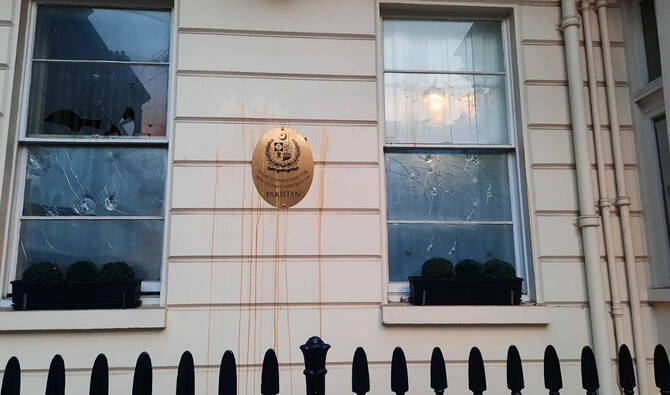
London police arrest man for pelting stones at Pakistan high commission, official says

Handout photo released by Pakistan High Commission in UK, on April 27, 2025 shows broken windows of the high commission and “saffron-colored paint” thrown at its plaque in London, UK. (Courtesy: Pakistan High Commission UK)
Short Url
Updated 28 April 2025
Follow

London police arrest man for pelting stones at Pakistan high commission, official says

  • The London police have not revealed the identity of the suspect, but scores of Indians gathered outside the Pakistani high commission to protest Pahalgam attack
  • New Delhi accused Pakistan of orchestrating the attack that killed 26 tourists, Islamabad denies involvement and says it is ready to take part in a credible probe

ISLAMABAD: Police have arrested a man for pelting stones and throwing “saffron-colored paint” at the Pakistan high commission in London, the top Pakistani diplomat in the United Kingdom (UK) said on Sunday, amid heightened tensions between Pakistan and India.
The London police have not revealed the identity of the suspect, but scores of Indian nationals last week gathered outside the Pakistani high commission in London to protest over an April 22 attack in Indian-administered Kashmir that killed 26 tourists.
New Delhi accused Pakistan of orchestrating the attack in the Pahalgam resort town. Islamabad has denied involvement and says it is ready to take part in a credible and transparent investigation into the attack.
“This morning [Apr. 27], at around 4-4:30am, a man came here and pelted stones [at the Pakistani high commission]. These are white stones, which are quite big and are not found here. He brought it from somewhere else. He had a bag and he [threw] this saffron-colored paint, this is like a paint, which you can see, this hit our logo and wall, and several [window] glasses were broken,” Pakistan’s High Commissioner Mohammad Faisal said.
“Police came and arrested that man. Now that man is in police custody, they are not telling us his nationality and identification details.”

In India, saffron is considered a sacred color, primarily associated with Hinduism, and is prominently featured in the national flag, where it represents strength and courage. A number of protesters, who gathered outside the Pakistan high commission, were seen wearing saffron-colored clothes.
On Sunday, Pakistan’s information minister, Attaullah Tarar, also accused Indian authorities of encouraging Indian nationals to “attack” Pakistan’s missions abroad, which he said was “unfortunate.” New Delhi did not immediately responded to Tarar’s statement.
High Commissioner Faisal said they had taken up the matter with Britain’s Foreign Office.
“This is a very big cause of concern for us as our security is at stake because, you know, our officials live on this street a little far from here,” he said.
“We will urge the British government to take action on this and punish the perpetrator behind this.”
Pakistan and India have fought multiple wars, including two on Kashmir, since their independence from British rule in 1947. Both neighbors rule part of the Himalayan territory but claim it in full.
New Delhi accuses Pakistan of supporting armed separatist militants in the Kashmir. Islamabad denies the allegations and says it supports the Kashmiri people diplomatically and politically.
The Pahalgam attack marks a dramatic shift in separatist assaults in Indian-administered Kashmir, which typically target Indian security forces.
In 2019, a suicide attack killed 41 Indian troops in Kashmir and triggered Indian air strikes inside Pakistan, bringing the countries to the brink of all-out war.


Nearly 25% of Pakistan’s primary schools enrolling girls operate as single-teacher ones— report

Updated 13 sec ago
Follow

Nearly 25% of Pakistan’s primary schools enrolling girls operate as single-teacher ones— report

  • Pakistan needs over 115,000 more teachers in primary schools enrolling girls to meet global benchmark of one teacher per 30 students, says report
  • Sixty percent of Pakistani primary schools enrolling girls are overcrowded, while 32% lack clean drinking water or toilets, says Tabadlab report

ISLAMABAD: Nearly 25% of Pakistan’s primary schools that enrolls girls operate as single-teacher ones, a report by a leading think tank said this week, calling on the government to devolve teacher recruitment powers, upskill underutilized teachers and introduce reforms to hire and promote faculty members. 

Pakistan faces an acute education crisis which is reflected in the fact that it has the world’s second-highest number of out-of-school children, an estimated 22.8 million aged 5-16 who are not in educational institutions, according to UNICEF. 

While poverty remains the biggest factor keeping children out of classrooms, Pakistan’s education crisis is exacerbated by inadequate infrastructure and underqualified teachers, cultural barriers and the impacts of frequently occurring natural disasters. 

According to “The Missing Ustaani,” a report published by Islamabad-based think tank Tabadlab and supported by Malala Fund and the Pakistan Institute of Education (PIE), Pakistan needs over 115,000 more teachers in primary schools with girls’ enrolment to meet the basic international benchmark of ensuring one teacher per 30 children. Currently, the average Student-to-Teacher Ratio (STR) across Pakistan’s primary schools with girls’ enrolment is 39:1, it said. 

“Approximately 60% of these schools are overcrowded, necessitating the recruitment of over 115,000 additional teachers nationwide,” the report said on Monday. “Compounding this, nearly 25% of primary schools with girls’ enrolment operate as single-teacher schools, placing immense pressure on the quality of education.”

It said the situation is more dire in Pakistan’s poverty-stricken southwestern Balochistan province, where nearly 52% of the schools are single-teacher only ones while the percentage decreases slightly in the southern Sindh province to 51 percent. 

The report said while the STR improves to 25:1 at the middle school level, acute shortages of subject specialists emerge as the top-priority concern for quality education in these schools.

“Furthermore, around 32% of primary schools with girls’ enrolment and 18% of middle schools face ‘critical infrastructural shortages’— lacking clean drinking water or toilets in addition to high STRs— which significantly affects girls’ attendance and learning, particularly during adolescence,” the report said. 

The report cited a set of priority recommendations to address Pakistan’s systemic teacher deployment challenges and improve educational equity for girls. 

It urged the government to devolve recruitment authority to school or cluster levels to enable timely, context-specific hiring. It also called upon authorities to reform teacher transfer and promotion policies to introduce school-specific postings with minimum service terms. 

This, it said, would reduce arbitrary transfers and improving continuity in classrooms. The report advised authorities to upskill surplus or underutilized primary teachers to support instruction at the middle school level, helping address subject-specialist shortages.

“Together, these reforms offer a pathway toward a more equitable, efficient, and responsive teaching workforce— one capable of improving learning outcomes and ensuring that every girl in Pakistan has access to a qualified teacher,” the report said. 

To tackle Pakistan’s education crisis, Prime Minister Shehbaz Sharif declared an ‘education emeregency’ in September 2024, stressing the importance of education for all.