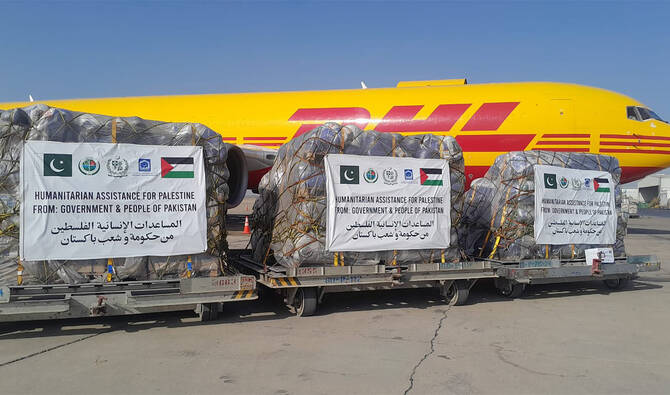
ISLAMABAD: Pakistan has dispatched 40 tons of humanitarian aid for the war-affected people of Gaza, the National Disaster Management Authority (NDMA) said on Sunday, amid continuing Israeli strikes on the Palestinian territory.
The development came as the Palestinian health ministry said hospitals in the Gaza Strip had received the remains of 51 Palestinians over the past 24 hours who were killed in Israeli strikes, bringing the Palestinian death toll from the 18-month-old Israel-Hamas war to 52,243.
The overall toll includes nearly 700 bodies for which the documentation process was recently completed, the ministry said in its latest update. The daily toll includes bodies retrieved from the rubble after earlier strikes.
Pakistan’s NDMA said the latest shipment, which is the 15th aid consignment for Gaza and the overall 26th sent to the Middle East, was sent as part of Pakistan’s ongoing humanitarian efforts.
“The latest consignment, sent in collaboration with Al-Khidmat Foundation, comprises approximately 20 tons of medicine, 5 tons of hygiene kits and 15 tons of tents,” the NDMA said.
“The aid was transported via a chartered flight from Jinnah International Airport, Karachi, to Amman (Jordon). Royal Medical Services Jordan will receive for onward distribution to the people of Palestine.”
Israel ended its months-long ceasefire with Hamas by launching a surprise bombardment on March 18, and has been carrying out daily waves of strikes since then. Ground forces have expanded a buffer zone and encircled the southern city of Rafah, and now control around 50 percent of the territory. Israel has also sealed off the territory’s 2 million Palestinians from all imports, including food and medicine, for nearly 60 days. Aid groups say supplies will soon run out and that thousands of children are malnourished.
Pakistan, which does not have diplomatic ties with Israel, has consistently condemned Israeli military actions and called for the uninterrupted flow of humanitarian aid into the Palestinian territory.
The South Asian country has dispatched a total of 1,518 tons of relief aid exclusively for Palestine, according to the NDMA. Overall, Pakistan has dispatched 2,045 tons of humanitarian aid, including 416 tons for Lebanon and 111 tons for Syria.
“The Government of Pakistan remains steadfast in its commitment to standing with the people of Palestine and will continue to provide humanitarian assistance based on the evolving needs of those affected by the ongoing crisis,” the NDMA said.


Pakistan dispatches another 40 tons of relief goods for Gaza
https://arab.news/2rfzr
Pakistan dispatches another 40 tons of relief goods for Gaza

- The development comes as the Palestinian death toll from the 18-month-old Israel-Hamas war rises to 52,243
- Pakistan has consistently condemned Israeli military actions, called for uninterrupted flow of aid into Gaza

Death toll in Pakistan shopping plaza fire rises to 67, officials say
- Rescue teams still searching for damaged Gul Plaza in Karachi where blaze erupted on Saturday, says police surgeon
- Karachi has a long history of deadly fires, often linked to poor safety standards, weak regulatory enforcement
KARACHI: The death toll from a devastating fire at a shopping plaza in Pakistan’s southern port city of Karachi jumped to 67 on Thursday after police and a hospital official confirmed that the remains of dozens more people had been found.
Police surgeon Dr. Summaiya Syed said rescue teams were still searching the severely damaged Gul Plaza in the Karachi, where the blaze erupted on Saturday.
Most remains were discovered in fragments, making identification extremely difficult, but the deaths of 67 people have been confirmed, she said. Asad Raza, a senior police official in Karachi, also confirmed the death toll. Authorities previously had confirmed 34 deaths.
Family members of the missing have stayed near the destroyed plaza and hospital, even after providing their DNA for testing. Some have tried to enter the building forcibly, criticizing the rescue efforts as too slow.
“They are not conducting the search properly,” said Khair-un-Nisa, pointing toward the rescuers. She stood outside the building in tears, explaining that a relative who had left to go shopping has been missing since the blaze.
Another woman, Saadia Saeed, said her brother has been trapped inside the building since Saturday night, and she does not know what has happened to him.
“I am ready to go inside the plaza to look for him, but police are not allowing me,” she said.
There was no immediate comment from authorities about accusations they have been too slow.
Many relatives of the missing claim more lives could have been saved if the government had acted more swiftly. Authorities have deployed police around the plaza to prevent relatives from entering the unstable structure, while rescuers continue their careful search.
Investigators say the blaze erupted at a time when most shop owners were either closing for the day or had already left. Since then, the Sindh provincial government has said around 70 people were missing after the flames spread rapidly, fueled by goods such as cosmetics, clothing, and plastic items.
The cause of the fire remains under investigation, though police have indicated that a short circuit may have triggered the blaze.
Karachi has a long history of deadly fires, often linked to poor safety standards, weak regulatory enforcement, and illegal construction.
In November 2023, a shopping mall fire killed 10 people and injured 22. One of Pakistan’s deadliest industrial disasters occurred in 2012, when a garment factory fire killed at least 260 people.


