DAMASCUS: The Syrian presidency rejected on Sunday a Kurdish call for a decentralized state, warning against attempts at separatism or federalism by the minority group.
“We reject clearly any attempt to impose a separatist reality or to create separate entities under the cover of federalism... without a national consensus,” the presidency said in a statement in which it also condemned “the recent activities and declarations” of the Kurdish-led Syrian Democratic Forces (SDF) that “call for federalism.”
“The unity of Syria, of its territories and its people is a red line,” the statement said.
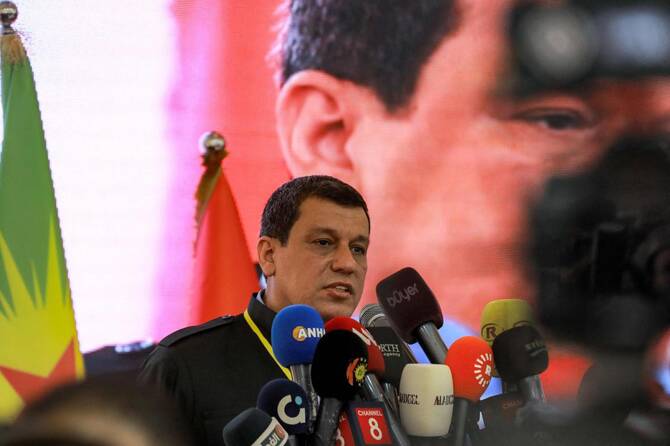
The declaration came a day after a conference of Syrian Kurdish parties adopted a joint vision of a “decentralized democratic state.”
The new authorities in Syria, who replaced the overthrown Bashar Assad in December, have repeatedly rejected the idea of Kurdish autonomy.
The US-backed Kurds control large areas of northeastern Syria, much of which they took over in the process of defeating jihadists of the Daesh group between 2015 and 2019.
They have enjoyed de facto autonomy since early in the civil war which broke out in 2011, but the new authorities have insisted on a unitary state.
In March, Syria’s interim president, Ahmed Al-Sharaa, and the SDF chief Mazloum Abdi, signed an agreement to integrate Kurdish institutions into the Syrian state.
Abdi told the conference on Saturday that “my message to all Syrian constituents and the Damascus government is that the conference does not aim, as some say, at division.”
Instead it aimed “for the unity of Syria,” he insisted.
“We support all Syrian components receiving their rights in the constitution to be able to build a decentralized democratic Syria that embraces everyone,” Abdi said.
Most of Syria’s oil and gas fields are in areas administered by the Kurdish authorities. These may prove a crucial resource for Syria’s new authorities as they seek to rebuild the war-devastated country.

Syria rejects Kurds’ call for decentralization
Short Url
https://arab.news/rs5fb
Syria rejects Kurds’ call for decentralization
- The new authorities in Syria, who replaced the overthrown Bashar Assad in December, have repeatedly rejected the idea of Kurdish autonomy
- Most of Syria’s oil and gas fields are in areas administered by the Kurdish authorities
UN force says Israel fired near peacekeepers in south Lebanon
- UNIFIL reports two incidents of gunfire hitting 50 meters away from its patrols
- The force has been working with Lebanon’s army to support a ceasefire between Israel and Hezbollah
BEIRUT: The United Nations Interim Force in Lebanon said gunfire from an Israeli position hit close to its peacekeepers twice on Friday, reporting no casualties but decrying a “concerning trend.”
UNIFIL has repeatedly reported Israeli fire near or toward its personnel in recent months, and last week said an Israeli attack near one of its positions lightly wounded a peacekeeper.
Personnel patrolling in south Lebanon on Friday “reported 15 rounds of small arms fire that struck no more than 50 meters away from them,” a UNIFIL statement said.
Shortly afterwards, “peacekeepers in a second patrol in the same area reported approximately 100 rounds of machine-gun fire struck approximately 50 meters from them,” it added, reporting no damage or injuries.
“Peacekeepers assessed that the fire came from an Israel Defense Forces (IDF) position south of the Blue Line in both cases,” the statement said, referring to the de facto border, and “sent a ‘stop fire’ request through its liaison channels.”
It said UNIFIL had informed the Israeli army about the peacekeepers’ activities in advance.
“Incidents like these are happening on a too-regular basis, and becoming a concerning trend,” the statement said.
“We reiterate our call to the IDF to cease aggressive behavior and attacks on or near peacekeepers working for peace and stability along the Blue Line.”
UNIFIL has acted as a buffer between Israel and Lebanon for decades, and recently has been working with Lebanon’s army to support a year-old ceasefire between Israel and militant group Hezbollah.
The force on Friday noted that “attacks on or near peacekeepers are serious violations” of a 2006 UN Security Council resolution that formed the basis of the current ceasefire.
Under the November 2024 truce, Israel was to withdraw its forces from south Lebanon, but it has kept them at five areas it deems strategic and carries out regular strikes on Lebanon, usually saying it is targeting Hezbollah sites and operatives.
Under heavy US pressure and fears of expanded Israeli strikes, Lebanon has committed to disarming Hezbollah, starting in the south near the frontier.
Last August, the UN Security Council voted for the peacekeepers to leave Lebanon in 2027.
UNIFIL has repeatedly reported Israeli fire near or toward its personnel in recent months, and last week said an Israeli attack near one of its positions lightly wounded a peacekeeper.
Personnel patrolling in south Lebanon on Friday “reported 15 rounds of small arms fire that struck no more than 50 meters away from them,” a UNIFIL statement said.
Shortly afterwards, “peacekeepers in a second patrol in the same area reported approximately 100 rounds of machine-gun fire struck approximately 50 meters from them,” it added, reporting no damage or injuries.
“Peacekeepers assessed that the fire came from an Israel Defense Forces (IDF) position south of the Blue Line in both cases,” the statement said, referring to the de facto border, and “sent a ‘stop fire’ request through its liaison channels.”
It said UNIFIL had informed the Israeli army about the peacekeepers’ activities in advance.
“Incidents like these are happening on a too-regular basis, and becoming a concerning trend,” the statement said.
“We reiterate our call to the IDF to cease aggressive behavior and attacks on or near peacekeepers working for peace and stability along the Blue Line.”
UNIFIL has acted as a buffer between Israel and Lebanon for decades, and recently has been working with Lebanon’s army to support a year-old ceasefire between Israel and militant group Hezbollah.
The force on Friday noted that “attacks on or near peacekeepers are serious violations” of a 2006 UN Security Council resolution that formed the basis of the current ceasefire.
Under the November 2024 truce, Israel was to withdraw its forces from south Lebanon, but it has kept them at five areas it deems strategic and carries out regular strikes on Lebanon, usually saying it is targeting Hezbollah sites and operatives.
Under heavy US pressure and fears of expanded Israeli strikes, Lebanon has committed to disarming Hezbollah, starting in the south near the frontier.
Last August, the UN Security Council voted for the peacekeepers to leave Lebanon in 2027.
© 2026 SAUDI RESEARCH & PUBLISHING COMPANY, All Rights Reserved And subject to Terms of Use Agreement.


