

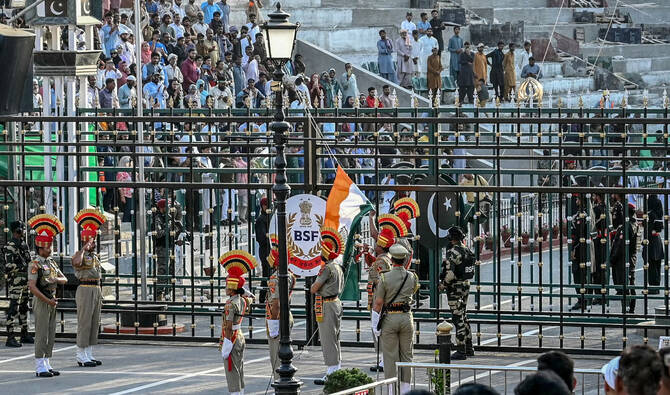
No handshake at muted India-Pakistan border ceremony

Indian Border Security Force personnel (brown uniform) and Pakistani Rangers (black uniform) take part in the beating retreat ceremony at the border gates of India and Pakistan at the Wagah border post, on April 25, 2025. (AFP)
Short Url
Updated 27 April 2025
Follow

No handshake at muted India-Pakistan border ceremony

  • Relations between Pakistan, India have soured after Apr. 22 attack on tourists in Indian-administered Kashmir
  • For years, Attari-Wagah border in Punjab separating India from Pakistan has been a hugely popular tourist attraction

ATTARI: With swaggering soldiers giving high kicks set to booming patriotic music cheered on by crowds, it was the usual daily border ceremony between nuclear-armed arch-rivals India and Pakistan.

But there was one key thing at the show that was missing — the usual symbol of cooperation, a handshake between the opposing soldiers, did not take place.

Relations have plummeted after New Delhi accused Islamabad of backing an attack targeting tourists on April 22 — the deadliest attack on civilians in Indian-administered Kashmir for years.

Islamabad rejects the claims, and the countries have since exchanged gunfire, diplomatic barbs, expelled citizens — and ordered the border to be shut.

The iron gates that separate the two sides remain locked.

“It just fills you with passion and patriotic pride,” said Simarjeet Singh, 17, from the nearby Indian city of Amritsar, his face painted with the national tricolor flag.

Many fear the risk of a military escalation in the coming days.

For years, the Attari-Wagah border in Punjab has been a hugely popular tourist attraction.

Visitors from both sides come to cheer on soldiers goose-stepping in a chest-puffing theatrical show of pageantry.

Numbers were muted at the sunset show on Saturday, but thousands of Indians still came to show their loyalty to their nation.

“There were people from all over who looked and dressed different but were cheering and screaming at the same time — for our country and the soldiers,” Singh said, who came with his friends from college.

Cheering crowds still filled the stadium-like space around the gates with noise, at least on the Indian side, where on Saturday some 5,000 people — about a fifth of full capacity — watched.

There was only a small fraction of the support on the Pakistani side.

Enthusiastic spectators sang in chorus, waving flags and chanting “India Zindabad,” or “Long live India.”

The frontier was a colonial creation at the violent end of British rule in 1947 which sliced the sub-continent into Hindu-majority India and Muslim-majority Pakistan.

The daily border ritual has largely endured over the decades, surviving innumerable diplomatic flare-ups and military skirmishes.

Reena Devi, 54, and PK Nath, 70, tourists from Tezpur in India’s northeastern state of Assam, are part of a tour of the country.

“We are just so excited to be here,” Devi said. “We just wanted to see this ceremony and experience being at the border with Pakistan.”

Nath said she and her group planned to visit a Hindu site in Jammu and Kashmir.

“Some of us are now a little apprehensive about the security there,” she said.

Nath said he “totally supported” New Delhi’s decision to expel Pakistani citizens and to shut down the border.

“You can’t send people to kill here and still not expect any response,” Nath said.

“We don’t know what will happen next but we are sure that the government would do the right thing,” he added.

As the energetic masters of the ceremony goaded the crowd, the Indian soldiers in red-fanned hats stomped up to the locked gate, kicking their legs up — with Pakistanis doing the same on the other side.

Aside from the ceremony, Indian and Pakistani citizens have been crossing the border since both sides canceled visas before India’s April 29 deadline to leave — tearing apart families with relations in both nations.

“There is obvious anxiety right now,” said Harpal Singh, an Amritsar-based taxi driver who regularly brings visitors to the ceremony, insisting the spectacle was still worth coming to see.

“There was no one who didn’t come back impressed and excited,” he said.

KT Ramesh, 57, from Kozhikode in the southern state of Kerala, said that even the scaled-down ceremony “was worth it.”

“There was no shortage of passion among our people,” Ramesh said.

He said that he’d “seen anger” about the attack in Kashmir “in whoever I spoke with, from our hotel staff to the taxi driver and other tourists here.”

“Everyone was talking about it,” he said. “We don’t like a war but this time we must teach them a lesson.”


Women traders face ruin as years of work turn to ash in deadly plaza inferno

Updated 5 sec ago
Follow

Women traders face ruin as years of work turn to ash in deadly plaza inferno

  • Traders estimate losses of over $53 million, more than 100 women workers, dozens of women-led businesses wiped out in Gul Plaza fire
  • In Pakistan, where women run a fraction of formal enterprises, disasters like Gul Plaza fire can erase decades of efforts overnight

KARACHI: Yasmeen Bano stood on the edge of MA Jinnah Road, staring at the blackened remains of Gul Plaza, a shopping center that for decades had been a gateway to financial independence for small traders in Pakistan’s commercial capital.

For Bano, a 55-year-old businesswoman, the charred structure represents far more than a shopping mall. It held the labor of two decades, the savings of a lifetime and the fragile economic security of her family, all wiped out in a deadly fire that tore through the multi-story plaza last week.

Bano began her ladies’ undergarments business in the mid-2000s, gradually expanding to own three shops in the bustling market, a rare achievement in a country where women face steep barriers to entrepreneurship. 

That progress vanished in hours as a blaze broke out on Jan. 17, trapping workers and shoppers inside and burning for more than 24 hours before being brought under control. Recovery operations are still underway as teams sift through unstable debris at the site, which housed over 1,200 shops.

“For 20 years, we worked day and night to build this business,” Bano told Arab News, standing near the wreckage. “I had three shops above, which were my own. All of them have been destroyed.”

Like many traders at Gul Plaza, she had restocked heavily ahead of the wedding season and the holy fasting month of Ramadan starting next month, when sales typically peak. Her inventory, worth around Rs15 million ($53,800), was entirely destroyed.

“All the season’s goods came on loan. Everything is finished,” she said. “Now we have nothing [left], we are insolvent financially.”

FRAGILE FOOTHOLD ERASED

Women entrepreneurs were among the hardest hit by the blaze, traders say. Many had invested personal savings, borrowed informally or relied on family credit to run small businesses that served as their households’ sole source of income.

In Pakistan, women own or lead only a small share of businesses. According to the World Bank and government data, fewer than 5 percent of women participate in formal entrepreneurship, with most operating in the informal sector, where access to insurance, credit protection and safety nets is minimal. In cities like Karachi, markets such as Gul Plaza have long offered women one of the few accessible entry points into commerce.

That precarious foothold has now collapsed.

Kainat Memon, an 18-year-old medical student, ran an undergarments shop with her widowed mother. Both were present when the fire broke out in the building, which housed around 1,200 shops selling garments, luggage, crockery and household goods.

“It was time to close the shop. Everyone was closing their shops... Suddenly there was a loud noise. People started saying that there is a fire,” she recalled.

“We were crying and our eyes were burning. We were having a hard time talking.”

The losses are devastating.

“We have incurred a loss of Rs7–8 million ($28,600) because we had stocked up. Ramadan was coming,” Memon said. “The goods are all burnt. We had invested all our savings. Now we are jobless. All our business is gone.”

For women traders, the losses extended beyond their own families. Many employed other women, often from low-income households, who depended on daily wages or monthly salaries.

“From the basement to the fourth floor, women work here. There are more than a hundred women working here,” said Aisha Farrukh, a 37-year-old trader whose family also lost its business in the blaze.

“Our workers are jobless. We can’t do anything for them now.”

Karachi has a long history of deadly fires in markets and factories, often linked to faulty wiring, overcrowding, illegal construction and weak enforcement of safety regulations. Police have said the Gul Plaza fire may have been triggered by a short circuit, though investigations are ongoing.

Farrukh questioned how quickly the fire spread through the building, saying safety measures were inadequate.

“The government would have to compensate for the financial losses but at this moment, it is difficult to understand how in 10 minutes the entire Gul Plaza turned to ash,” she said. 

“In front of our eyes, our 20 years of hard work turned to ash in under 20 minutes.”

LONG ROAD BACK

The scale of the losses has pushed many traders into insolvency. Tanveer Pasta, president of the Gul Plaza Market Association, said all shops in the plaza were destroyed, estimating total losses at up to Rs15 billion ($53.6 million).

“There were big importers sitting here,” he said. “Just three days before this fire, 31 [shipping] containers were unloaded.”

For women like Bano, Memon and Farrukh, the fire has stripped away not just income but autonomy, turning business owners into debtors overnight in an economy already strained by inflation and slow growth.

The traders are now appealing for government support, warning that without assistance, many women-led enterprises will never reopen.

“We are ruined now,” Farrukh said. “Whether it happened accidentally or because of someone, we need a solution.”