

Azad Kashmir warns of flooding in river Jhelum as India releases water amid tensions

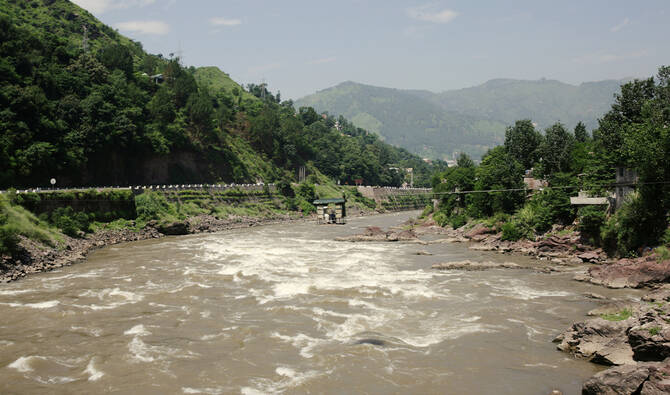
A general view of the River Jhelum is pictured from the Manak Payan refugee camp in Muzaffarabad, Pakistan-administered Kashmir, on August 8, 2019. (REUTERS/File)
Short Url
Updated 27 April 2025
Follow

Azad Kashmir warns of flooding in river Jhelum as India releases water amid tensions

  • Jhelum river flows from Indian-administered Kashmir into Azad Kashmir and then Pakistan’s Punjab province
  • Suspension of Indus Waters Treaty means India can stop sharing crucial information on release of water

ISLAMABAD: The government in Pakistan-administered Kashmir on Saturday warned of flooding in river Jhelum after India’s unannounced discharge of additional water, amid surging tensions between the two nuclear-armed neighbors. 

India announced this week it will suspend the 1960 Indus Waters Treaty under which the two neighbors regulate the water share of six rivers in the Indus Basin. This decision was taken after New Delhi blamed Pakistan for being involved in an attack in Indian-administered Kashmir that killed 26 tourists this week. Pakistan denies the allegations.

The Jhelum river flows from Indian-administered Kashmir into Azad Kashmir and then Punjab. Suspension of the Indus Waters Treaty means India can stop sharing crucial information and data on the release of water from barrages/dams or on flooding.

“Due to India releasing more water than usual into the Jhelum River, there is moderate flooding,” a spokesperson of the Azad Kashmir government said in a press release on Saturday. 

The spokesperson urged residents to avoid visiting areas near the Jhelum river due to the rising water levels.

As per the Indus Waters Treaty, Pakistan has rights to the western rivers— Indus, Jhelum, and Chenab— for irrigation, drinking, and non-consumptive uses like hydropower. India controls the eastern rivers— Ravi, Beas, and Sutlej— for unrestricted use but must not significantly alter their flow.

India can use the western rivers for limited purposes such as power generation and irrigation, without storing or diverting large volumes. Experts, like Hassaan F. Khan from Tufts University, argue that India lacks the infrastructure to divert large amounts of Indus waters.

Prime Minister Shehbaz Sharif on Saturday warned attempts to reduce or divert the flow of water belonging to Pakistan under the Indus Waters Treaty would be “responded to with full force.”

“Our valiant armed forces remain fully capable and prepared to defend the country’s sovereignty and its territorial integrity against any misadventure as clearly demonstrated by its measured yet resolute response to India’s reckless incursion in February 2019,” he said.


Pakistan, ADB sign $730 loan agreements to boost SOE reforms, energy infrastructure

Updated 25 December 2025
Follow

Pakistan, ADB sign $730 loan agreements to boost SOE reforms, energy infrastructure

  • Both sign $330 million Power Transmission Strengthening Project and $400 million SOE Transformation Program loan agreements
  • Economic Affairs Division official says Transmission Project will secure Pakistan’s energy future by strengthening national grid’s backbone

KARACHI: Pakistan and the Asian Development Bank (ADB) on Thursday signed two loan agreements totaling $730 million to boost reforms in state-owned enterprises (SOEs) and energy infrastructure in the country, the bank said.

The first of the two agreements pertains to the SOE Transformation Program worth $400 million while the second loan, worth $330 million, is for a Power Transmission Strengthening Project, the lender said. 

The agreements were signed by ADB Country Director for Pakistan Emma Fan and Pakistan’s Secretary of Economic Affairs Division Humair Karim. 

“The agreements demonstrate ADB’s enduring commitment to supporting sustainable and inclusive economic growth in Pakistan,” the ADB said. 

Pakistan’s SOEs have incurred losses worth billions of dollars over the years due to financial mismanagement and corruption. These entities, including the country’s national airline Pakistan International Airlines, which was sold to a private group this week, have relied on subsequent government bailouts over the years to operate.

The ADB approved the $400 million loan for SOE reforms on Dec. 12. It said the program seeks to improve governance and optimize the performance of Pakistan’s commercial SOEs. 

Karim highlighted that the Power Transmission Strengthening Project will enable reliable evacuation of 2,300 MW from Pakistan’s upcoming hydropower projects, relieve overloading of existing transmission lines and enhance resilience under contingency conditions, the Press Information Department (PID) said. 

“The Secretary emphasized that both initiatives are transformative in nature as the Transmission Project will secure Pakistan’s energy future by strengthening the backbone of the national grid whereas the SOE Program will enhance transparency, efficiency and sustainability of state-owned enterprises nationwide,” the PID said. 

The ADB has supported reforms by Pakistan to strengthen its public finance and social protection systems. It has also undertaken programs in the country to help with post-flood reconstruction, improve food security and social and human capital. 

To date, ADB says it has committed 764 public sector loans, grants and technical assistance totaling $43.4 billion to Pakistan.