

Pakistan’s commercial capital shuts down on religious party’s call for strike over Gaza

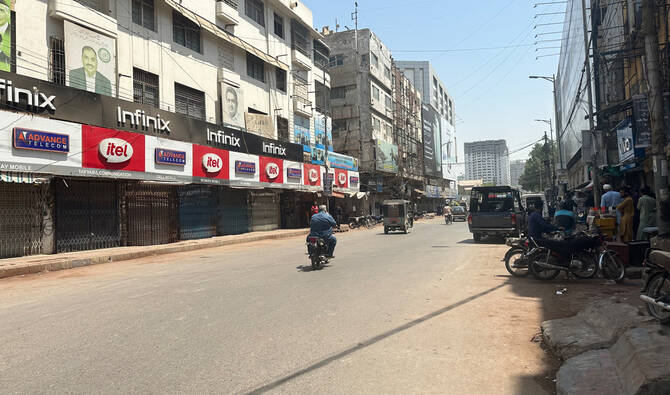
Commuters make their way through a partially deserted street during a nationwide strike called by a Pakistani political party and supported by trade organizations against the Israeli military aggression in Gaza, in Karachi, Pakistan on April 26, 2025. (AN Photo)
Short Url
Updated 26 April 2025
Follow

Pakistan’s commercial capital shuts down on religious party’s call for strike over Gaza

  • The strike was widely supported by organizations representing traders, lawyers and people from different walks of life
  • Pakistan has consistently demanded Israel’s accountability and called for uninterrupted flow of humanitarian aid into Gaza

KARACHI: Markets and businesses remained shut in Pakistan’s commercial capital of Karachi on Saturday in response to a nationwide strike called by Jamaat-e-Islami (JI) religious party to express solidarity with the people of Gaza, amid renewed Israeli military strikes in the Palestinian enclave.
The strike was widely supported by various organizations representing traders, lawyers and people from different walks of life, and there was no major commercial activity in the southern Pakistani port city.
It followed massive Gaza solidarity marches in Lahore, Karachi and Islamabad this month, which were attended by tens of thousands of Pakistanis who demanded the world stop Israeli military actions.
“Today, there is a strike throughout Karachi,” JI Karachi chief Monem Zafar Khan said, noting the strike was not only supported by Karachi’s business community but also by professionals and civil society groups.
“It is a shutter-down strike, and the entire business community of Karachi, the lawyers of Karachi, the students of Karachi, the scholars of Karachi, the civil society of Karachi — all of them are supporting this.”



Police patrol on streets during a nationwide strike called by a Pakistani political party and supported by trade organizations against the Israeli military aggression in Gaza, in Karachi, Pakistan on April 26, 2025. (AN Photo)

The strike was largely observed in Karachi and it could only partially take hold elsewhere in Pakistan.
Pakistan, which does not have diplomatic ties with Israel, has consistently condemned Israeli military actions and called for the uninterrupted flow of humanitarian aid into the Palestinian territory.
The South Asian country has stressed the urgent need to revive negotiations aimed at a two-state solution to the Palestine Issue, with East Jerusalem as the capital of a future Palestinian state.
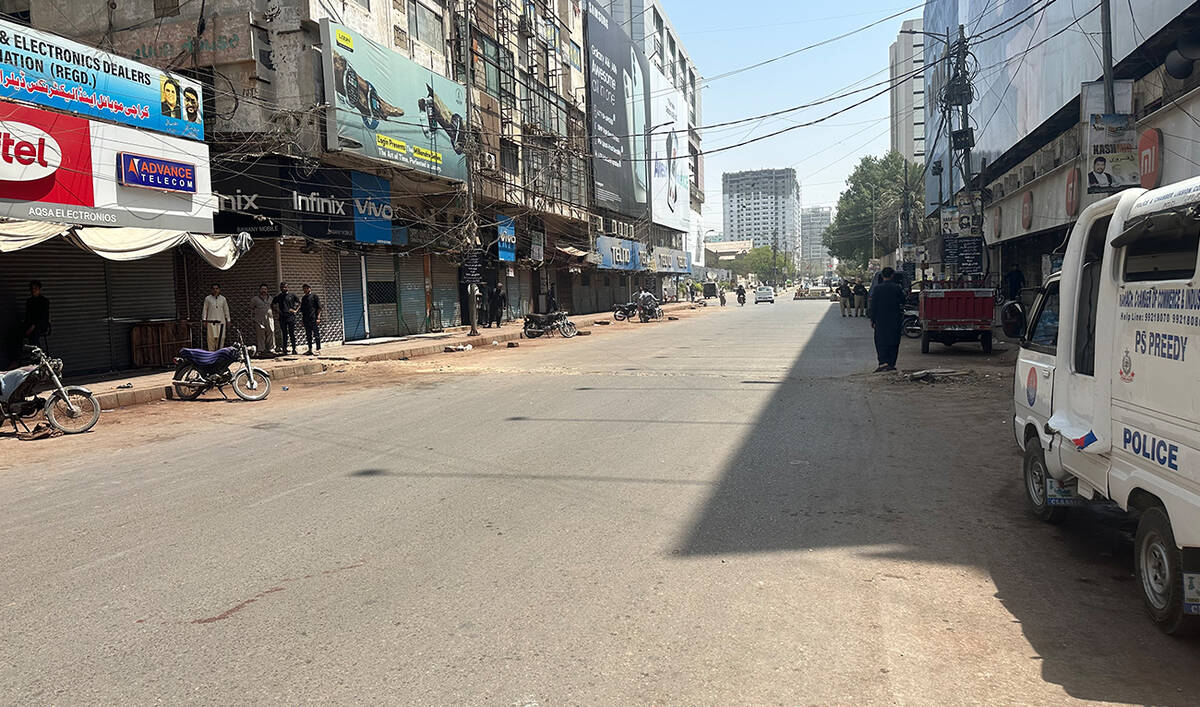


Commuters make their way through a partially deserted street during a nationwide strike called by a Pakistani political party and supported by trade organizations against the Israeli military aggression in Gaza, in Karachi, Pakistan on April 26, 2025. (AN Photo)

Muhammad Aslam Khan, general-secretary of the Cooperative Market Association, condemned Israel’s war on Gaza, which has killed over 50,000 Palestinians since Oct. 2023, and demanded stronger international action over it.
“It is now 12 o’clock and the city is completely silent and shut down,” Aslam told Arab News, surrounded by closed shops in the Saddar business district.
“We are sending them [Palestinians] a clear message that the hearts of the people are beating for the Palestinian Muslims, and we are deeply pained by the genocide happening to them, the oppression they are facing, and the fact that their basic needs like food and water have been completely cut off.”



Police stand guard during a nationwide strike called by a Pakistani political party and supported by trade organizations against the Israeli military aggression in Gaza, in Karachi, Pakistan on April 26, 2025. (AN Photo)

Usman Sharif, a representative of the All-Pakistan Cottage Industry Association in Karachi, said the Pakistani trader fraternity wanted to contribute to the Palestinian cause.
“Every trader says that they want to contribute in some way, whether it be through prayers, funds, participating in the strike, joining a rally, or through a boycott,” he said.
“The strike is happening across Pakistan, and here in Karachi as well, people have participated in the strike.”


Pakistan terms climate change, demographic pressures as ‘pressing existential risks’

Updated 06 December 2025
Follow

Pakistan terms climate change, demographic pressures as ‘pressing existential risks’

  • Pakistan has suffered frequent climate change-induced disasters, including floods this year that killed over 1,000
  • Pakistan finmin highlights stabilization measures at Doha Forum, discusses economic cooperation with Qatar 

ISLAMABAD: Pakistan’s Finance Minister Muhammad Aurangzeb on Saturday described climate change and demographic pressures as “pressing existential risks” facing the country, calling for urgent climate financing. 

The finance minister was speaking as a member of a high-level panel at the 23rd edition of the Doha Forum, which is being held from Dec. 6–7 in the Qatari capital. Aurangzeb was invited as a speaker on the discussion titled: ‘Global Trade Tensions: Economic Impact and Policy Responses in MENA.’

“He reaffirmed that while Pakistan remained vigilant in the face of geopolitical uncertainty, the more pressing existential risks were climate change and demographic pressures,” the Finance Division said. 

Pakistan has suffered repeated climate disasters in recent years, most notably the 2022 super-floods that submerged one-third of the country, displaced millions and caused an estimated $30 billion in losses. 

This year’s floods killed over 1,000 people and caused at least $2.9 billion in damages to agriculture and infrastructure. Scientists say Pakistan remains among the world’s most climate-vulnerable nations despite contributing less than 1 percent of global greenhouse-gas emissions.

Aurangzeb has previously said climate change and Pakistan’s fast-rising population are the only two factors that can hinder the South Asian country’s efforts to become a $3 trillion economy in the future. 

The finance minister noted that this year’s floods in Pakistan had shaved at least 0.5 percent off GDP growth, calling for urgent climate financing and investment in resilient infrastructure. 

When asked about Pakistan’s fiscal resilience and capability to absorb external shocks, Aurangzeb said Islamabad had rebuilt fiscal buffers. He pointed out that both the primary fiscal balance and current account had returned to surplus, supported significantly by strong remittance inflows of $18–20 billion annually from the Middle East and North Africa (MENA) and Gulf Cooperation Council (GCC) regions. 

Separately, Aurangzeb met his Qatari counterpart Ali Bin Ahmed Al Kuwari to discuss bilateral cooperation. 

“Both sides reaffirmed their commitment to strengthening economic ties, particularly by maximizing opportunities created through the newly concluded GCC–Pakistan Free Trade Agreement, expanding trade flows, and deepening energy cooperation, including long-term LNG collaboration,” the finance ministry said. 

The two also discussed collaboration on digital infrastructure, skills development and regulatory reform. They agreed to establish structured mechanisms to continue joint work in trade diversification, technology, climate resilience, and investment facilitation, the finance ministry said.