

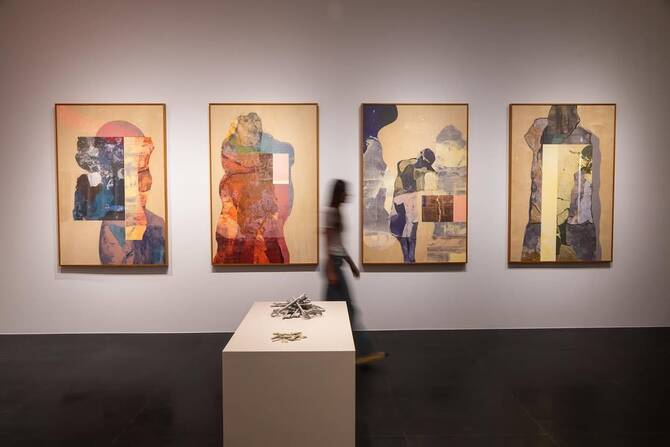

DUBAI: In his new exhibition, “Not There, Yet Felt,” at Tabari Artspace in Dubai, the Palestinian artist Hazem Harb is making things personal, both literally and figuratively, exploring the theme of displacement.
“It’s an out-of-body experience. I’m here and I’m not here,” he told Arab News. Harb is feeling torn; while his life and studio are physically based in Dubai, his heart and mind are emotionally attached to his birthplace of Gaza.
The show, on view until May 27, is lined with a series of aluminium self-portraits, based on silhouettes of the artist’s head and upper chest. Instead of seeing detailed facial features, the silhouettes are black, filled with images of colorful walls of Harb’s family home, which was destroyed as a result of the continuing Israeli assault. Such details of the walls, which were photographed by Harb’s nephew and a photojournalist in Gaza, took him by surprise. “I had no idea we had shades of blue, pink and yellow in the house,” he said. “There are so many layers and memories in that house.”
Above this series of self-portraits, a central neon artwork reads “Hope Is Power,” yet ‘power’ is flickering, indicating uncertainty and a loss of normalcy in daily life. Another instance of disturbance can be sensed in a large self-portrait, printed on paper and hanging on the wall, where the end parts of the paper are intensely crumpled. Exploring the multi-layered idea of peeling, there is also a group of calming, hand-made collage works, where wall peelings resemble figurative shapes.
Unlike his solo exhibition last year, in which there was a heady showcase of violently passionate work, entering Harb’s new show has a lighter, romantic feel, thanks to the gentle and romantic hues and language used. “Your Skin Is My Land,” a wall text reads. In the back room of the gallery, Harb is also presenting figurative paintings he made 20 years ago, resembling the flowing forms he experimented with for his new exhibition.
Despite the uncertainty felt by the artist, there is a glimmer of hope. One piece that shows this is a large work, where a body (made of medical gauze) stands still, carrying emotional wounds yet rising from the ashes. “The show is a statement. I felt a responsibility,” he said. “The whole world, not just Palestine, is in a very critical time, and I was thinking about the role of art in a sensitive, genocidal time. Art is a way to say something and is a part of history, an archive for the future.”


