Pakistan asks intending pilgrims to get vaccinated against meningitis, flu before leaving for Hajj

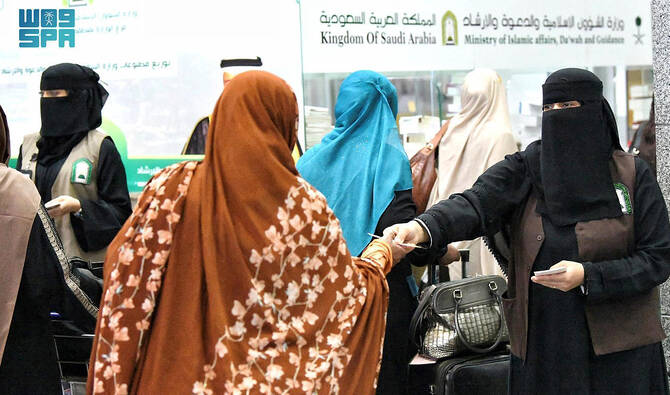
Pakistani pilgrims arrive at the King Abdulaziz International Airport in Jeddah on May 30, 2024. (SPA/File)
Short Url
Updated 29 April 2025
Follow

Pakistan asks intending pilgrims to get vaccinated against meningitis, flu before leaving for Hajj

  • Pakistan will launch its Hajj flight operations from April 29
  • Over 113,000 Pakistanis are expected to perform Hajj this year

ISLAMABAD: Pakistan’s religious affairs ministry on Saturday asked intending pilgrims to get vaccinated against meningitis, flu and polio before leaving for Saudi Arabia to perform the annual Hajj pilgrimage.
The annual pilgrimage is expected to take place in June. Nearly 90,000 Pakistanis are expected to travel to Saudi Arabia under the government scheme, while 23,620 Pakistanis will perform Hajj through private tour operators this year.
The South Asian country started vaccinating intending Hajj pilgrims against meningitis, flu and polio this week, with arrangement for the vaccination of pilgrims at 11 Hajj camps across the country.
The religious affairs ministry said it was mandatory to get the vaccinations, which are free of charge, warning that all pilgrims have to get jabbed and receive a proof of vaccination before leaving for the Kingdom.
“Without this, entry into Saudi Arabia will not be possible,” it said in a statement.
“Pilgrims over 65 years of age must carry their old coronavirus vaccine card. In case of absence of the card, only pilgrims over 65 years of age should get the coronavirus vaccine from the nearest Hajj camp.”
Pakistan will launch Hajj flight operations from Apr. 29, with the first flight departing from the eastern city of Lahore.
While a precise number of pilgrims for Hajj 2025 is difficult to be determined in advance, projections suggest it will be a record-breaking year, with over 2.5 million pilgrims expected.


Pakistan to auction 600 MHz spectrum next month to boost Internet speeds

Updated 05 January 2026
Follow

Pakistan to auction 600 MHz spectrum next month to boost Internet speeds

  • Pakistan has more than 130 million broadband connections, but access remains uneven despite increasing IT exports
  • Pakistani Internet users currently operate on about 274 MHz of spectrum, compared to around 600 MHz in Bangladesh

ISLAMABAD: Pakistan is set to auction a 600-megahertz (MHz) spectrum next month to ensure high speed and reliable Internet services across the country, state media reported on Monday, citing Information Technology (IT) Minister Shaza Fatima Khawaja.

The development comes at a time of mounting pressure on Pakistan’s telecom networks, with users and businesses complaining of slow Internet speeds and frequent disruptions as a limited spectrum struggles to serve the South Asian country.

Pakistan has more than 130 million broadband connections but access remains uneven, though its IT exports reached a record $3.8 billion in FY 2024–25, up from $3.2 billion the previous year, marking an 18 percent year-on-year increase, according to the Pakistan Software Export Board.

Speaking at an event in Islamabad, the IT minister said the federal cabinet has ratified the decision of spectrum auction, the Radio Pakistan broadcaster reported.

“This will not only improve 4G speed but also help roll out 5G services,” Khawaja was quoted as saying.

Khawaja last month said the quality of Internet service in Pakistan is not at par with international best practices or even regional standards, and one of the fundamental reasons for this was the non-availability of the spectrum.

Pakistani Internet users currently operate on about 274 MHz of spectrum, compared with around 600 MHz in Bangladesh, that leads to congestion, she told a news conference on Dec. 23, likening the situation to “trying to run eight lanes of traffic through two lanes.”

Speaking at Monday’s event, Khawaja reaffirmed the government’s commitment to investing in capacity-building of the youth.

“Youth are the country’s greatest asset,” she said, highlighting that over half a million young Pakistanis had been trained in various fields over the past 18 months.