


KARACHI: A high-level Pakistani delegation will “shortly” visit the United States to address trade imbalance between the two countries, Pakistani Finance Minister Muhammad Aurangzeb said on Friday.
The statement came after Aurangzeb’s meeting with Thomas Lersten, a senior State Department Official for economic growth, energy and environment, in Washington, on the sidelines of the International Monetary Fund-World Bank spring meetings.
The development comes as Islamabad mulls options, which range from importing crude oil from the US to abolishing tariffs on American imports, to offset a trade imbalance that has triggered higher tariffs from Washington.
In his meeting with Lersten, Aurangzeb thanked the United States for the participation of a well-represented US delegation in a minerals summit held in Pakistan this month, according to the Pakistani finance ministry.
“He expressed Pakistan’s desire to engage constructively to address the trade imbalance between the two countries and informed that a high-level trade and investment delegation was expected to visit the United States shortly to explore avenues of mutually rewarding economic engagement,” the ministry said.

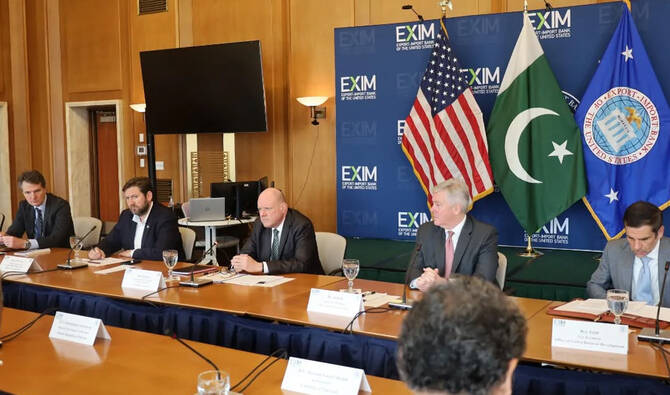
This handout photo, released by Pakistan’s Finance Ministry on April 26, 2025, shows officials from Pakistan (right) and senior representatives of the United States Export-Import Bank (left) during a meeting in Washington, on the sidelines of the IMF–World Bank Spring Meetings. (Photo courtesy Handout/Finance Ministry)
Pakistan is looking to buy more cotton and soybean from the US, while it is also in talks to tear down non-trade barriers to open its markets to more US products.
“We can also look at if there are any issues with respect to non-tariff discussion, whether there are any onerous inspections at our end for US products, we can obviously view that,” Aurangzeb told Bloomberg this week.
Islamabad is trying to appease the US to seek reprieve from the 29 percent reciprocal tariffs imposed by Trump. Those levies are on hold until July.
The US is Pakistan’s largest export market with over $5 billion in annual exports as of 2024, while Pakistan’s imports from the US are about $2.1 billion.
Aurangzeb also held a meeting with senior representatives of the US Export-Import Bank (EXIM), led by its Vice Chairman Jim Barrows, according to his ministry. The finance minister briefed the EXIM delegation on Pakistan’s improving macroeconomic fundamentals and the fiscal consolidation measures undertaken by the government.
“He called for the EXIM Bank’s enhanced support to facilitate greater US investment in Pakistan,” the finance minister said.
“Senator Aurangzeb further expressed Pakistan’s desire to engage constructively with the United States to address tariff-related issues and strengthen bilateral trade relations.”
Authorities are trying to rebuild Pakistan’s tattered economy after it came close to a default in 2023. The South Asian nation last year secured a 37-month, $7 billion IMF program to help stabilize the $350 billion South Asian economy.
This month, Fitch upgraded Pakistan’s credit rating, citing confidence that the South Asian country will be able to sustain reforms under the IMF loan program.


