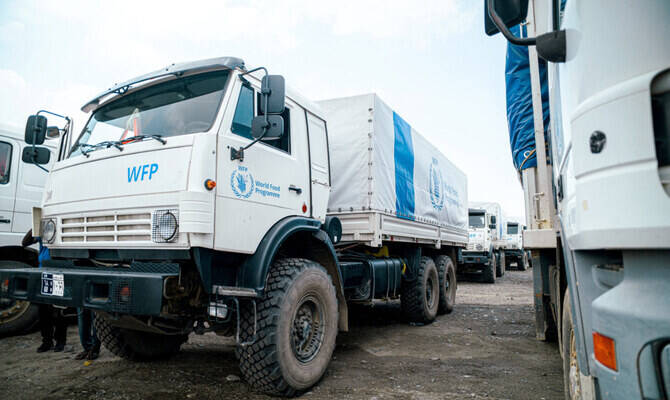
UN food, refugee agencies plan deep cuts as funding slashed, memos show

The UN agencies for food and refugees plan deep cuts due to an unprecedented plunge in funding, including from former top donor the US, internal memos sent to staff show, raising questions about how to maintain hunger relief. (Reuters/File)
Short Url
Updated 25 April 2025
Follow

UN food, refugee agencies plan deep cuts as funding slashed, memos show

  • The humanitarian sector has been roiled by funding cuts from major donors, led by the US
  • WFP director Stephen Omollo said that the cuts were necessary due to the “unprecedented funding environment“

GENEVA: The UN agencies for food and refugees plan deep cuts due to an unprecedented plunge in funding, including from former top donor the US, internal memos sent to staff show, raising questions about how to maintain hunger relief.
The humanitarian sector has been roiled by funding cuts from major donors, led by the United States under President Donald Trump, and other Western countries as they prioritize defense spending prompted by growing fears of Russia and China.
The World Food Programme, a Rome-based UN agency, warned last month that 58 million people are at risk of extreme hunger or starvation unless urgent funding for food aid arrives. Millions of people facing acute food shortages in Sudan could be affected, the WFP said on Friday.
In an internal memo sent to staff on Thursday and seen by Reuters, WFP director Stephen Omollo said that the cuts were necessary due to the “unprecedented funding environment,” with the 2025 donor outlook at $6.4 billion, or a 40 percent reduction versus last year. He did not name any countries responsible.
“We remain concerned that the situation shows no sign of improving,” he said, adding that the planned cuts might not be sufficient and that further downsizing was being explored.
“In this challenging donor environment, WFP will prioritize its limited resources on vital programs that bring urgently needed food assistance to the 343 million people struggling with hunger, and increasingly facing starvation,” the WFP said in a statement to Reuters.
The United States, Germany, Britain and the European Commission have been among the top donors in recent years, its website showed. WFP, like many United Nations agencies, relies entirely on voluntary donations.
The note to staff from UN High Commissioner for Refugees (UNHCR) chief Filippo Grandi dated April 23 said that it planned an overall reduction in costs of 30 percent and that the number of senior positions would be cut in half.
“We will have to close some country offices, instead covering these countries through strengthened multi-country office structures,” Grandi said.
UNHCR spokesperson William Spindler told a Geneva press briefing that the agency has been severely affected by funding uncertainty. “We have had to respond to this by stopping a lot of work we have been doing in the field,” he said.
A second spokesperson later added that UNHCR was undertaking a comprehensive review of its operations, staffing and structures, declining to give a timeline since the review is ongoing.


Chinese, Iranian warships in South Africa for exercises

Updated 4 sec ago
Follow

Chinese, Iranian warships in South Africa for exercises

  • China-led exercises near main navy base are also meant to involve Russia
  • Drills risk further straining South Africa’s ties with the United States
SIMON’S TOWN, South Africa: Chinese and Iranian warships were docked off South Africa’s main navy base Thursday ahead of exercises that officials said were also meant to involve Russia.
The January 9-16 “Will for Peace” drill hosted by South Africa risks further straining its ties with the United States, which is in dispute with many of the countries taking part.
AFP journalists saw two Chinese ships in Cape Town’s False Bay harbor on Wednesday, joined by an Iranian vessel on Thursday.
South African navy officials said warships from Russia were also expected to take part in the China-led exercises.
The drill was focused on the “safety of shipping and maritime economic activities,” the South African defense force said in December when it announced the maneuvers.
It was intended to “deepen cooperation in support of peaceful maritime security initiatives,” it said.
The statement said the exercise would involve navies from BRICS countries.
BRICS, originally made up of Brazil, Russia, India, China and South Africa, has expanded to include Egypt, Ethiopia, Iran, Saudi Arabia, the United Arab Emirates and, more recently, Indonesia.
The joint drills — previously known as Exercise Mosi — were initially scheduled for November 2025 but were postponed due to a clash with the G20 summit in Johannesburg.
South Africa’s Democratic Alliance (DA), a member of the ruling unity government, said parliament had not been “properly briefed” on the drills, including cost, command structure and diplomatic consequences.
“South Africa’s defense and foreign policy must be transparent, constitutional, and principled and certainly not being quietly reshaped through military exercises that contradict our stated neutrality and damage our standing in the world,” DA spokesperson on defense, Chris Hattingh, said in a statement.
The center-right party — which joined government after the African National Congress lost its majority in 2024 due to voter disillusionment with corruption and mismanagement — vowed to demand full transparency in parliament.
President Donald Trump has accused countries in the BRICS group of emerging nations of “anti-American” policies.
South Africa has drawn US criticism for its close ties with Russia and a range of other policies, including its decision to bring a genocide case against Israel at the International Court of Justice over the Gaza war.
South Africa’s military was criticized for hosting naval exercises with Russia and China in 2023 that coincided with the one-year anniversary of the Kremlin’s invasion of Ukraine.
The three countries first conducted joint naval drills in 2019.