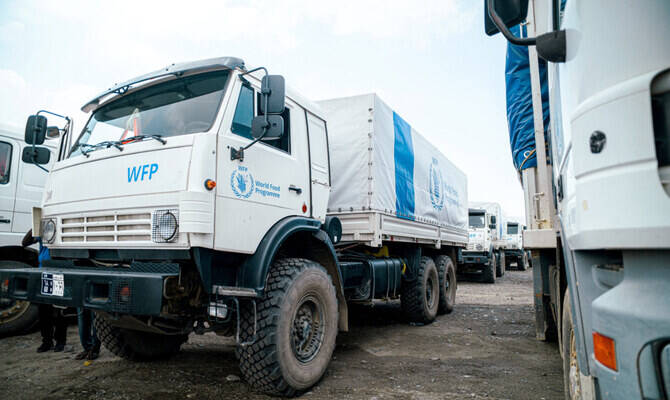
Funding shortages may halt global child malnutrition programs, WFP warns

Programmes to help prevent malnourishment in children in Yemen, Afghanistan and Syria could be suspended within months if urgent funding is not found, the UN's World Food Programme warned on Wednesday. (Reuters/File)
Short Url
Updated 26 March 2025
Follow

Funding shortages may halt global child malnutrition programs, WFP warns

  • “If we fail to act, we are condemning millions of children to a lifetime of suffering,” said WFP Executive Director Cindy McCain
  • The US provided $4.5 billion of the $9.8 billion budget last year for the WFP

GENEVA: Programmes to help prevent malnourishment in children in Yemen, Afghanistan and Syria could be suspended within months if urgent funding is not found, the UN’s World Food Programme warned on Wednesday.
“If we fail to act, we are condemning millions of children to a lifetime of suffering,” said WFP Executive Director Cindy McCain in a statement ahead of a summit in Paris on Wednesday where governments and charities will discuss tackling growing global malnutrition and hunger.
The WFP has suffered severe financial setbacks after the US, its single largest donor, announced a 90-day pause on foreign aid assistance while it determines if programs are aligned with the Trump administration’s “America first” policy.
The US provided $4.5 billion of the $9.8 billion budget last year for the WFP, which gives food and cash assistance to people suffering from hunger due to crop shortages, conflict and climate change worldwide.
The organization called on Wednesday for $1.4 billion to deliver malnutrition prevention and treatment programs for 30 million mothers and children in 56 countries in 2025, saying malnutrition is worsening worldwide due to war, economic instability and climate change.
It did not give details on its financial shortfall or mention the US
Prevention programs in Yemen, where one-third of children under the age of 5 are malnourished, could stop from May if additional funding was not received, the WFP said. The UN children’s agency UNICEF said on Tuesday that western coastal areas of Yemen are on the verge of a catastrophe due to malnutrition.
McCain said that the WFP is being forced to make tough choices such as prioritising treatment over prevention due to lack of funds. Programmes in Afghanistan could also be stopped by May, while in Syria and the Democratic Republic of Congo programs could be reduced from June unless money is found.
Earlier this month, the WFP announced potential cuts to food rations for Rohingya refugees, raising concern among aid workers of rising hunger in the overcrowded camps.
The WFP said the reduction was due to a broad shortfall in donations, not the Trump administration’s move to cut foreign aid globally.
But a senior Bangladeshi official told Reuters that the US decision most likely played a role, as the US has been the top donor for Rohingya refugee aid.


Trump says he asked Putin not to target Kyiv for 1 week during brutal cold spell

Updated 29 January 2026
Follow

Trump says he asked Putin not to target Kyiv for 1 week during brutal cold spell

  • “I personally asked President Putin not to fire on Kyiv and the cities and towns for a week during this ... extraordinary cold,” Trump said
  • Zelensky, for his part, thanked Trump for his effort and welcomed the “possibility” of a pause

KYIV: US President Donald Trump said Thursday that President Vladimir Putin has agreed not to target the Ukrainian capital and other towns for one week as the region experiences frigid temperatures.
There was no immediate confirmation from the Kremlin that Putin has agreed to such a pause.
Russia has been pounding Ukraine’s critical infrastructure, hoping to wear down public resistance to the war while leaving many around the country having to endure the dead of winter without heat.
“I personally asked President Putin not to fire on Kyiv and the cities and towns for a week during this ... extraordinary cold,” Trump said during a Cabinet meeting at the White House, adding that Putin has “agreed to that.”
Kremlin spokesman Dmitry Peskov was asked earlier Thursday whether a mutual halt on strikes on energy facilities was being discussed between Russia and Ukraine, and he refused to comment on the issue.
Ukrainian President Volodymyr Zelensky late Wednesday had warned that Moscow was planning another large-scale barrage despite plans for further US-brokered peace talks at the weekend.
Trump said he was pleased that Putin has agreed to the pause. Kyiv, which has grappled with severe power shortages this winter, is forecast to enter a brutally cold stretch starting Friday that is expected to last into next week. Temperatures in some areas will drop to minus 30 degrees Celsius (minus 22 Fahrenheit), the State Emergency Service warned.
“A lot of people said, ‘Don’t waste the call. You’re not going to get that.’” the Republican US president said of his request of Putin. “And he did it. And we’re very happy that they did it.”
Zelensky, for his part, thanked Trump for his effort and welcomed the “possibility” of a pause in Russian military action on Kyiv and beyond. “Power supply is a foundation of life,” Zelensky said in his social media post.
Trump did not say when the call with Putin took place or when the ceasefire would go into effect. The White House did not immediately respond to a query seeking clarity about the scope and timing of the limited pause in the nearly four-year war.
Russia has sought to deny Ukrainian civilians heat and running water over the course of the war, which began with Russia’s full-scale invasion on Feb. 24, 2022. Ukrainian officials describe the strategy as “weaponizing winter.”
Last year was the deadliest for civilians in Ukraine since 2022 as Russia intensified its aerial barrages behind the front line, according to the UN Human Rights Monitoring Mission in the country.
The war killed 2,514 civilians and injured 12,142 in Ukraine — 31 percent higher than in 2024, it said.