
RIYADH: The Saudi Arabian Museum of Contemporary Art in Riyadh is currently hosting “Adaptability,” an exhibition of work in clay by 11 artists from five different Arab countries, each offering their unique perspective on our relationship with the material. The show runs until May 20.
“This exhibition beautifully illustrates the adaptability of clay, showcasing human creativity and our capacity for enduring change across cultures and civilizations,” curator Samer Yamani told Arab News. “It shows the similarity between clay and humans: We both are so strong, but fragile, and the higher the fire gets, the stronger we get — we adapt to new circumstances and new things happening in life; we are able to innovate and to be present.”
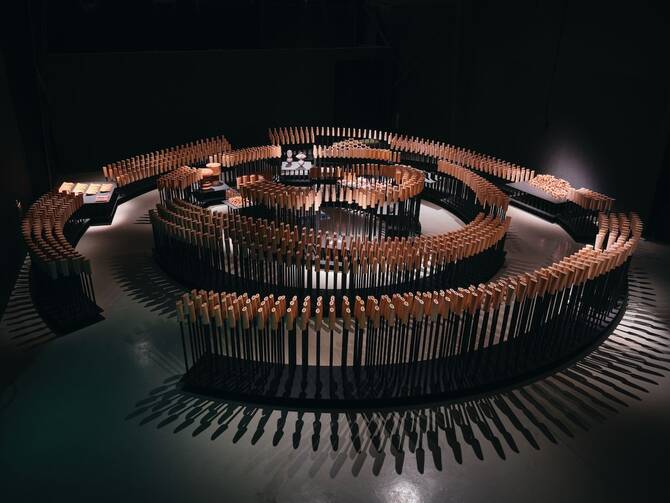
The show is laid out in three circles. The inner one includes work that expresses inner thoughts and emotions; the middle explores topics related to communities, culture, and life; the outer circle addresses heritage, urbanism, and sustainability.

Hana El-Sagini's 'The Doctor's Desk.' (Supplied)
“Clay is such a malleable material that you can shape through many different forms — hand-made, technological, mechanical… so it’s interesting to see all the different ways that the various artists have used or thought about clay; some more technical, some to express more emotional stories. The dialogue between the different ways of thinking with the same material is very interesting,” participating Jordanian artist Sama Alsaket told Arab News.
Alsaket’s piece, found in the middle circle, is titled “Shades of Terracotta” and was constructed from five different types of clay sourced from her home country. Combining her background in architecture with visual art, her work is intended to spark discourse around handmade, digital, and industrial processes.
“My work focuses on researching the different kinds of clay in Jordan and documenting traditional techniques there,” she said. “Through exploring these kinds of clay, which are iron-rich and usually used for terracotta, I was thinking about how to translate a vessel which is usually made out of terracotta and used to store water into something that is vertical. I was also thinking about how to leverage the different qualities and characteristics of terracotta in architecture.”
She added: “Riyadh seems like such an amazing platform for artists and they’re trying to shape and think about what contemporary art in the Middle East is.”

Sama Alsaket's ‘Shades of Terracotta.’ (Supplied)
Egyptian artist Hana El-Sagini’s “The Doctor’s Desk” also features in the exhibition.
“It’s a reflection on illness as a female,” El-Sagini told Arab News. “I was a cancer patient and as a Middle Eastern Muslim woman you kind of protect your body and it’s very sacred, but once you become a patient, things totally change. You become this object they need to fix, which is very noble of them, but it’s a very overwhelming experience for us. Anyone who’s going through adversity goes through surreal ideas of reality versus illusion and ‘Is this really happening to me?’ Like with heartbreak, or the death of a loved one, or illness — all of these — you find yourself in a surreal state. This is why there are a lot of fingers in the work.”
The work is playful as well, she added. “I’m Egyptian, so I need to have that dark humor.”
El-Sagini is better known as a painter. In fact, “The Doctor’s Desk” is her first ceramic work.
“It was the right medium for this work: it’s fragile, it’s real, it’s malleable, raw, and very expressive,” she said. “It’s not perfect. It’s kind of a reflection on the human form.”