

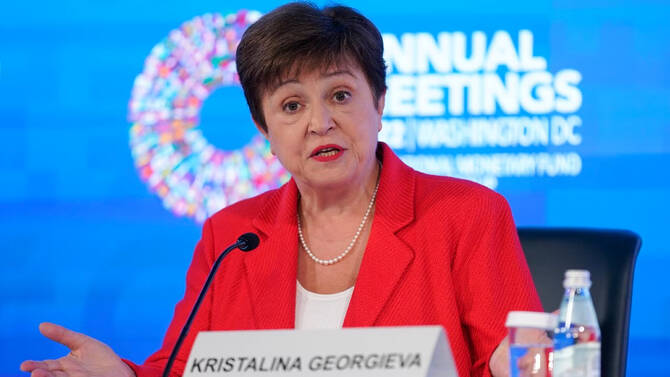
IMF to help Syria reintegrate into global economy, says Georgieva

IMF chief Kristalina Georgieva told reporters that Syria’s central bank governor and finance minister attended the Spring Meetings of the IMF and World Bank this week for the first time in over 20 years.
Short Url
Updated 24 April 2025
Follow

IMF to help Syria reintegrate into global economy, says Georgieva

WASHINGTON: The International Monetary Fund plans to work with Syria to help it reintegrate into the global economy, IMF chief Kristalina Georgieva said on Thursday, citing a meeting on the war-scarred nation held this week.

Georgieva told reporters that Syria’s central bank governor and finance minister attended the Spring Meetings of the IMF and World Bank this week for the first time in over 20 years.

“Our intention is to, first and foremost, help them rebuild institutions so they can plug themselves in the world economy,” she said.

Officials from the IMF and World Bank met with Syrian officials and other finance ministers and key stakeholders to discuss the country’s reconstruction on the sidelines of the meetings in Washington.

The high-level Syrian government delegation’s Washington trip marked the first US visit by Syria’s new authorities since former President Bashar Al-Assad was toppled in December.

Much of Syria’s infrastructure has been left in ruins by nearly 14 years of war sparked by the government authorities’ deadly crackdown on protests against Al-Assad.

The government that took over after Al-Assad was ousted has sought to rebuild Syria’s ties in the region and further afield and to win support for reconstruction efforts.

But tough US sanctions imposed during Al-Assad’s rule remain in place.

In January, the US issued a six-month exemption for some sanctions to encourage humanitarian aid, but this has had limited effect.

Reuters reported in February that efforts to bring in foreign financing to pay public sector salaries had been hampered by uncertainty over whether this could breach US sanctions.


Saudi Arabia’s cultural sector is a new economic engine between Riyadh and Paris, says ambassador

Updated 25 January 2026
Follow

Saudi Arabia’s cultural sector is a new economic engine between Riyadh and Paris, says ambassador

RIYADH: Culture has become a fundamental pillar in bilateral relations between France and Saudi Arabia, according to the French Ambassador to the Kingdom, Patrick Maisonnave.

Maisonnave noted its connection to the entertainment and tourism sectors, which makes it a new engine for economic cooperation between Riyadh and Paris.

He told Al-Eqtisadiah during the opening ceremony of La Fabrique in the Jax district of Diriyah that cultural cooperation with Saudi Arabia is an important element for its attractiveness in the coming decades.

La Fabrique is a space dedicated to artistic creativity and cultural exchange, launched as part of a partnership between the Riyadh Art program and the French Institute in Riyadh. 

Running from Jan. 22 until Feb 14, the initiative will provide an open workspace that allows artists to develop and work on their ideas within a collaborative framework.

Launching La Fabrique as a space dedicated to artistic creativity

The ambassador highlighted that the transformation journey in the Kingdom under Vision 2030 has contributed to the emergence of a new generation of young artists and creators, alongside a growing desire in Saudi society to connect with culture and to embrace what is happening globally. 

He affirmed that the relationship between the two countries is “profound, even cultural par excellence,” with interest from the Saudi side in French culture, matched by increasing interest from the French public and cultural institutions unfolding in the Kingdom.

Latest estimates indicate that the culture-based economy represents about 2.3 percent of France’s gross domestic product, equivalent to more than 90 billion euros ($106.4 billion) in annual revenues, according to government data. The sector directly employs more than 600,000 people, making it one of the largest job-creating sectors in the fields of creativity, publishing, cinema, and visual arts.

Saudi Arabia benefiting from French experience in the cultural field

Maisonnave explained that France possesses established cultural institutions, while Saudi Arabia is building a strong cultural sector, which opens the door for cooperation opportunities.

This comes as an extension of the signing of 10 major cultural agreements a year ago between French and Saudi institutions, aiming to enhance cooperation and transfer French expertise and knowledge to contribute to the development of the cultural system in the Kingdom.

He added that experiences like La Fabrique provide an opportunity to meet the new generation of Saudi creators, who have expressed interest in connecting with French institutions and artists in Paris and France.

La Fabrique encompasses a space for multiple contemporary artistic practices, including performance arts, digital and interactive arts, photography, music, and cinema, while providing the public with an opportunity to witness the stages of producing artistic works and interact with the creative process.