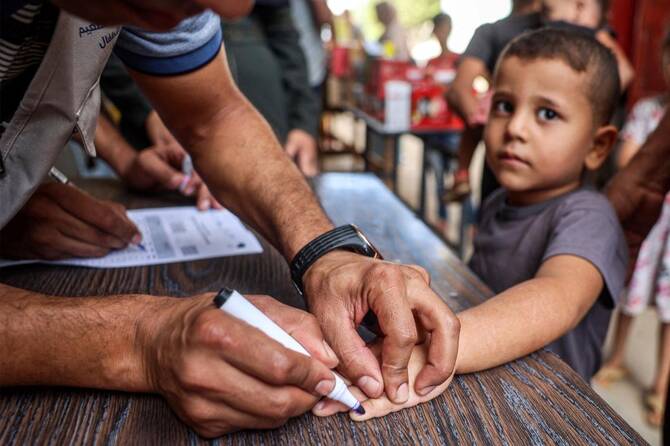
LONDON: Global aid funding cuts, led by the United States, are disrupting efforts to vaccinate children against deadly diseases almost as much as the COVID-19 pandemic did, the United Nations said on Thursday.
Outbreaks of infectious diseases, including measles, meningitis and yellow fever, have been increasing globally.
Emergency and routine vaccinations meanwhile were significantly affected in nearly half of countries at the start of April due to the funding cuts, according to reports from World Health Organization offices in 108 largely low and lower-middle income countries.
Cuts to funding also reduced vaccine supplies and hampered disease surveillance, the WHO and UNICEF said in a joint release with Gavi, the Vaccine Alliance.
“Setbacks (are) at a similar level to what we saw during COVID-19. We cannot afford to lose ground in the fight against preventable disease,” said Catherine Russell, UNICEF executive director. COVID-19 caused what was called the largest backslide in childhood vaccination in a generation, and aid funding cuts, led by the US – formerly the world’s largest donor – risked the same outcome, the joint release said.
They called for funding for childhood immunization to be maintained ahead of Gavi’s funding round, which will be launched in June. The group is seeking $9 billion for its work from 2026-2030.
Sania Nishtar, Gavi’s chief executive officer, said it was possible to fight the rise of infectious diseases but only if the group is fully funded.
Measles cases have increased year-on-year since 2021, while meningitis surged in Africa last year and yellow fever cases also rose after declines in the last decade, the agencies said. Last month, an internal US government document showed it would follow its cuts to UNICEF and the WHO, part of wider plans to streamline and focus foreign aid to align with the “America First” policy, by canceling its contribution of around $300 million annually to Gavi.
Last week, the US State Department told Reuters it had nominated Mark Lloyd, assistant administrator for global health, to Gavi’s 28-person board. The US seat had previously been vacant.
Both the US State Department and Gavi declined to comment about what this could mean for US funding.

Aid funding cuts disrupt child vaccinations almost as much as pandemic, says UN
https://arab.news/c5vz2
Aid funding cuts disrupt child vaccinations almost as much as pandemic, says UN
- Outbreaks of infectious diseases, including measles, meningitis and yellow fever, have been increasing globally
- Cuts to funding also reduced vaccine supplies and hampered disease surveillance
Report highlights role of British Muslim charitable giving in supporting UK public services
- The study, “Building Britain: British Muslims Giving Back,” finds that donations from British Muslims are helping to bolster overstretched service
LONDON: British Muslim charitable giving is playing an increasingly significant role in supporting frontline public services across the UK, according to a new report by policy and research organization Equi.
The study, “Building Britain: British Muslims Giving Back,” finds that donations from British Muslims are helping to bolster overstretched services, including local councils, the NHS and welfare systems, at a time of growing financial pressure.
The report estimates that Muslim donors contribute around £2.2 billion ($2.9 billion) annually, making them the UK’s most generous community.
This figure is around four times the national giving average and rises to almost 10 times the average among higher earners.
According to the findings, Muslim-led charities are providing a wide range of support, including housing assistance, emergency cash grants, food provision and mental health services, easing demand on statutory services.
Equi points to evidence from 2023 showing that housing support delivered by the National Zakat Foundation helped prevent evictions that would have cost councils an estimated £28.8 million, with every £1 of charitable spending generating £73 in public sector savings.
The report also highlights a generational shift, with younger British Muslims increasingly directing their donations toward domestic causes such as homelessness, child poverty and mental health challenges.
Despite their growing impact, Muslim charities face a number of barriers, including de-banking, restrictive funding rules, securitization measures and what the report describes as limited recognition from government. Equi argues that these challenges are constraining the sector’s ability to maximize its contribution.
“British Muslim giving is not just generosity but a lifeline for public services that needs recognizing,” said Equi Managing Director Prof. Javed Khan.
“From preventing evictions to supporting mental health, these donations are saving millions for the taxpayer and strengthening communities across Britain. The evidence is clear that Muslim-led action is delivering frontline support where the state is struggling,” he added.
Equi is calling on policymakers to engage more closely with Muslim-led charities and to move beyond what it describes as symbolic recognition.
The report recommends measures such as UK-based match-funding schemes and greater faith literacy within policymaking, which it says could unlock billions of pounds in additional domestic spending while maintaining the UK’s global humanitarian commitments.
The study concluded that with greater collaboration between government and Muslim charities, charitable giving could play an even more transformative role in strengthening public services and social cohesion across the country.


