Pakistan calls for revival of multilateralism at UN amid rising global tensions​

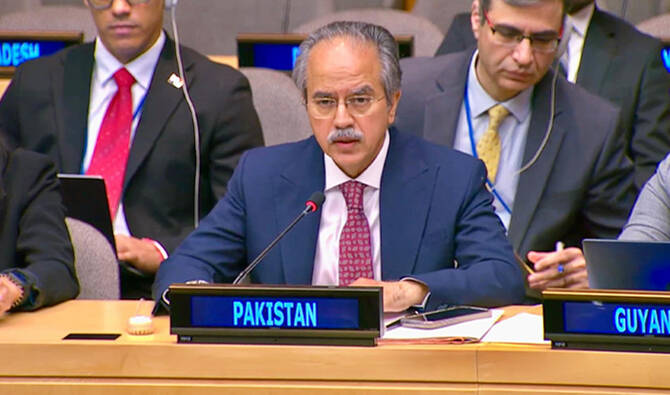
Permanent Representative of Pakistan to the United Nations, Ambassador Asim Iftikhar Ahmad, addresses United Nations Security Council's meeting in New York, US, on April 23, 2025. (@PakistanUN_NY/X)
Short Url
Updated 24 April 2025
Follow

Pakistan calls for revival of multilateralism at UN amid rising global tensions​

  • Ambassador Ahmad highlights the unraveling of longstanding norms supporting global peace
  • He says international trade should reflect the aspirations and needs of developing countries

ISLAMABAD: Pakistan’s top diplomat to the United Nations, Ambassador Asim Iftikhar Ahmad, urged the international community to reaffirm it commitment to multilateralism and collective action during a Security Council meeting convened by China on Wednesday.
​An informal session, the meeting provided a platform to the member states to discuss the challenges posed by unilateral actions in the current global context.
Ambassador Ahmad highlighted the unraveling of longstanding norms that underpin global peace and cooperation, emphasizing the need to revive faith in multilateralism.​
“History reminds us that enduring peace and sustainable solutions have never come from unilateral actions or coercive practices,” he said. “They emanate from inclusion, respect, shared purpose and unified responses.”
The Pakistani diplomat also called for reforms in the international trading system to better reflect the aspirations and needs of developing countries.
“Trade should be a bridge, not a barrier — a vehicle for peace and shared prosperity, not domination or isolation,” he added.
Ahmad underscored the importance of empowering the UN to lead global development cooperation and champion equitable systems of trade, finance and climate governance.
He reaffirmed Pakistan’s unwavering belief in multilateralism and the central role of the world body in fostering a fairer, more peaceful and compassionate international order.​
The UN meeting was held at a time when the international community faces increasing polarization, with wars, inequality, economic instability and climate change threatening global peace and security.



Pakistan to begin first phase of Hajj 2026 trainings from today

Updated 31 December 2025
Follow

Pakistan to begin first phase of Hajj 2026 trainings from today

  • Training programs to be held in phases across Pakistan till February, says religion ministry
  • Saudi Arabia allocated Pakistan a total quota of 179,210 pilgrims for Hajj 2026

ISLAMABAD: Pakistan’s religious affairs ministry has said that it will begin the first phase of mandatory Hajj 2026 training for pilgrims intending to perform the pilgrimage from today, Thursday.

The one-day Hajj training programs will be held in phases across the country at the tehsil level until February. The ministry directed intending pilgrims to bring their original identity cards and the computerized receipt of their Hajj application to attend the training sessions.

“Pilgrims should attend the one-day training program according to their scheduled date,” Pakistan’s Ministry of Religious Affairs (MoRA) said in a statement.

The ministry said training schedules are being shared through the government’s Pak Hajj 2026 mobile application as well as via SMS. It added that details of the schedule are also available on its website.

According to the ministry, training programs will be held in Abbottabad on Jan. 2; Ghotki, Thatta and Kotli on Jan. 3; and Tando Muhammad Khan and Khairpur on Jan. 4.

Hajj training sessions will be held in Rawalakot, Badin and Naushahro Feroze on Jan. 5, while pilgrims in Fateh Jang, Dadu and Tharparkar will receive the training on Jan. 6.

The ministry said training programs will be conducted in Umerkot and Larkana on Jan. 7, followed by sessions in Mirpurkhas, Shahdadkot and Mansehra on Jan. 8.

Pakistan’s religious affairs ministry has previously said these trainings will be conducted by experienced trainers and scholars using multimedia.

It said the training has been made mandatory to ensure that intending pilgrims are fully aware of Hajj rituals and administrative procedures.

Saudi Arabia has allocated Pakistan a quota of 179,210 pilgrims for Hajj 2026, of which around 118,000 seats have been reserved under the government scheme, while the remainder will be allocated to private tour operators.

Under Pakistan’s Hajj scheme, the estimated cost of the government package ranges from Rs1,150,000 to Rs1,250,000 ($4,049.93 to $4,236), subject to final agreements with service providers.