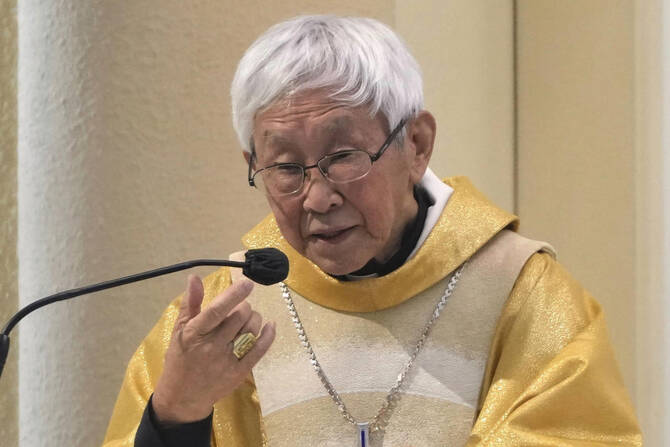
HONG KONG: Hong Kong’s outspoken Roman Catholic Cardinal Joseph Zen was allowed to leave the southern Chinese city to attend Pope Francis’ funeral in Vatican City.
Zen, a 93-year-old retired bishop, left Hong Kong on Wednesday night after applying at a court to get back his passport, his secretary said in a text message on Thursday. Authorities confiscated his passport after his controversial arrest under a Beijing-imposed national security law in 2022.
Zen is among the critics in recent years who have said the Vatican’s agreement with Chinese authorities on the appointment of bishops betrays pro-Vatican Chinese Catholics. He has also criticized Secretary of State Pietro Parolin, the official charged with negotiations with Beijing, as a “man of little faith.”
Parolin is considered one of the main contenders to be the next pope, given his prominence in the Catholic hierarchy.
On Tuesday, media reports said Zen had issued a critique of the Vatican, questioning why pre-conclave meetings started as early as Tuesday. The AP could not independently verify the reports, but Zen reposted the reporters’ posts about his statement on his X account.
His secretary said Zen would return to Hong Kong after the late pope’s funeral, which is scheduled for Saturday. But she was unsure about his exact return date.
It was not the first time Zen had to go through the city’s court to leave Hong Kong. In 2023, he went through similar procedures to pay his respects to the late Pope Emeritus Benedict XVI. He met Pope Francis in a private audience during that trip.
Zen was first arrested in 2022 on suspicion of colluding with foreign forces under the security law. His arrest sent shockwaves through the Catholic community at that time.
While Zen has not yet faced national security-related charges, he and five others were fined in 2022 after being found guilty of failing to register a now-defunct fund that aimed to help people arrested in widespread 2019 pro-democracy protests in Hong Kong. A hearing on his appeal against the conviction is scheduled for December.
Separately, Hong Kong cardinal Stephen Chow will travel to the Vatican for the conclave, the city’s Catholic Social Communications Office said Thursday.
In 2023, a Beijing bishop who was installed by China’s state-controlled Catholic church as an archbishop visited Hong Kong at the invitation of Chow. It was the first-ever official visit by a Beijing bishop to the city. Experts at that time said Chow’s invitation was a symbolic gesture that could strengthen the fragile ties between China and the Vatican.
Beijing and the Vatican severed diplomatic ties following the Chinese Communist Party’s rise to power and the expulsion of foreign priests. Since the break in ties, Catholics in China have been divided between those who belong to an official, state-sanctioned church and those in an underground church loyal to the pope. The Vatican recognizes members of both as Catholics but claims the exclusive right to choose bishops.


![]()


Hong Kong allows outspoken Cardinal Joseph Zen to attend Pope Francis’ funeral
Short Url
https://arab.news/bbuu5
Hong Kong allows outspoken Cardinal Joseph Zen to attend Pope Francis’ funeral
- Zen have said the Vatican’s agreement with Chinese authorities on the appointment of bishops betrays pro-Vatican Chinese Catholics
- He has also criticized Secretary of State Pietro Parolin, the official charged with negotiations with Beijing, as a ‘man of little faith’

US NATO envoy says allies must ‘pull weight’ after Czech defense cut
PRAGUE, March 12 : The United States’ ambassador to NATO said on Thursday that all allies must “pull their weight,” after Czech lawmakers approved a 2026 budget that cuts defense outlays.
Czech Prime Minister Andrej Babis’ government, in power since December, pushed a revamped budget through the lower house on Wednesday evening which cut the defense ministry’s allocation versus a previous proposal to 154.8 billion crowns ($7.31 billion), or 1.73 percent of gross domestic product.
That is below a NATO target of 2 percent of GDP already expected before alliance members pledged last year in the Hague to raise defense spending to 3.5 percent of GDP plus 1.5 percent on other defense-relevant investments over the next decade.
The Czech Finance Ministry says total defense spending in the budget will reach 2.07 percent of GDP, but the country’s budget watchdog has warned that includes money earmarked elsewhere, like for the transport ministry for road projects, that may not be recognized by NATO.
“All Allies must pull their weight and honor The Hague Defense Commitment,” US Ambassador to NATO Matthew Whitaker said on X on Thursday with a picture of a news headline on the Czech budget approval.
“These numbers are not arbitrary. They are about meeting the moment — and the moment requires 5 percent as the standard. No excuses, no opt-outs.”
European NATO countries are under pressure to raise defense spending amid the Ukraine-Russia war and at US President Donald Trump’s urging.
Babis, whose populist ANO party won elections last year, said in February the country was “certainly not” on the path to raising core defense spending to the 3.5 percent target, saying there was a different focus, like on health care.
The budget watchdog on Thursday reiterated “strong doubts” that some spending deemed defense in this year’s budget would meet NATO’s definition.
President Petr Pavel, a former NATO official, has also said defense cuts risked a loss of trust from allies — but has signalled he would not veto the budget.
US Ambassador to Prague Nicholas Merrick said last week the Czech Republic may slip to the bottom of NATO’s defense-spending ranks.
Czech Prime Minister Andrej Babis’ government, in power since December, pushed a revamped budget through the lower house on Wednesday evening which cut the defense ministry’s allocation versus a previous proposal to 154.8 billion crowns ($7.31 billion), or 1.73 percent of gross domestic product.
That is below a NATO target of 2 percent of GDP already expected before alliance members pledged last year in the Hague to raise defense spending to 3.5 percent of GDP plus 1.5 percent on other defense-relevant investments over the next decade.
The Czech Finance Ministry says total defense spending in the budget will reach 2.07 percent of GDP, but the country’s budget watchdog has warned that includes money earmarked elsewhere, like for the transport ministry for road projects, that may not be recognized by NATO.
“All Allies must pull their weight and honor The Hague Defense Commitment,” US Ambassador to NATO Matthew Whitaker said on X on Thursday with a picture of a news headline on the Czech budget approval.
“These numbers are not arbitrary. They are about meeting the moment — and the moment requires 5 percent as the standard. No excuses, no opt-outs.”
European NATO countries are under pressure to raise defense spending amid the Ukraine-Russia war and at US President Donald Trump’s urging.
Babis, whose populist ANO party won elections last year, said in February the country was “certainly not” on the path to raising core defense spending to the 3.5 percent target, saying there was a different focus, like on health care.
The budget watchdog on Thursday reiterated “strong doubts” that some spending deemed defense in this year’s budget would meet NATO’s definition.
President Petr Pavel, a former NATO official, has also said defense cuts risked a loss of trust from allies — but has signalled he would not veto the budget.
US Ambassador to Prague Nicholas Merrick said last week the Czech Republic may slip to the bottom of NATO’s defense-spending ranks.
Latest updates


© 2026 SAUDI RESEARCH & PUBLISHING COMPANY, All Rights Reserved And subject to Terms of Use Agreement.