A dozen states sue the Trump administration to stop tariff policy

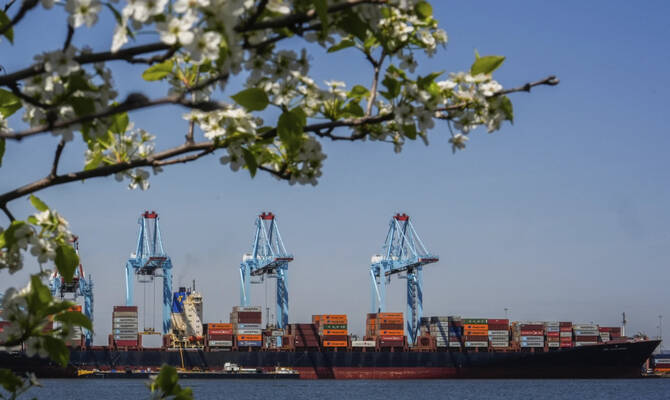
Shipping containers sit on the container ship Alexandra at the Port Newark Container Terminal, April 18, 2025, in Newark, New Jersey. (AP)
Short Url
Updated 24 April 2025
Follow

A dozen states sue the Trump administration to stop tariff policy

  • The suit asks the court to declare the tariffs to be illegal, and to block government agencies

NEW YORK: A dozen states sued the Trump administration in the US Court of International Trade in New York on Wednesday to stop its tariff policy, saying it is unlawful and has brought chaos to the American economy.
The lawsuit said the policy put in place by President Donald Trump has left the national trade policy subject to Trump’s “whims rather than the sound exercise of lawful authority.”
It challenged Trump’s claim that he could arbitrarily impose tariffs based on the International Emergency Economic Powers Act. The suit asks the court to declare the tariffs to be illegal, and to block government agencies and its officers from enforcing them.
A message sent to the Justice Department for comment was not immediately returned.
The states listed as plaintiffs in the lawsuit were Oregon, Arizona, Colorado, Connecticut, Delaware, Illinois, Maine, Minnesota, Nevada, New Mexico, New York and Vermont.
In a release, Arizona Attorney General Kris Mayes called Trump’s tariff scheme “insane.”
She said it was “not only economically reckless — it is illegal.”
The lawsuit maintained that only Congress has the power to impose tariffs and that the president can only invoke the International Emergency Economic Powers Act when an emergency presents an “unusual and extraordinary threat” from abroad.
“By claiming the authority to impose immense and ever-changing tariffs on whatever goods entering the United States he chooses, for whatever reason he finds convenient to declare an emergency, the President has upended the constitutional order and brought chaos to the American economy,” the lawsuit said.
Last week, California Gov. Gavin Newsom, a Democrat, sued the Trump administration in US District Court in the Northern District of California over the tariff policy, saying his state could lose billions of dollars in revenue as the largest importer in the country.
White House spokesperson Kush Desai responded to Newsom’s lawsuit, saying the Trump administration “remains committed to addressing this national emergency that’s decimating America’s industries and leaving our workers behind with every tool at our disposal, from tariffs to negotiations.”


Grand jury declines to indict man in shooting that killed teen at Kentucky State University

Updated 8 sec ago
Follow

Grand jury declines to indict man in shooting that killed teen at Kentucky State University

  • After the grand jury decision, Kentucky State officials said they “will cooperate with law enforcement and investigators as appropriate” and are focused on student safety and well-being

FRANKFORT, Kentucky: A grand jury has declined to indict the father of two Kentucky State University students who was charged with murder in an on-campus shooting that killed one student and critically injured another.
In a social media post after the Tuesday hearing, defense attorney Scott Danks said grand jurors decided not to indict his client, Jacob Lee Bard, for the Dec. 9 shooting and he is out of jail. Bard’s attorneys have said that 20 to 30 people had gathered to attack his son and family, and that he was justified in shooting two people who were beating his son.
After the grand jury decision, Kentucky State officials said they “will cooperate with law enforcement and investigators as appropriate” and are focused on student safety and well-being.
Bard’s attorneys say the family was moving their younger son out, with two armed campus police officers present, after withdrawing both sons from school because of “multiple armed, violent” incidents against them and other students in the days leading up to Dec. 9, some captured on security cameras.
When the family and an officer reached the dormitory entrance on the move-out day, the group of people in masks and hoods rushed out and began violently assaulting the family and others, including beating the son’s head against the pavement, the attorneys said.
In October, the younger son reported a burglary in his dorm room to campus police and received threats of violence afterward, the attorneys said.
Because of continued death threats, the sons are now staying in an undisclosed location, the attorneys added.
“Jacob’s actions were absolutely justified under the law, and were the only measure that prevented his son’s death or serious injury,” the attorneys wrote.
Investigators have said the shooting was isolated, but they have not publicly shared details of the circumstances or a possible motive. The shooting killed 19-year-old De’Jon Fox of Indianapolis.
In a message to the campus community, Kentucky State said the grand jury decision “does not lessen the pain our community continues to feel, nor does it change our priorities.”
“Our commitment remains centered on supporting our students and ensuring Kentucky State University is a safe place to learn, live, and work,” it said.
The shooting was the second in four months near the residence hall. Someone fired multiple shots from a vehicle on Aug. 17, striking two people who the university said weren’t students. Frankfort police said one victim was treated for minor injuries and the second sustained serious injuries. The dorm and at least one vehicle were damaged by gunfire.
Police have said Bard, 48, is from Evansville, Indiana, which is about 150 miles (240 kilometers) west of Frankfort.
Kentucky State is a public historically Black university with about 2,200 students. Lawmakers authorized the school’s creation in 1886.