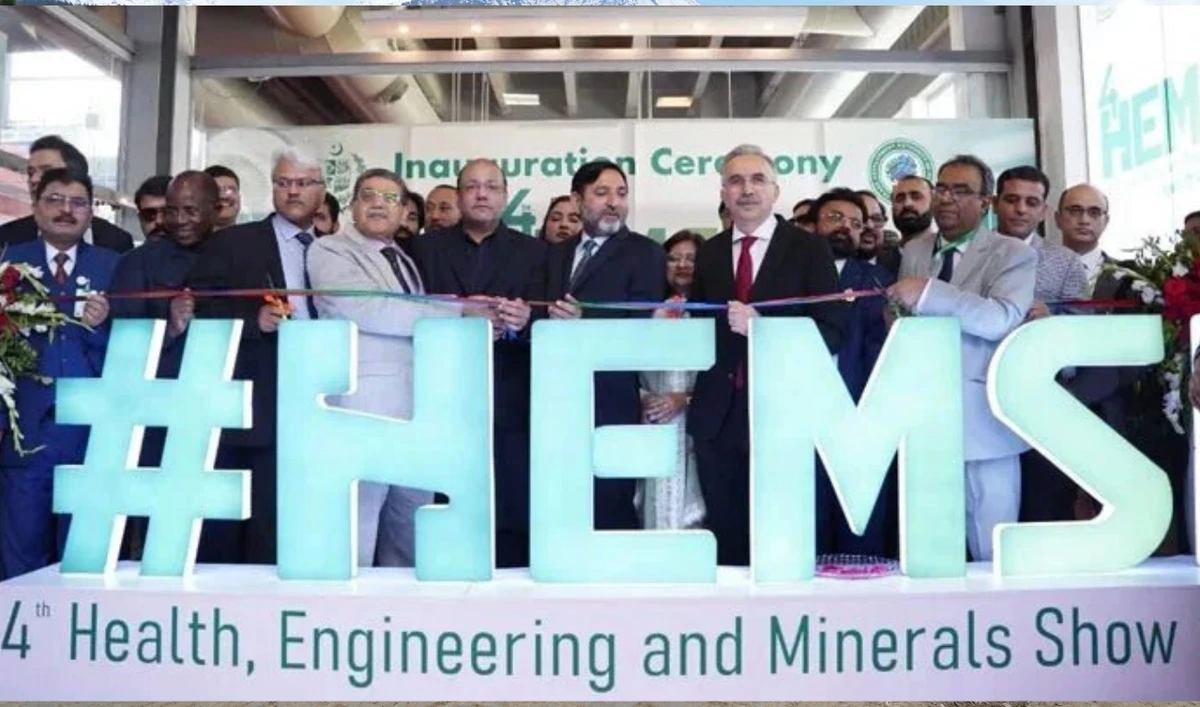
200 Chinese firms participate in Pakistan health and minerals expo, securing $375 million in deals

Provincial Minister for Industries and Commerce Chaudhry Shafay Hussain inaugurates the 4th Health, Engineering and Minerals Show 2025 at the Expo Centre on April 17, 2025. (Photo courtesy: Facebook/ @tdapofficial)
Short Url
Updated 23 April 2025
Follow

200 Chinese firms participate in Pakistan health and minerals expo, securing $375 million in deals

  • Key agreements included $60 million quartz stone export deal, $45 million joint venture in medical device manufacturing
  • Chinese delegations expressed interest in Pakistan’s salt, copper, fluorite, gemstones, information technology and real estate 

ISLAMABAD: Two hundred Chinese firms took part in the Health, Engineering and Minerals Show (HEMS) hosted by Pakistan in April, sealing trade and investment deals worth $375 million, Pakistani state media reported on Wednesday.

The HEMS 2025 was held in the eastern city of Lahore from Apr. 17-19, bringing together many global delegates to spotlight Pakistan’s strengths in key industries. The expo featured a dedicated Mineral Investment Pavilion and aimed to boost international trade, investment and industrial growth.

Pakistan aims to increase its economic partnership with China, with whom it also enjoys cordial ties. Chinese companies are collaborating with local Pakistani firms to establish joint ventures, with Beijing focusing on tapping Pakistan’s vast natural resources. 

“Representatives from more than 150 Chinese companies engaged in a series of business-to-business meetings across health care, engineering, minerals and mining, resulting in the signing of 29 memorandums of understanding, letters of intent and contracts worth over $375 million,” the Pakistan Television Corporation (PTV) said in a report.

“Key agreements included a $60 million quartz stone export deal (with a $10 million investment component), a $45 million joint venture in medical device manufacturing and an $80 million technology transfer contract in electric vehicles.”

The statement said Chinese delegations led by Pakistan’s Ambassador to China Khalil Hashmi also expressed interest in salt, copper, fluorite, gemstones, information technology, real estate and the branding of Pakistani products.

The report said Prime Minister Shehbaz Sharif hosted a dinner for 800 delegates from 50 countries, during which he praised Ambassador Hashmi and his team for facilitating the largest-ever Chinese business delegation’s to visit Pakistan.

Pakistan is home to one of the world’s largest porphyry copper-gold mineral zones, while the Reko Diq mine in southwestern Balochistan province has an estimated 5.9 billion tons of ore. Barrick Gold, which owns a 50 percent stake in the Reko Diq mines, considers them one of the world’s largest underdeveloped copper-gold areas, and their development is expected to have a significant impact on Pakistan’s struggling economy.

Earlier in April, Pakistan also hosted a minerals summit aimed at attracting foreign investment in the country’s mining sector. It saw participation from major international companies including Canada-based Barrick Gold and government officials from the United States, Saudi Arabia, China, Turkiye, the United Kingdom, Azerbaijan and other nations.
Islamic military coalition, Pakistan to deepen cooperation to combat ‘terrorism’ — Pakistani military

Updated 02 February 2026
Follow

Islamic military coalition, Pakistan to deepen cooperation to combat ‘terrorism’ — Pakistani military

  • Islamic Military Counter Terrorism Coalition is a 43-member alliance that includes Pakistan, Saudi Arabia, Egypt, Jordan, UAE and other nations
  • The Pakistani military statement comes after a meeting between IMCTC secretary-general and the chief of Pakistani defense forces in Rawalpindi

ISLAMABAD: Pakistan and the Islamic Military Counter Terrorism Coalition (IMCTC) have reaffirmed their commitment to deepening cooperation, including intelligence sharing and capacity building, to jointly combat “terrorism” and “extremism,” the Pakistani military said on Monday.

The IMCTC is a 43-member military alliance that was formed on Saudi Arabia’s initiative in Dec. 2015 to consolidate Muslim countries’ efforts in countering “terrorism.”

A 17-member IMCTC delegation is visiting Pakistan from Feb. 2-6 to conduct a training at National University of Sciences and Technology on “Re-integration and Rehabilitation of Extremist Elements,” according to the Pakistani military.

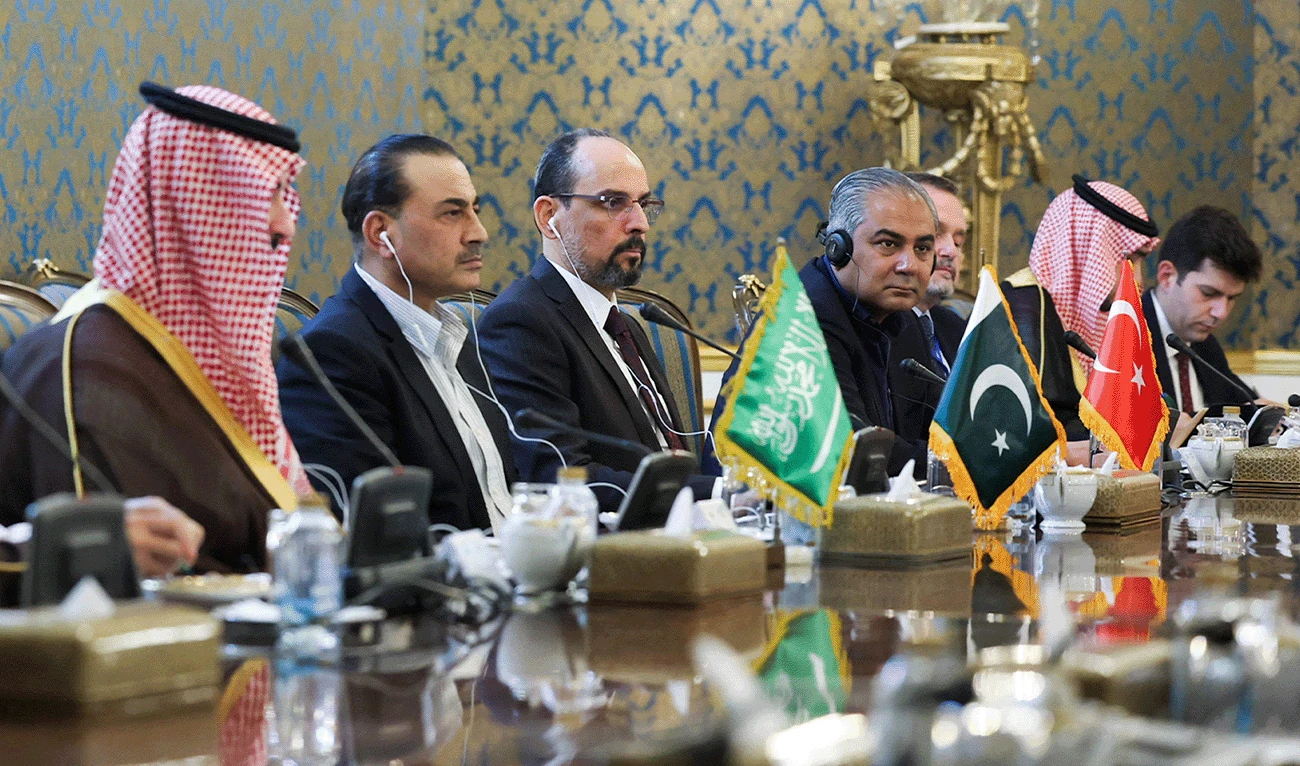
On Monday, IMCTC Secretary-General Maj. Gen. Mohammed bin Saeed Al-Moghedi held a meeting with Chief of Pakistani Defense Forces Field Marshal Asim Munir to discuss cooperation among IMCTC member states.

“During the meeting, matters of mutual interest were discussed, with particular emphasis on regional security dynamics and enhanced cooperation in counter-terrorism efforts,” the Inter-Services Public Relations (ISPR), the Pakistani military’s media wing, said in a statement.

“Both sides reaffirmed their shared commitment to combating terrorism and extremism through collaborative strategies, intelligence sharing, and capacity building among member states.”

The IMCTC features Pakistan, Saudi Arabia, Türkiye, Afghanistan, Egypt, Jordan, Qatar, Palestine, UAE, Bangladesh and other nations. In 2017, Pakistan’s former army chief Gen. (retd) Raheel Sharif was appointed as the IMCTC commander-in-chief.

During discussions with Major General Al-Moghedi, Field Marshal Munir appreciated the role of IMCTC in fostering stability and promoting coordinated counterterrorism initiatives across the Islamic world, according to the ISPR.

The IMCTC secretary-general acknowledged Pakistan’s significant contributions and sacrifices in the fight against militancy and lauded the professionalism of Pakistan’s armed forces.

“The meeting underscored the resolve of both sides to further strengthen institutional collaboration for peace, stability, and security in the region,” the ISPR added.

Pakistan enjoys cordial ties with most Muslim countries around the world, particularly Gulf Cooperation Council countries. In Sept. 2025, Pakistan signed a landmark defense pact with Saudi Arabia according to which an act of aggression against one country will be treated as an act of aggression against both.