

Private sector integration advancing to meet Saudi Vision 2030 goals: finance minister

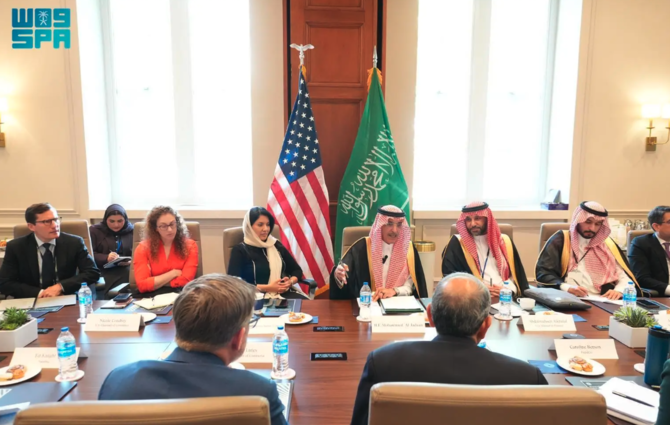
Mohammed Al-Jadaan speaking in a roundtable meeting at the US Chamber of Commerce. SPA
Short Url
Updated 23 April 2025
Follow

Private sector integration advancing to meet Saudi Vision 2030 goals: finance minister

JEDDAH: Saudi Arabia is stepping up efforts to strengthen its economy by deepening private sector partnerships and improving regulatory practices, the Kingdom’s finance minister has said.

Speaking during a roundtable at the US Chamber of Commerce, held on April 23 in Washington alongside the 2025 Spring Meetings of the World Bank Group and the International Monetary Fund,  Mohammed Al-Jadaan said Saudi Arabia’s Vision 2030 seeks to reshape and diversify the country’s economy.

This year’s Spring Meetings of the World Bank Group and the IMF take place against the backdrop of rising trade tensions sparked by US President Donald Trump’s tariff announcement, raising concerns regarding global economic forecasts and the impact on various economies.

According to the Saudi Press Agency, Al-Jadaan “emphasized that one of the Kingdom’s key priorities is establishing clear frameworks and effective governance to enhance integration with the private sector, support economic growth, and achieve the objectives of the Vision.”

The drive to diversify the Saudi economy saw the Kingdom’s gross fixed capital formation reach SR1.18 trillion ($313.68 billion) in 2024, reflecting a 5.3 percent annual increase. This growth was driven by a 7.6 percent rise in private sector investments, according to the Ministry of Investment.

The roundtable was attended by Saudi Arabia’s Ambassador to the US Reema bint Bandar and following his participation in the meeting, Al-Jadaan said in a post on his X account: “We discussed ways to enhance the economic partnership between Saudi Arabia and the US, as well as the valuable investment opportunities under Saudi Vision 2030.”

He added that he held talks with US Treasury Secretary Scott Bessent on strengthening bilateral and multilateral cooperation, focusing on supporting the efforts of the IMF and the World Bank.

In a separate post, the minister said: “I also met with Tobias Adrian, the IMF’s financial counsellor and director of the monetary and capital markets department, as well as Pierre-Olivier Gourinchas, the IMF’s economic counsellor and director of research. We discussed recent developments in global macroeconomic and financial policies.”

In an additional post on X, Al-Jadaan said he held talks with Indermit Gill, the World Bank’s senior vice president for development economics and chief economist, and Ousmane Dione, the bank’s vice president for the Middle East and Africa region. Al-Jadaan added: “We discussed economic developments globally and regionally.”

Al-Jadaan also met with the Syrian Minister of Finance Mohammed Barnieh and the Central Bank of Syria Governor Abdulkader Husrieh to discuss the latest economic developments in Syria and explore ways to strengthen bilateral cooperation.

A further meeting was held with Sweden’s Minister of Finance Elisabeth Svantesson to discuss global economic developments and ways to enhance bilateral collaboration.


Saudi Arabia’s foreign reserves rise to a 6-year high of $475bn

Updated 22 February 2026
Follow

Saudi Arabia’s foreign reserves rise to a 6-year high of $475bn

RIYADH: Saudi Arabia’s foreign reserves climbed 3 percent month on month in January to SR1.78 trillion, up SR58.7 billion ($15.6 billion) from December and marking a six-year high.

On an annual basis, the Saudi Central Bank’s net foreign assets rose by 10 percent, equivalent to SR155.8 billion, according to data from the Saudi Central Bank, Argaam reported.

The reserve assets, a crucial indicator of economic stability and external financial strength, comprise several key components.

According to the central bank, also known as SAMA, the Kingdom’s reserves include foreign securities, foreign currency, and bank deposits, as well as its reserve position at the International Monetary Fund, Special Drawing Rights, and monetary gold.

The rise in reserves underscores the strength and liquidity of the Kingdom’s financial position and aligns with Saudi Arabia’s goal of strengthening its financial safety net as it advances economic diversification under Vision 2030.

The value of foreign currency reserves, which represent approximately 95 percent of the total holdings, increased by about 10 percent during January 2026 compared to the same month in 2025, reaching SR1.68 trillion.

The value of the reserve at the IMF increased by 9 percent to reach SR13.1 billion.

Meanwhile, SDRs rose by 5 percent during the period to reach SR80.5 billion.

The Kingdom’s gold reserves remained stable at SR1.62 billion, the same level it has maintained since January 2008.

Saudi Arabia’s foreign reserve assets saw a monthly rise of 5 percent in November, climbing to SR1.74 trillion, according to the Kingdom’s central bank.

Overall, the continued advancement in reserve assets highlights the strength of Saudi Arabia’s fiscal and monetary buffers. These resources support the national currency, help maintain financial system stability, and enhance the country’s ability to navigate global economic volatility.

The sustained accumulation of foreign reserves is a critical pillar of the Kingdom’s economic stability. It directly reinforces investor confidence in the riyal’s peg to the US dollar, a foundational monetary policy, by providing SAMA with ample resources to defend the currency if needed.

Furthermore, this financial buffer enhances the nation’s sovereign credit profile, lowers national borrowing costs, and provides essential fiscal space to navigate global economic volatility while continuing to fund its ambitious Vision 2030 transformation agenda.