

Lebanon’s annual inflation slows to 14.2% in March, down from over 70%

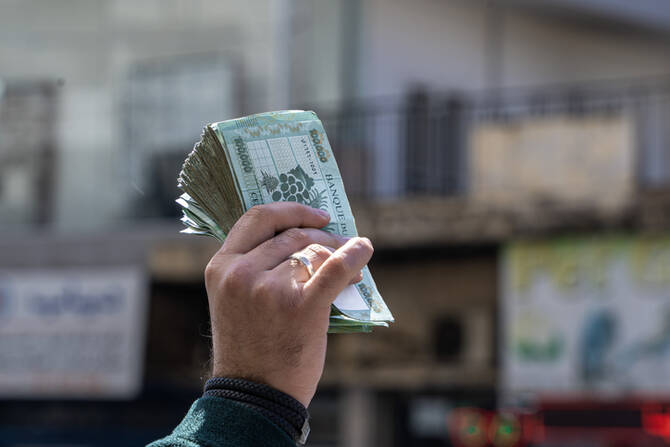
The volume of Lebanese pounds in circulation dropped sharply in 2024. Getty
Short Url
Updated 23 April 2025
Follow

Lebanon’s annual inflation slows to 14.2% in March, down from over 70%

  • A key factor behind easing inflation is the stabilization of the exchange rate

BEIRUT: Lebanon’s annual inflation rate eased to 14.2 percent in March, down from 70.36 percent a year earlier, according to the latest data from the country’s Central Administration of Statistics.

A key factor behind easing inflation is the stabilization of the exchange rate, with the Lebanese pound holding steady at around 89,500 Lebanese pounds per US dollar since mid-2023.

According to the International Monetary Fund’s March staff report on Lebanon, this stabilization has been supported by the halt of monetary financing and foreign exchange subsidies, as well as improvements in fiscal revenue collection.

Concurrently, monetary tightening by the central bank has played a critical role. The volume of Lebanese pounds in circulation dropped sharply from $20.51 billion in 2020 to $0.73 billion in 2024, significantly dampening inflationary pressures, as noted in a 2024 analysis by Blominvest.

Dollarization has also accelerated across key sectors such as healthcare, education, and telecommunications, where services are increasingly billed in US dollars.

This shift has helped anchor price stability in dollarized segments of the economy, further moderating consumer price volatility, according to a 2024 article by Bloomberg.

A strong base effect also contributed to the lower year-on-year inflation reading, as March 2024 had recorded exceptionally high price levels, making current figures appear relatively subdued.

Despite the recent moderation, Lebanon’s underlying economic conditions remain fragile. The expanding dollarization trend has also deepened inequality, disproportionately impacting households and workers who continue to be paid in the domestic currency.

On a monthly basis, consumer prices rose by 0.44 percent in March, a modest uptick by Lebanon’s recent standards. The increase was driven mainly by higher costs in food and beverages, housing and utilities, and clothing and footwear.

However, the magnitude of monthly price changes has notably cooled compared to previous years, when double-digit jumps were not uncommon.

Regionally, inflation trends varied across governorates. The north of Lebanon recorded the highest monthly inflation at 1.41 percent, driven primarily by food and non-alcoholic beverage prices, which rose 3.8 percent month-on-month.

The Nabatieh region followed with a monthly rise of 0.81 percent, while Mount Lebanon posted the lowest increase at 0.11 percent and Beirut at 0.33 percent.

This divergence highlights the continued impact of geographic and income disparities on exposure to inflation.

Lebanon’s consumer price index is calculated by CAS using a representative basket of goods and services based on 2013 consumption patterns. The CPI remains the country’s most widely cited benchmark for tracking the cost of living.


Closing Bell: Saudi main index extends gains as market opens wider to foreign investment

Updated 02 February 2026
Follow

Closing Bell: Saudi main index extends gains as market opens wider to foreign investment

RIYADH: Saudi Arabia’s Tadawul All Share Index rose on Monday, gaining 153.61 points, or 1.38 percent, to close at 11,321.09.

The total trading turnover of the benchmark index was SR5.85 billion ($1.56 billion), as 207 of the listed stocks advanced, while 55 retreated.

The MSCI Tadawul Index increased, up 21.20 points or 1.41 percent, to close at 1,524.18.

The Kingdom’s parallel market Nomu gained 278.13 points, or 1.17 percent, to close at 24,013.03. This comes as 43 of the listed stocks advanced, while 29 retreated.

The best-performing stock was Saudi Pharmaceutical Industries and Medical Appliances Corp., with its share price surging by 7.26 percent to SR28.94.

Other top performers included Rasan Information Technology Co., which saw its share price rise by 6.51 percent to SR144, and Knowledge Economic City, which saw a 6.25 percent increase to SR13.09.

On the downside, the worst performer of the day was Najran Cement Co., whose share price fell by 2.11 percent to SR6.49.

Almasane Alkobra Mining Co. and Saudi Cable Co. also saw declines, with their shares dropping by 2 percent and 1.88 percent to SR103.10 and SR166.80, respectively.

On the announcement front, Riyad Bank has announced its annual financial results for 2025, with the total income from special commission of financing reaching SR24.1 billion, while net income from special commission of financing amounted to SR12 billion.

In a statement on Tadawul, the bank said: “Net income increased by 11.7 percent mainly due to an increase in total operating income and a decrease in total operating expenses.”

The bank further noted that the rise in total operating income was primarily driven by increased revenue from fees and commissions, trading activities, special commissions, gains on non-trading investments, and other operating sources. This growth was partially tempered by declines in exchange and dividend income.

“Net provision of expected credit losses and other losses decreased by 15.8 percent due to a decrease in impairment charge of credit losses and impairment charge for other financial assets, partially offset by an increase in impairment charge for investments,” it added.

RIBL’s share price closed at SR18.18 on the main market, marking a 1.43 percent increase.