

Cherry and apricot blossoms brighten snowy fields in Pakistan’s Gilgit-Baltistan

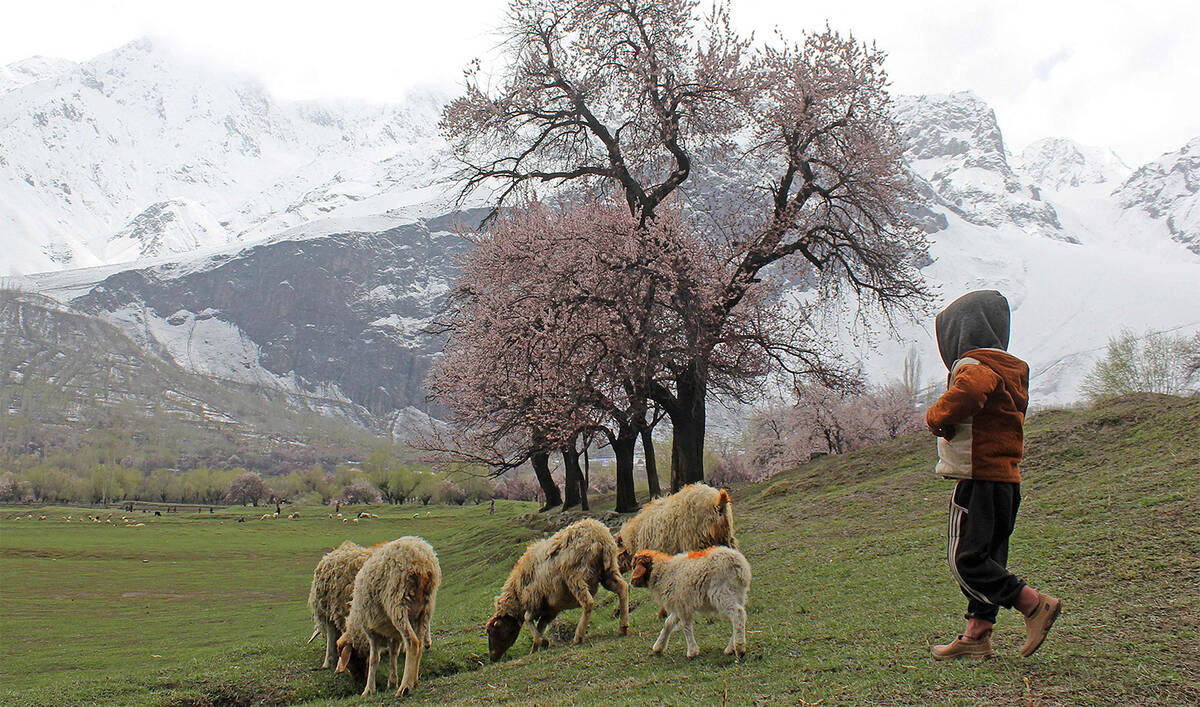
A shepherd walks with a flock of sheep near Apricot Blossom trees at Choundha Valley of Skardu district in Gilgit-Baltistan region on April 20, 2025. (AFP)
Short Url
Updated 23 April 2025
Follow

Cherry and apricot blossoms brighten snowy fields in Pakistan’s Gilgit-Baltistan

  • Tourists in GB’s Choundha Valley say they have never seen such a beautiful landscape before
  • Known for its tall mountains, the region’s diverse climate supports a variety of fruit orchards

SKARDU, Pakistan: In the mountainous region of Gilgit-Baltistan (GB) in northern Pakistan, valleys like Choundha transform into picturesque landscapes each spring, as cherry and apricot blossoms emerge amid lingering snow.
The fleeting natural spectacle draws tourists eager to witness the vibrant contrast of pink and white flowers against snow-covered fields.
Located at an altitude of approximately 2,500 meters, Choundha Valley is surrounded by towering peaks and verdant forests. The region is renowned for its breathtaking scenery and is considered one of the most spectacular areas in Pakistan.
“This is the first time I have seen this valley and also the first time I have fully explored Gilgit-Baltistan,” a female tourist from Lahore, who only identified herself as Sarah, said.
“Seeing the valley was really amazing,” she added. “It was such a beautiful experience. After seeing it, I really felt like I had finally seen real nature. Honestly, I don’t even have the words to fully explain what it was like and how incredible everything we saw was.”
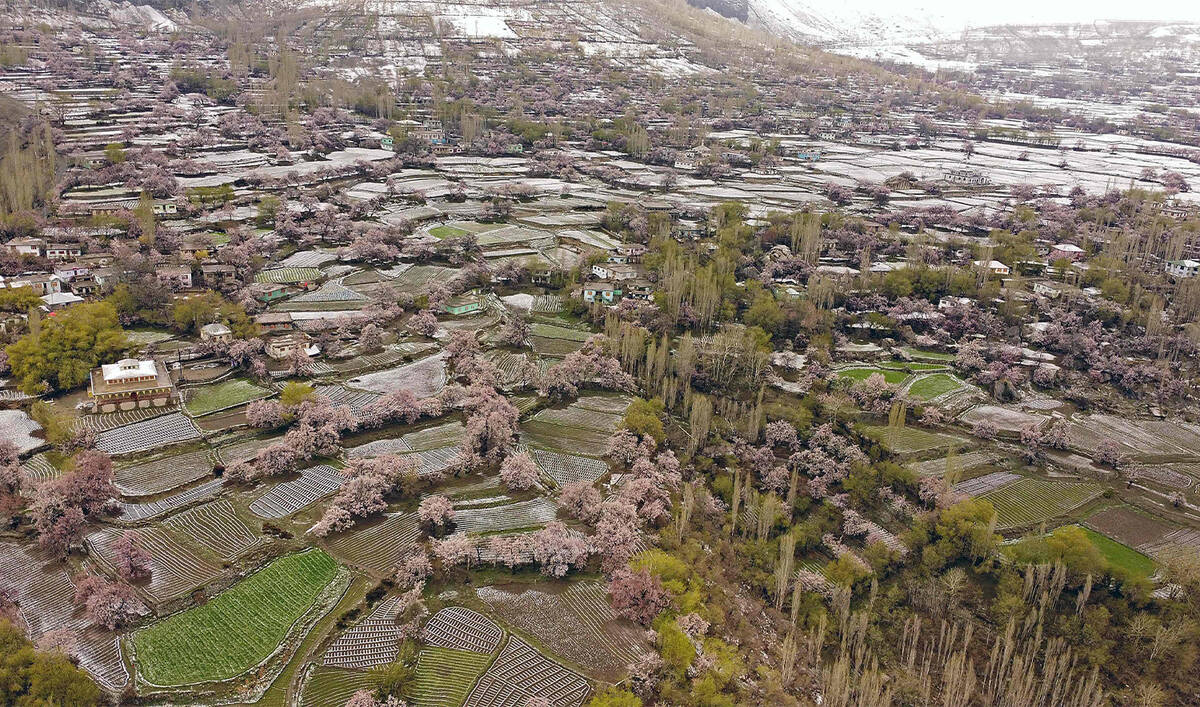


This aerial photograph taken on April 20, 2025 shows a general view of Apricot Blossom trees along the snow covered field at Choundha Valley of Skardu district in Gilgit-Baltistan region. (AFP)


GB, an administrative territory in northern Pakistan, is known for its mountain ranges, including the Karakoram and the western Himalayas. The region is home to five of the world’s 14 peaks exceeding 8,000 meters, including K2, the second-highest mountain globally.
The region’s diverse climate and fertile valleys support a variety of fruit orchards, making it a significant contributor to Pakistan’s fruit production.
The region’s harsh winters and short spring season make the rare overlap of snowfall and blossoms a visual treat.
“By sheer luck, we were able to see both cherry blossoms and snow-covered mountains today,” Muhammad Farqan, 36, said. “This particular spot only happens once in a while — when both snow and cherry blossoms appear together — and we were lucky enough to experience it. Being here lifted my spirits, everything felt vibrant and alive.”


This aerial photograph taken on April 20, 2025 shows a general view of Apricot Blossom trees along the snow covered field at Choundha Valley of Skardu district in Gilgit-Baltistan region. (AFP)

Apricots hold particular importance in the region’s agricultural landscape. Traditional sun-drying methods are employed to produce dried apricots, a staple in local diets and a source of income for many families.
Additionally, apricot kernels are used to extract oil and the fruit is made into jams and juices.
Cherries, too, are harvested in abundance and are sold fresh during the summer or preserved for local consumption.
In recent years, cherry-based products such as jams and syrups have also gained popularity, contributing to household incomes, particularly among women engaged in small-scale food processing.
“Last night it was very cold in the Choundha Valley and there was snowfall, which made the view even more magical today,” said tourist Yogi Samyia. “I feel that this moment fulfilled the whole purpose of our trip and every penny we spent was absolutely worth it.”
For many, the surreal setting leaves a lasting impression.
“It’s truly breathtaking to see God’s creation and the beauty of nature in such a pure form,” said Fahad Ali, 28. “I just can’t stop looking. It has become one of the most memorable experiences of my life. I have traveled to many countries, but I have never seen anything like this.”


Nearly 25% of Pakistan’s primary schools enrolling girls operate as single-teacher ones— report

Updated 13 sec ago
Follow

Nearly 25% of Pakistan’s primary schools enrolling girls operate as single-teacher ones— report

  • Pakistan needs over 115,000 more teachers in primary schools enrolling girls to meet global benchmark of one teacher per 30 students, says report
  • Sixty percent of Pakistani primary schools enrolling girls are overcrowded, while 32% lack clean drinking water or toilets, says Tabadlab report

ISLAMABAD: Nearly 25% of Pakistan’s primary schools that enrolls girls operate as single-teacher ones, a report by a leading think tank said this week, calling on the government to devolve teacher recruitment powers, upskill underutilized teachers and introduce reforms to hire and promote faculty members. 

Pakistan faces an acute education crisis which is reflected in the fact that it has the world’s second-highest number of out-of-school children, an estimated 22.8 million aged 5-16 who are not in educational institutions, according to UNICEF. 

While poverty remains the biggest factor keeping children out of classrooms, Pakistan’s education crisis is exacerbated by inadequate infrastructure and underqualified teachers, cultural barriers and the impacts of frequently occurring natural disasters. 

According to “The Missing Ustaani,” a report published by Islamabad-based think tank Tabadlab and supported by Malala Fund and the Pakistan Institute of Education (PIE), Pakistan needs over 115,000 more teachers in primary schools with girls’ enrolment to meet the basic international benchmark of ensuring one teacher per 30 children. Currently, the average Student-to-Teacher Ratio (STR) across Pakistan’s primary schools with girls’ enrolment is 39:1, it said. 

“Approximately 60% of these schools are overcrowded, necessitating the recruitment of over 115,000 additional teachers nationwide,” the report said on Monday. “Compounding this, nearly 25% of primary schools with girls’ enrolment operate as single-teacher schools, placing immense pressure on the quality of education.”

It said the situation is more dire in Pakistan’s poverty-stricken southwestern Balochistan province, where nearly 52% of the schools are single-teacher only ones while the percentage decreases slightly in the southern Sindh province to 51 percent. 

The report said while the STR improves to 25:1 at the middle school level, acute shortages of subject specialists emerge as the top-priority concern for quality education in these schools.

“Furthermore, around 32% of primary schools with girls’ enrolment and 18% of middle schools face ‘critical infrastructural shortages’— lacking clean drinking water or toilets in addition to high STRs— which significantly affects girls’ attendance and learning, particularly during adolescence,” the report said. 

The report cited a set of priority recommendations to address Pakistan’s systemic teacher deployment challenges and improve educational equity for girls. 

It urged the government to devolve recruitment authority to school or cluster levels to enable timely, context-specific hiring. It also called upon authorities to reform teacher transfer and promotion policies to introduce school-specific postings with minimum service terms. 

This, it said, would reduce arbitrary transfers and improving continuity in classrooms. The report advised authorities to upskill surplus or underutilized primary teachers to support instruction at the middle school level, helping address subject-specialist shortages.

“Together, these reforms offer a pathway toward a more equitable, efficient, and responsive teaching workforce— one capable of improving learning outcomes and ensuring that every girl in Pakistan has access to a qualified teacher,” the report said. 

To tackle Pakistan’s education crisis, Prime Minister Shehbaz Sharif declared an ‘education emeregency’ in September 2024, stressing the importance of education for all.