NEW DELHI: US Vice President JD Vance on Tuesday called for enhanced engagement with India and said that the South Asian country should buy more defense equipment and energy from the US and allow Washington greater access to its market, lending momentum to an expected bilateral trade deal.
Vance, who is on a four-day visit to India, said that he and Prime Minister Narendra Modi made progress on trade talks during their discussions on Monday, and confirmed that both sides had finalized the terms of reference for the trade negotiation — a vital step toward setting the road map for the final agreement.
India and the US hope to seal a bilateral trade agreement this year and have set an ambitious target of more than doubling their bilateral trade to $500 billion by 2030. If achieved, the trade deal could significantly enhance economic ties between both countries and potentially strengthen diplomatic ties as well.
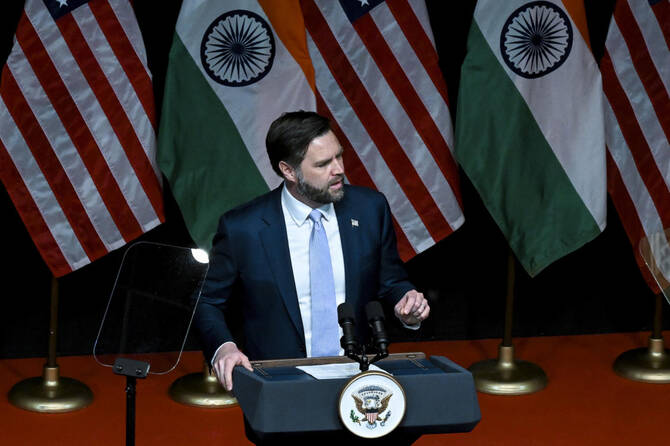
“I believe there is much that India and America can accomplish together,” Vance said at an event in the western city of Jaipur, where he, his wife Usha Vance and their three children were on a sightseeing tour.
Vance’s first visit to New Delhi came amid the backdrop of US President Donald Trump’s partially-paused tariff program against most countries, including India. Earlier this month, Trump announced a 90-day pause in which imports from most countries would face a baseline 10 percent tax so that there was time to hold talks and possibly structure broader deals.
The trade negotiations are especially urgent for India and could help New Delhi avoid sharp US tariffs. Meanwhile, the Trump administration has portrayed its strategy of tariffs as forcing negotiations that could limit the reach and influence of China, the world’s dominant manufacturer and New Delhi’s main rival in the region.
At the event, Vance sought to assuage fears over Trump’s tariff decisions and said his administration was seeking to rebalance global trade so that the US, with friends like India, can build a better future. He said that trade relations must be based on fairness.
“I come here with a simple message,” Vance said. The Trump administration “seeks trade partners on the basis of fairness and shared national interest. We want to build relationships with our foreign partners who respect their workers.”
Vance said that he was in India to strengthen ties between both nations, and criticized previous governments for looking at New Delhi as a cheap source of labor.
“I believe that if India and the United States work together successfully, we are going to see a 21st century that is prosperous and peaceful,” he said, adding that if this didn’t happen, it would mean a “dark time for all humanity.”
Washington has long sought to develop a deeper partnership with New Delhi, which is seen as a bulwark against China. Modi has established a good working relationship with Trump, and the two leaders are likely to further boost cooperation between their countries.
Modi was also among the first leaders to visit the US and hold talks with Trump that kickstarted a negotiation process to minimize the possible fallout of Trump’s tariffs. The two leaders also said they planned to grow their defense partnership.
India is a close partner of the US and is part of the Quad, which is made up of the US, India, Japan and Australia, and is seen as a counterbalance to China’s expansion in the region. It is also a major defense partner of the US, a status only enjoyed by some of the closest allies of Washington.
In line with Trump’s push for supplying more military equipment to India, Vance said Washington was seeking greater collaboration with New Delhi for the sale of advanced military gear, as well as coproduction. He also pitched Washington’s fifth-generation stealth fighter to India.
“F-35 will help protect your people like never before,” he said.
Over the past several decades, India has been largely dependent on Russian weapons, fighters and military equipment, but has gradually started diversifying its purchase basket from countries such as the US, France and the UK
In recent years, India has embedded advanced American jets, helicopters, missiles and other equipment into its armed forces and the two countries have announced plans to sign a 10-year framework later this year to further strengthen the defense partnership.


![]()

Vance calls for greater ties with India, hails progress on trade talks
Short Url
https://arab.news/yfany
Vance calls for greater ties with India, hails progress on trade talks
- “I believe there is much that India and America can accomplish together,” Vance said
- The Trump administration “seeks trade partners on the basis of fairness and shared national interest
Related

Latest updates


© 2026 SAUDI RESEARCH & PUBLISHING COMPANY, All Rights Reserved And subject to Terms of Use Agreement.