

Pakistan praises Islamic Development Bank’s anti-polio efforts, with $587 million disbursed since 2013

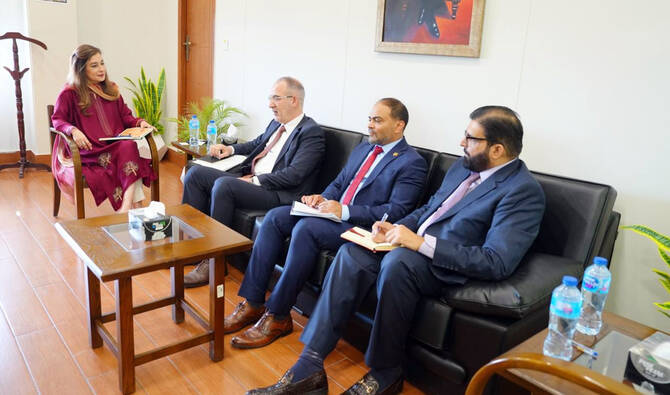
Prime Minister’s Focal Person for Polio Eradication, Ayesha Raza Farooq (left) meets a delegation from the Islamic Development Bank (IsDB) in Islamabad, Pakistan, on April 22, 2025. (Facebook/@polioeradicationinitiative)
Short Url
Updated 22 April 2025
Follow

Pakistan praises Islamic Development Bank’s anti-polio efforts, with $587 million disbursed since 2013

  • PM’s focal person for polio eradication, Ayesha Raza Farooq, meets IsDB delegation in Islamabad
  • IsDB is one of largest financiers of Pakistan’s anti-polio program, announced $587 million loan in 2023

ISLAMABAD: Pakistani prime minister’s aide on polio eradication, Ayesha Raza Farooq, on Tuesday acknowledged the Islamic Development Bank’s (IsDB) financial and strategic contributions to sustain its anti-polio program in the country. 

The IsDB has contributed over $587 million to eradicate poliovirus from Pakistan since 2013, making it one of the largest financiers of the country’s anti-polio program. It announced a loan of $100 million in December 2023 to support Pakistan’s polio eradication efforts. 

Farooq met a high-level delegation of the IsDB’s Regional Hub in Turkiye at the National Emergency Operations Center (NEOC) in Islamabad on Tuesday, the Pakistan Polio Eradication Programme said. 

“The Islamic Development Bank has been a pillar of strength for the Pakistan Polio Eradication Programme, especially during its most challenging phases,” Farooq was quoted as saying by Pakistan’s anti-polio program. 

“Your financial and strategic contributions have been instrumental in sustaining the program and ensuring that vaccination campaigns reach the most vulnerable children across the country.”

Pakistan is only one of two countries worldwide where polio remains endemic. The Pakistani government launched a seven-day nationwide campaign on Monday to vaccinate over 45 million children against the disease. 

Dr. Walid Mohamad Abdelwahab, director of the IsDB’s regional hub in Turkiye, reaffirmed the institution’s support for Pakistan in achieving a polio-free future, the statement said. He commended Pakistan for its efforts and collaboration in the fight against polio, it added. 

The delegation briefly visited the NEOC control room following the meeting, where they were informed about the national reach of the campaign. The IsDB delegation was told the campaign would cover over 45.4 million children through the efforts of more than 400,000 frontline health workers via door-to-door vaccinations.

“IsDB commended the Government of Pakistan’s relentless efforts and reaffirmed its support in reaching the last mile of polio eradication,” Pakistan’s anti-polio program said.

In 2024, Pakistan reported an alarming 74 polio cases. The country’s polio program, launched in 1994, has faced persistent challenges including vaccine misinformation and resistance from some religious hard-liners, who claim immunization is a foreign conspiracy to sterilize Muslim children or a guise for Western espionage. 

Militant groups have also repeatedly targeted and killed polio vaccination workers during nationwide drives.


Peshawar church attack haunts Christians at Christmas

Updated 13 sec ago
Follow

Peshawar church attack haunts Christians at Christmas

  • The 2013 suicide attack at All Saints Church killed 113 worshippers, leaving lasting scars on survivors
  • Prime Minister Shehbaz Sharif vowed to protect religious minorities on Christmas, act against any injustice

PESHAWAR: After passing multiple checkpoints under the watchful eyes of snipers stationed overhead, hundreds of Christians gathered for a Christmas mass in northwest Pakistan 12 years after suicide bombers killed dozens of worshippers.

The impact of metal shards remain etched on a wall next to a memorial bearing the names of those killed at All Saints Church in Peshawar, in the violence-wracked province of Khyber Pakhtunkhwa.

“Even today, when I recall that day 12 years ago, my soul trembles,” Natasha Zulfiqar, a 30-year-old housewife who was wounded in the attack along with her parents, told AFP on Thursday.

Her right wrist still bears the scar.

A militant group claimed responsibility for the attack on September 22, 2013, when 113 people were killed, according to a church toll.

“There was blood everywhere. The church lawn was covered with bodies,” Zulfiqar said.

Christians make up less than two percent of Pakistan’s 240 million people and have long faced discrimination in the conservative Muslim country, often sidelined into low-paying jobs and sometimes the target of blasphemy charges.

Along with other religious minorities, the community has often been targeted by militants over the years.

Today, a wall clock inside All Saints giving the time of the blast as 11:43 am is preserved in its damaged state, its glass shattered.

“The blast was so powerful that its marks are still visible on this wall — and those marks are not only on the wall, but they are also etched into our hearts as well,” said Emmanuel Ghori, a caretaker at the church.

Addressing a Christmas ceremony in the capital Islamabad, Prime Minister Shehbaz Sharif vowed to protect religious minorities.

“I want to make it clear that if any injustice is done to any member of a minority, the law will respond with full force,” he said.

For Azzeka Victor Sadiq, whose father was killed and mother wounded in the blasts, “The intensity of the grief can never truly fade.”

“Whenever I come to the church, the entire incident replays itself before my eyes,” the 38-year-old teacher told AFP.