

Breaking barriers: Women fuel change at Pakistan’s male-dominated petrol pumps

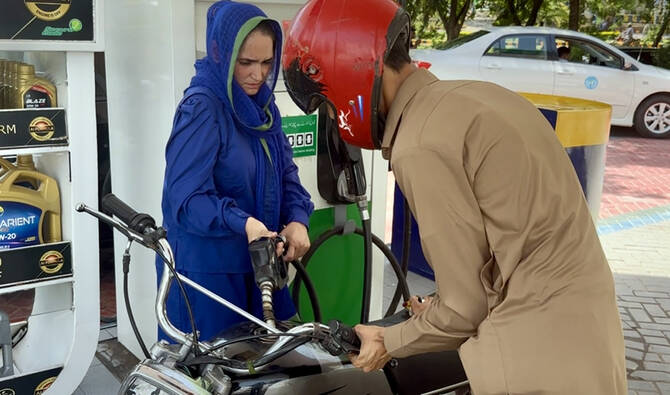
Sumeera Bibi, a female fuel station attendant, pumps petrol into a motorcycle in Islamabad, Pakistan, on April 21, 2025. (AN)
Short Url
Updated 22 April 2025
Follow

Breaking barriers: Women fuel change at Pakistan’s male-dominated petrol pumps

  • While fuel stations have been predominantly staffed by men, there is a growing movement toward gender inclusivity
  • In the federal capital of Islamabad, hundreds of women are now working alongside male staff at fuel stations

ISLAMABAD: Clad in a crisp blue uniform and gripping the nozzle with practiced ease, Sumeera Bibi pumped fuel into the tank of a car, gesturing to the driver to check the reading on the dispenser machine. 

While fuel stations in Pakistan have been traditionally staffed by men, there is a growing movement toward gender inclusivity, with some stations now employing women like Sumeera as attendants. 

One notable example was the launch last year of Pakistan’s first all-female staffed fuel station, located in Johar Town, Lahore. 

In the federal capital of Islamabad also, hundreds of women are now working alongside male staff at fuel stations.

“Since getting this job, I have been able to care for my children on my own and overcome all my problems,” Sumeera, a mother of five, told Arab News on Monday at a Pakistan State Oil station on Constitution Avenue, home to major government buildings and embassies.


Sumeera Bibi receives cash from a customer after refueling a car at a fuel station in Islamabad, Pakistan, on April 22, 2025. (AN)

Getting the job has been life changing for Sumeera, married for years to a drug addict, before the relationship spiraled out of control and she was forced to move in with her sister.

“There were many difficulties as I had no job and was dependent on my sister,” said Sumeera, who works an 8 am-6pm shift six days a week.

“We faced many problems in the beginning, especially when customers would often try to touch our hands while returning their [credit] cards,” she said.

But getting a timely salary, annual bonus, free medical care and the means to raise and educate her children without being dependent on anyone have made all the difficulties worth it. 

“Before this, I had never worked. I had never even dealt with strangers,” she said. “Now, I deal with all kinds of people every day. There’s no shame in hard work.”

“POSITIVE RESPONSE“

The overall labor force participation rate for women in Pakistan at 25 percent is significantly lower than the global and South Asian average. A large portion of women in the labor force (67 percent) are employed in agriculture, with only 16 percent in services and 14 percent in manufacturing, according to UN Women. Even among women with higher education, labor force participation rates are relatively low, with only around 25 percent of women with a university degree participating in the labor force. 

Several factors contribute to the lower female labor force participation, including social norms, safety concerns, lack of mobility, and the availability of transportation. 
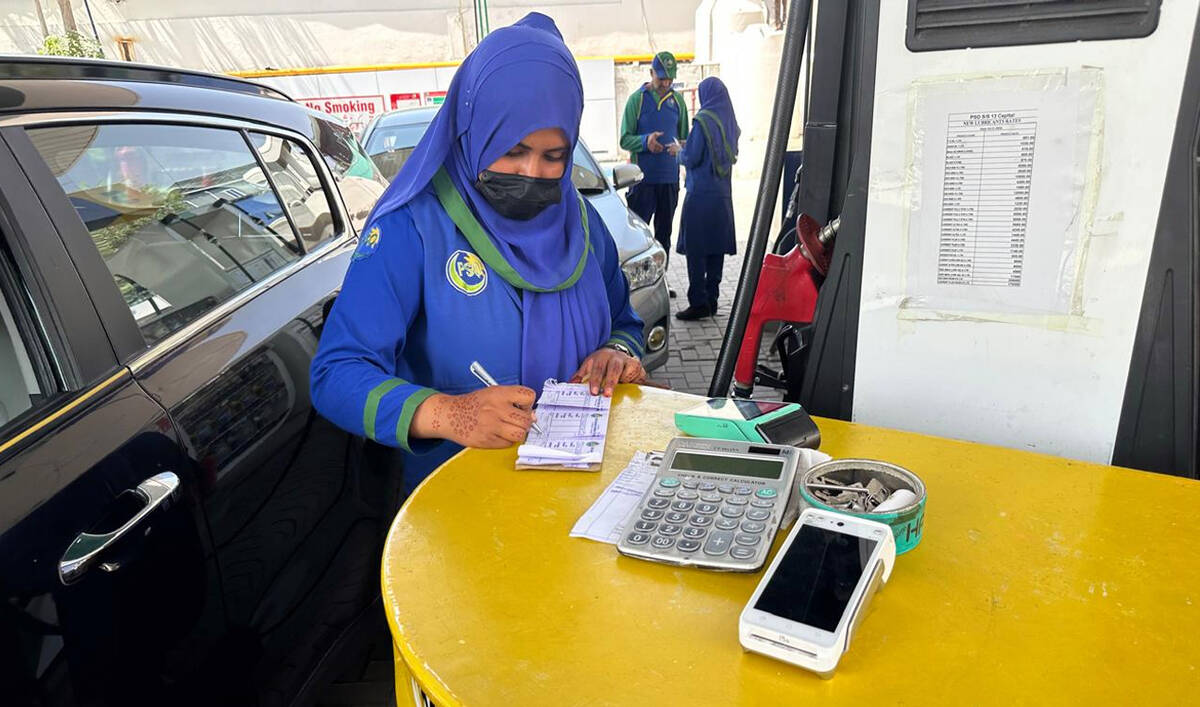


A female worker prepares a bill at a fuel station in Islamabad, Pakistan, on April 21, 2025. (AN)

But despite the challenges, more and more women are venturing out.

Another fuel station attendant, Sana, who only gave her first name, said getting a job had taught her how to face the world and deal with all kinds of people, including those who did not appreciate women working in public spaces in a male-dominated filed.

“Every type of customer visits the station,” she told Arab News.

“Some customers praise our work, saying it’s great that we are working in an open environment instead of being confined to an office, while others discourage us, saying it’s not suitable for women.”

But management was supportive and helped to protect against and handle customers who caused trouble or misbehaved, Sana added. 
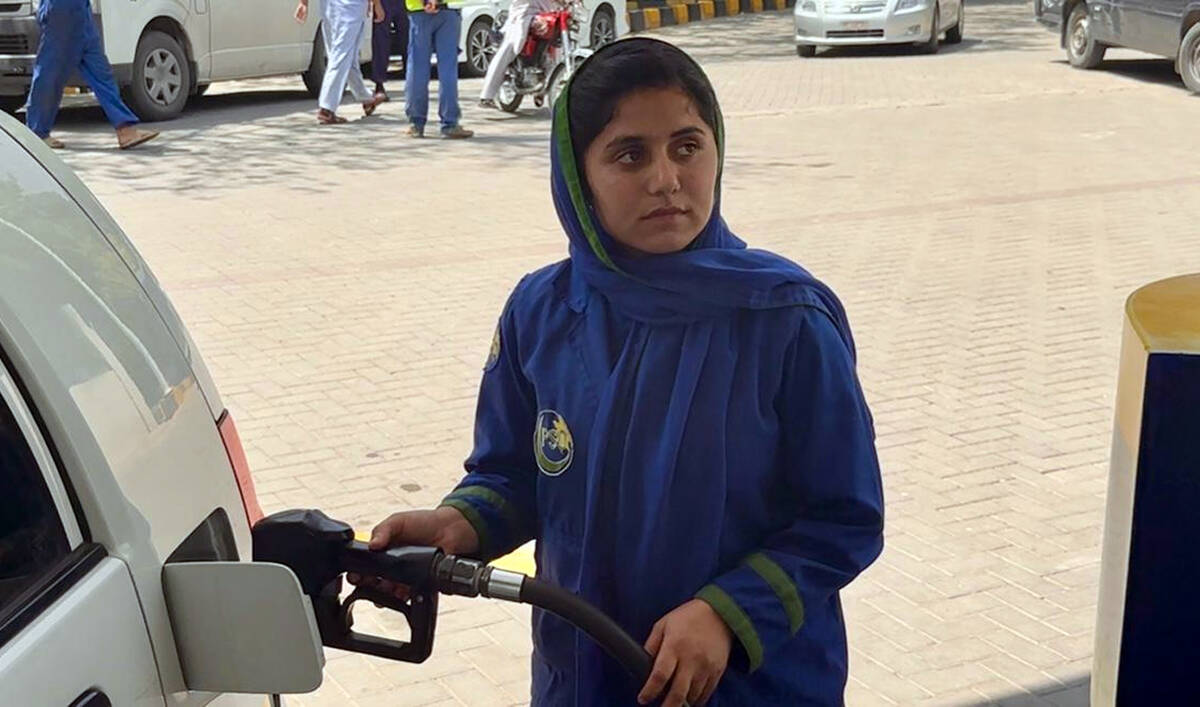


Sana, a female fuel station attendant, refuels a car in Islamabad, Pakistan, on April 21, 2025. (AN)

Rukhsana Bibi, who works at a PSO station in Islamabad’s F-8 sector, said she felt “secure” at the job, as all stations were monitored by CCTV cameras.

Coming from a middle-class background with limited education, Rukhsana said she stepped out of her home not just to earn but to build a better future for her children.

“My husband is a laborer, and his income couldn’t cover our household expenses and children’s education, that’s why I left home.”

Jahanzaib Abbasi, Deputy Division Manager at PSO Islamabad, said the company, as an equal opportunity employer, had started hiring women during the coronavirus pandemic.

“We received a very positive response,” he said. “Many women have now been working for six months to two years, and they are satisfied and happy with their jobs.”

For customers like Azka Durrani, seeing women confidently working at fuel stations is a “heartening sign of growing empowerment and changing social norms.”

“Whenever I see these ladies working at a fuel station,” she said as Rukhsana filled her car’s tank, “I feel empowered.”


Pakistan’s oil price hike to slow growth, increase inflation, warn economists, industrialists

Updated 3 sec ago
Follow

Pakistan’s oil price hike to slow growth, increase inflation, warn economists, industrialists

  • Pakistan hiked fuel prices by over 21 percent this week as ongoing Middle East conflict triggers surge in global crude prices
  • Economists and industrialists say increased fuel prices may will inflation, inland freight costs and hurt exports

KARACHI: Pakistan’s economy is bound to bear the brunt of a recent hike in fuel prices by more than 20 percent, economists and industry leaders warned this week, fearing the move is expected to slow economic growth, increase inflation and hurt already declining exports. 

Pakistan’s government on Friday increased petrol and diesel prices by Rs55 ($0.20) per liter each as the ongoing conflict in the Middle East, involving Iran, Israel and the US, sent global oil prices sharply higher and disrupted energy supply routes.

The price of petrol was revised up by 21 percent to Rs321.17 per liter while diesel was increased by 20 percent to Rs335.86 per liter. International oil prices have surged by 37 percent to around $106.8 per barrel from $78 on Mar. 1, while diesel prices have increased to about $150 per barrel since the conflict began on Feb. 28. 

“The economy was picking up sluggishly, so I think that space will slow down a bit,” Muhammad Saad Ali, head of research at Lucky Investments Ltd., told Arab News.

“Next year, it is expected that there will be more than 4 percent GDP growth, so potentially that might not happen,” he added. 

Pakistan’s central bank said in February that the country’s growth outlook for the current fiscal year has improved to 3.75-4.75 percent due to improved economic activity. The growth will further improve in FY27, the State Bank of Pakistan (SBP) said in its bi-annual Monetary Policy Report.

Ali said the surge in fuel prices would also weigh on consumer price inflation, which rose to 7 percent last month to mark a 16-month high.

“It’s obvious that inflation will increase by 0.7 percent to 1 percent in the future,” Ali said.

He said it was expected that inflation would increase to 8-9 percent by May or June due to the base effect.

“Potentially, it will increase by 0.5 percent to 1 percent,” he said, adding that inflation projections would jump “a lot” in the months ahead.

“The State Bank talks about it a lot. People will cut back on their expenses,” he warned.

Pakistan’s finance adviser Khurram Schehzad and finance ministry spokesperson Qamar Sarwar Abbasi did not respond to Arab News’ questions on the issue. 

HUGE BURDEN’

Pakistan’s SBP surprised investors in January by keeping the policy rate unchanged at 10.5 percent. The International Monetary Fund (IMF) has asked Islamabad to maintain an “appropriately tight” monetary policy to anchor inflation. 

“If oil prices remain elevated, it would upset our inflation and interest rate outlook,” Ali said, adding that the IMF too was likely to be “strict” in its dealings with Pakistan now.

Ali expects the SBP to maintain its borrowing rate at 10.5 percent or increase it by 50 basis points next week. The central bank is scheduled to announce its monetary policy on Monday.

Meanwhile, Karachi Chamber of Commerce & Industry (KCCI) President Rehan Hanif lamented that the oil price hike was “unjustified.”

“This is a huge burden that the government has put on the middle class at a time when people are already coping with Ramadan and Eid-related inflation,” he said.

“This burden could have been avoided without any loss because the reserves of petroleum that you have now came at an old price.”

Hanif noted that while oil supplies can be maintained by importing Saudi oil via a different shipping route, Pakistani industries may suffer due to gas shortages.

“Qatar has stopped gas production,” Hanif warned. “This will lead to a huge gas crisis.”

Pakistan’s trade deficit widened by 25 percent to $25 billion in the July-February period of FY26, as per official data, with exports declining by 7.3 percent to $20.5 billion and imports rising by 8.1 percent to $45.5 billion.

“I see a shortage of gas and because of that, there will be a shortage in our industry. And our exports will be affected,” the KCCI president said. 

Textiles comprise the largest chunk of Pakistan’s exports, earning around $18 billion in FY25. 

Textile manufacturers, however, fear a surge in inland freight by 30 percent due to increased fuel prices. 

“Your inland freight, that is Karachi to Central Punjab and Central Punjab to Karachi, will increase 25-30 percent,” Kamran Arshad, chairman of the All Pakistan Textile Mills Association (APTMA), told Arab News.

Pakistan Railways notified a 9 percent increase in its goods transportation freight and a 5 to 10 percent increase in passenger fares on Saturday.

Last year Pakistan imported petroleum products worth $16 billion, accounting for the most on Islamabad’s $58.4 billion import bill, as per official data.

Arshad explained that increasing oil prices will also increase the country’s import bill. 

“The problem at the governmental level is that for every $5 increase in international oil prices, there is a $1 billion increase in Pakistan’s import bill, because your biggest import is oil,” he said.